Nickname(s):Los Potros de Hierro(The Iron Colts),El Equipo del Pueblo(The People's Team)
Founded:1916
Stadium:Estadio Agustín Coruco Díaz
Capacity:24,443
1920-1939
1939-1967
1967-1980
1980-1982
1982-1983
1983-1985
1985-1986
1986-1993
1993-1997
1997-2002
2002-2007
2007-2011
2011-2016
2016-2018
2018-2022
2022-Present
Atlante FC Crest History
The crest history of Atlante FC reflects more than a century of Mexican football. Despite numerous redesigns, the club has consistently retained its traditional red and blue colours, while green and white have frequently been incorporated to reflect the colours of Mexico.
The 1920–1939 crest already established the basic shield format. It featured the name ATLANTE across the top, with red and blue sections below and green and white details. This early design introduced many of the elements that would repeatedly return in later badges.
From 1939 to 1967, the shield became narrower and more structured. The Atlante name remained prominent, while the lower section incorporated the letters representing the football club. Red, blue, green and white continued to dominate the design.
The 1967–1980 crest modernised this concept with cleaner lines and a more symmetrical shield. The initials FC appeared prominently in the central blue section, surrounded by Atlante's traditional red.
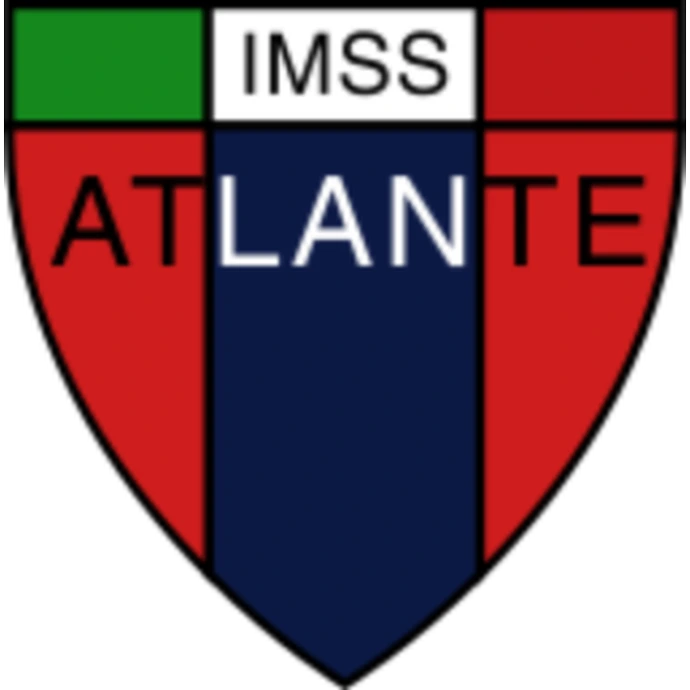
A major change occurred between 1980 and 1985, when the club became associated with the Instituto Mexicano del Seguro Social (IMSS). The crest consequently incorporated the initials IMSS, while several different shield designs appeared during this period.
In 1985, Atlante returned to an identity more closely connected with its traditional colours. The 1985–1993 crests again emphasised the name ATLANTE, red and blue fields and the Mexican green-white-red colour combination.
The 1993–1997 badge introduced a more modern appearance, with a red shield, dark-blue central section and diagonal green, white and gold details. This was refined again for 1997–2002, producing a cleaner version closer to the club's historic shield.
Between 2002 and 2007, Atlante experimented with one of its most distinctive modern designs. The traditional shield was placed inside a rounded blue-and-gold frame, giving the crest a considerably more elaborate appearance.
From 2007, the club returned to the classic shield. Three gold stars appeared above the badge, representing Atlante's three Mexican top-flight championships, while the red-and-blue identity remained central.
A special silver crest was introduced during 2011–2016, incorporating the number 95 in recognition of the club's approaching centenary. Atlante also used a dedicated centenary identity in 2016, celebrating 100 years since its foundation.
The 2018–2022 crest restored the traditional shield in a cleaner form. Three gold stars appeared above it, while additional stars beneath the shield represented the club's international achievements.
The 2022–present crest further modernised this historic design. The shield retains the name ATLANTE, the red and dark-blue fields, the club initials and the small green-white-red detail representing Mexico. The foundation year 1916 is also incorporated near the bottom.
Atlante FC Club History
Atlante Fútbol Club is one of the historic institutions of Mexican football. Founded in Mexico City in 1916, the club developed from modest neighbourhood origins into a major force in the country's professional game. Its strong connection with ordinary supporters produced the famous nickname El Equipo del Pueblo, The People's Team.
Atlante emerged during a period when football in Mexico City was still dominated by clubs associated with foreign communities and wealthier social groups. Atlante instead developed a strongly popular identity, particularly among working-class supporters, helping distinguish the club from many of its early rivals.
During the 1920s and 1930s, Atlante became increasingly competitive in the capital's football competitions. The club won important championships during the amateur era and produced several outstanding Mexican players, establishing itself as one of the country's leading teams before the introduction of professional football.
Atlante was among the clubs that participated when Mexico's professional league was established in 1943. The club quickly became successful in the new competition and won its first professional league championship in 1946–47.
The club also became closely associated with legendary striker Horacio Casarín, one of the greatest Mexican footballers of his generation. His goals and popularity helped strengthen Atlante's reputation as one of the country's most widely supported clubs.
The decades that followed were considerably more difficult. Atlante remained an important institution but struggled to reproduce its early championship success. Financial problems and inconsistent performances became recurring features of the club's history.
Atlante's identity also became unusual because of its repeated changes of home. Although historically a Mexico City club, it has played in several stadiums and even relocated to different cities during parts of its history.
A major institutional change occurred in the late 1970s, when the club was acquired by the Instituto Mexicano del Seguro Social (IMSS). This ownership period influenced both the organisation and the crest, with the initials IMSS appearing prominently on Atlante badges during the early 1980s.
Sporting fortunes eventually improved, and Atlante returned to the summit of Mexican football in the 1992–93 season. The club defeated Monterrey in the championship final, ending a wait of more than four decades for another professional league title.
Atlante subsequently experienced further relocations and changes of stadium before beginning one of the most successful periods in its modern history following a move to Cancún in 2007.
The impact was immediate. Atlante won the Apertura 2007 championship, defeating Pumas UNAM in the final. It was the club's third professional Mexican league championship and restored Los Potros de Hierro to the top of the national game.
International success followed. Atlante won the 2008–09 CONCACAF Champions League, defeating fellow Mexican club Cruz Azul in the final. The victory gave Atlante one of the most important trophies in its history and qualified the club for the 2009 FIFA Club World Cup.
At the Club World Cup in Abu Dhabi, Atlante defeated Auckland City before facing European champions Barcelona in the semi-final. Atlante briefly took the lead but eventually lost 3–1 to a Barcelona side featuring players such as Lionel Messi, Xavi and Andrés Iniesta.
The successful Cancún period eventually came to an end. Results declined, and in 2014 Atlante was relegated from Mexico's top division. The relegation began a long period outside Liga MX.
In 2020, the club returned to Mexico City, reconnecting Atlante with the city in which its history had begun more than a century earlier. The team established itself at the Estadio Ciudad de los Deportes, a ground with strong historical connections to the club.
Atlante subsequently became one of the strongest teams in Mexico's second-level Liga de Expansión MX, winning multiple tournaments and regularly competing for honours. However, changes to Mexico's promotion and relegation system prevented the traditional route back to Liga MX during this period.
Atlante's historic rivalries are closely connected with its Mexico City origins. The club has traditionally contested important matches against teams such as América, Necaxa and Pumas UNAM, although changes in divisions and Atlante's repeated relocations have reduced the regularity of some of these fixtures.