Budapest Honvéd FC Crest History
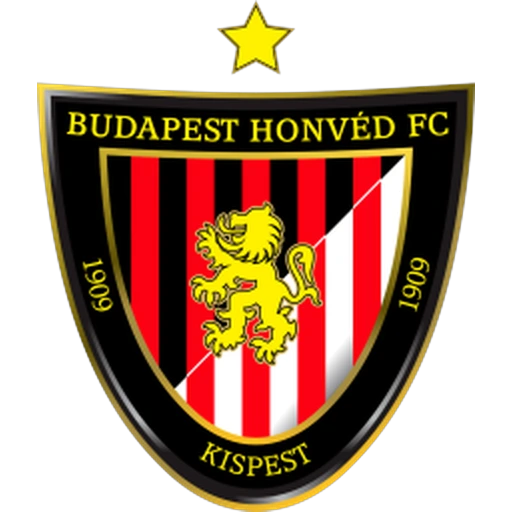
Between 2004 and 2020, Budapest Honvéd used a black shield with a gold outline featuring red-and-white vertical stripes, the club's traditional colours inherited from its origins as Kispesti AC. At the centre stood a gold lion, taken from the coat of arms of Kispest, symbolising courage, strength, and the club's deep connection to the district where it was founded. The words Budapest Honvéd FC appeared across the top, while Kispest was displayed at the bottom to honour the club's historic roots. The founding years 1909 and 1990 were placed on either side of the shield, representing the club's original foundation and its reorganisation following the end of the communist era. A single gold star above the crest commemorated the club's ten Hungarian league championships.
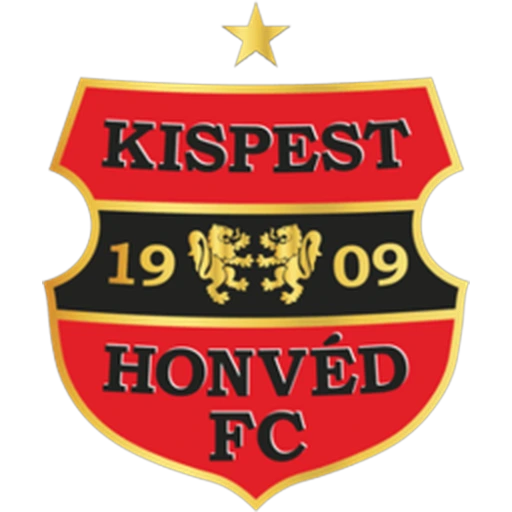
In 2020, Budapest Honvéd introduced a redesigned crest that paid even greater tribute to the club's heritage. The new badge adopted a retro shield inspired by historic Kispest emblems, using the traditional red and black colours instead of the previous striped design. The name KISPEST occupies the top of the crest, while HONVÉD FC appears below, emphasising both the club's origins and its modern identity. The founding year 1909 is split across the centre, flanking a gold lion taken from the historic coat of arms of Kispest. A single gold star remains above the badge, representing the club's ten Hungarian league titles.
Budapest Honvéd FC Club History
Budapest Honvéd FC was founded on 3 August 1909 in the district of Kispest, then an independent town outside Budapest, as Kispesti Athletikai Club (KAC). The club initially competed in regional football before establishing itself in Hungary's top division during the early twentieth century. Its traditional red and black colours have remained a defining part of its identity ever since.
Following the Second World War, Hungarian football underwent major political changes. In 1949, Kispest was taken over by the Hungarian Ministry of Defence and renamed Budapest Honvéd FC. The word "Honvéd" means "Homeland Defender", reflecting the club's new status as the army team. This transformation allowed Honvéd to recruit many of Hungary's finest footballers, creating one of the greatest club sides in football history.
The 1950s marked the club's golden era. Honvéd became the dominant force in Hungarian football, winning multiple Hungarian league championships while providing the backbone of Hungary's legendary "Golden Team" (Aranycsapat). Club legends such as Ferenc Puskás, Sándor Kocsis, József Bozsik, Zoltán Czibor, and Gyula Grosics helped Hungary become one of the strongest national teams in the world. During this period, Honvéd was widely regarded as one of Europe's finest clubs.
The 1956 Hungarian Revolution had a profound impact on the club. While Honvéd was abroad playing a European Cup match against Athletic Bilbao, the uprising broke out in Hungary. Several of the club's biggest stars, including Ferenc Puskás, Sándor Kocsis, and Zoltán Czibor, chose not to return to communist Hungary and instead continued their careers abroad. Despite this major setback, Honvéd remained a competitive force in domestic football.
Throughout the 1960s, 1970s, and 1980s, Honvéd continued to compete at the highest level, although it was not until the arrival of coach Imre Komora and a talented new generation that the club returned to dominance. During the 1980s, Honvéd won eight Hungarian league championships, becoming Hungary's leading club once again. Players such as Lajos Détári, József Garaba, and Tibor Sikesdi helped establish another highly successful era.
After the fall of communism, the club became Budapest Honvéd FC once again and entered a more challenging period. Financial difficulties and increased competition reduced its dominance, but Honvéd remained one of Hungary's historic clubs. In 2006–07, the club won its first Hungarian championship in 14 years, ending a long wait for league success.
Another memorable achievement came in 2016–17, when Budapest Honvéd won its 14th Hungarian league title under Italian coach Marco Rossi. Built around a disciplined, hard-working squad rather than expensive stars, the championship was one of the biggest surprises in modern Hungarian football and marked the club's return to the summit of the Nemzeti Bajnokság I.
In recent years, however, Honvéd has faced more difficult times. After several seasons battling near the bottom of the table, the club was relegated from NB I in 2023, ending a 44-year stay in Hungary's top division. Since then, Budapest Honvéd has been working to rebuild while playing at the modern Bozsik Aréna, which opened in 2021 on the site of the club's historic stadium.
Budapest Honvéd's fiercest rivalry is with Ferencvárosi TC, while matches against Újpest FC, MTK Budapest, and Vasas SC are also among the most important fixtures in Hungarian football. As one of the country's most historic clubs, Honvéd remains forever associated with Ferenc Puskás and the legendary Golden Team, ensuring its place among the greatest names in Hungarian football history.