Historical Crests AEK Athens FC
Name: AEK Athens FC
Nickname(s): Enosis (The Union)
Founded: 1924
Stadium: OPAP Arena
Capacity: 32500
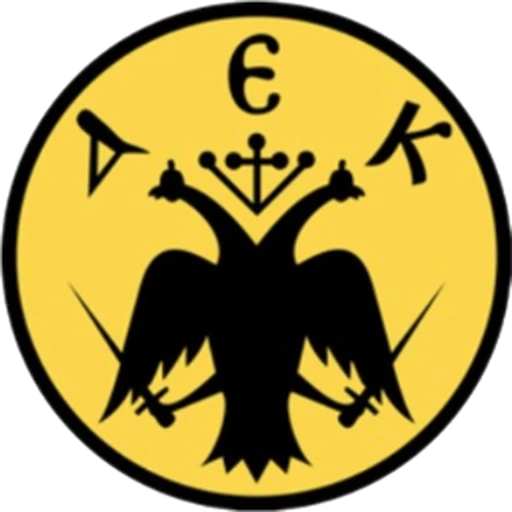
1924-1993
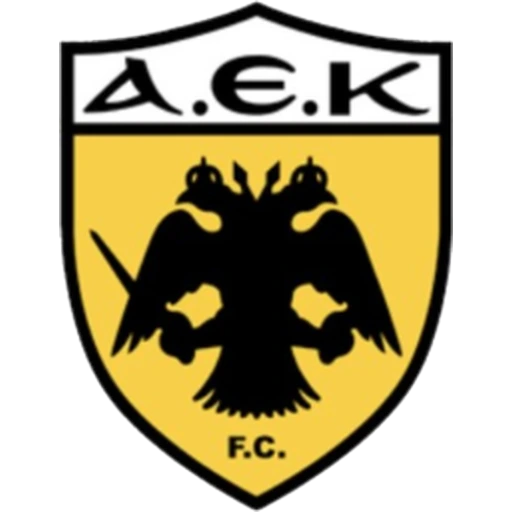
1993-2014
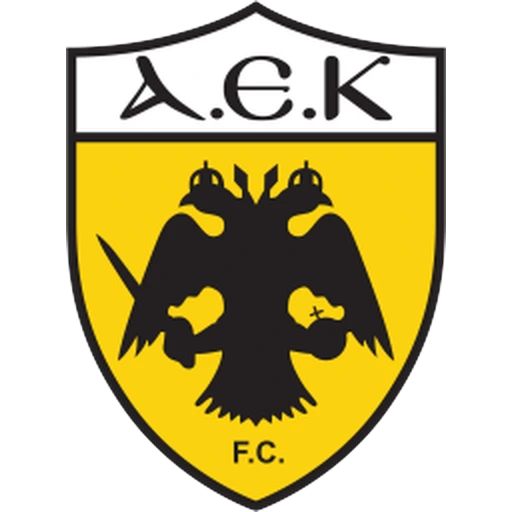
2014-Present
AEK Athens FC Crest History
The original crest of AEK Athens, introduced upon the club's foundation in 1924, reflected the origins of its founders, who were Greek refugees from Constantinople (Istanbul) following the Greco-Turkish War and the population exchange between Greece and Turkey. The badge consisted of a gold circular emblem featuring a black double-headed eagle, the historic symbol of the Byzantine Empire and the Ecumenical Patriarchate of Constantinople. Above the eagle appeared the Greek initials Α.Ε.Κ. (Athlitiki Enosis Konstantinoupoleos – Athletic Union of Constantinople). The club adopted black and yellow, the traditional Byzantine colours, and this emblem remained virtually unchanged for almost seventy years, becoming one of the most iconic symbols in Greek football.
In 1993, AEK introduced its first major redesign. The historic circular badge was replaced by a shield-shaped crest, while preserving the double-headed eagle as its central symbol. The Greek initials Α.Ε.Κ. were placed across the top within a white banner, with F.C. added at the bottom. The shield modernised the club's visual identity while maintaining its deep connection to Byzantine heritage and the memory of Constantinople. This crest accompanied AEK during one of the club's most successful modern eras, including multiple league championships and domestic cups.
A subtle refinement followed in 2014, after AEK's rebirth following financial collapse and its return from the amateur divisions. The overall shield design remained unchanged, but the double-headed eagle was redrawn with sharper, cleaner lines, and the typography was modernised.
AEK Athens FC Club History
Founded on 13 April 1924, AEK Athens Football Club was established by Greek refugees from Constantinople (modern-day Istanbul) who had been forced to leave their homes following the Greco-Turkish War and the 1923 population exchange between Greece and Turkey. The club's full name, Athlitiki Enosis Konstantinoupoleos (Athletic Union of Constantinople), reflects its origins, while its black and yellow colours and the double-headed Byzantine eagle symbolise the heritage of the Byzantine Empire and the Greek community of Constantinople. From its foundation, AEK became more than a football club, serving as a cultural symbol for Asia Minor refugees in Greece.
AEK quickly established itself among the leading clubs in Greek football, winning its first Greek Championship in 1939 and completing the first domestic League and Cup Double in Greek football history the same year. Throughout the 1960s and 1970s, the club remained a dominant force, winning several league titles and cups while becoming the first Greek club to reach the quarter-finals of the European Cup in 1968–69 under coach Branko Stanković.
The club enjoyed another golden era during the late 1980s and early 1990s. Under legendary coach Dušan Bajević, AEK won three consecutive Greek league championships between 1992 and 1994, playing attractive attacking football with stars such as Vasilis Dimitriadis, Refik Šabanadžović, Stelios Manolas, and Toni Savevski. During this period, AEK also became a regular participant in European competitions, strengthening its reputation beyond Greece.
The early 21st century brought financial instability despite continued success on the pitch. Serious economic problems culminated in 2013, when AEK entered administration and, after relegation, chose to restart in Gamma Ethniki, the third tier of Greek football, rather than continue under heavy debts. The decision marked the lowest point in the club's history but also allowed AEK to rebuild on solid financial foundations.
The recovery was remarkable. After achieving consecutive promotions, AEK returned to the Super League Greece in 2015. Just three years later, under coach Manolo Jiménez, the club won the 2017–18 Greek Super League title, ending a 24-year wait for the championship. In 2022, AEK returned to its spiritual home in Nea Filadelfeia with the opening of the modern OPAP Arena, built on the site of the historic Nikos Goumas Stadium. The following season, under Matías Almeyda, AEK completed a historic League and Greek Cup Double, reaffirming its position among Greece's elite clubs.
Today, AEK Athens is one of the "Big Four" clubs in Greek football.
AEK Athens' fiercest rivalry is with Olympiacos in the Derby of the Eternal Enemies, one of the biggest fixtures in Greek football. Matches against Panathinaikos in the Athens Derby and PAOK also rank among the country's most intense rivalries, reflecting the long-standing competition between Greece's largest clubs.
PAE AEK Athens Pin
Your Dynamic Snippet will be displayed here... This message is displayed because you did not provide enough options to retrieve its content.