Historical Crests Getafe CF
Name: Getafe CF
Nickname(s): Azulones (Deep Blue Ones)
Founded: 1983 (1946)
Stadium: Estadio Coliseum (Getafe)
Capacity: 16,500
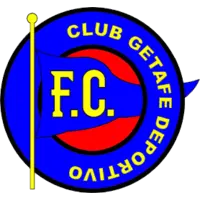
1982-1983
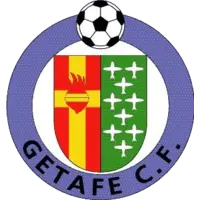
1983-1996
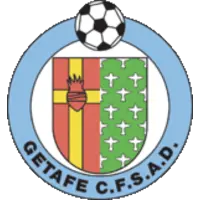
1996-2003
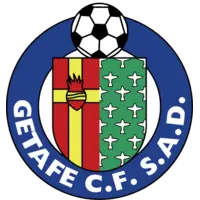
2003-2011
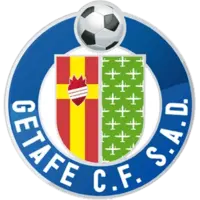
2011-Present
Getafe CF Crest History
Founded in 1983, Getafe CF is one of the younger clubs in Spanish professional football. Throughout its history, the club has undergone several visual identity redesigns, though these can largely be grouped into two principal eras: the short-lived emblem inherited from its predecessor and the crest introduced with the foundation of Getafe CF in 1983, which remains the basis of the club’s identity today.
The first logo was associated with Club Getafe Deportivo, the predecessor club that existed before Getafe CF was established. This emblem was used for only a brief period and featured a bright blue circular badge surrounded by a broad red outline. At its centre was a blue waving flag with a yellow handle and yellow lettering. The flag displayed the initials “F.C.” in an elegant traditional typeface, while the words “Club Getafe Deportivo” appeared alongside in a bold sans-serif font. Although relatively simple, the design reflected the football culture of the city before the formation of the modern club.
A major transformation occurred in 1983, when Getafe CF was founded and adopted an entirely new crest. This redesign introduced the visual elements that would become synonymous with the club. The centre of the badge featured the coat of arms of the city of Getafe, incorporating the municipality’s traditional green and red heraldic colours. Surrounding the shield was a broad circular frame, while a football was placed above the crest, giving the emblem a distinctive and easily recognisable appearance.
The inclusion of the municipal coat of arms was particularly significant. Unlike many clubs that focus on initials or abstract symbols, Getafe chose to place the city itself at the heart of its identity. This reinforced the club’s role as a representative of the community and strengthened the connection between the team and its supporters.
In 1996, the crest received its first significant modernisation. The colour palette became lighter and cleaner, while the wording around the badge was updated to reflect the club’s corporate structure as “Getafe C. F. S. A. D.” The football motif above the shield also became larger and more prominent, giving the emblem greater visual balance.
Further refinements followed in 2003, a period that coincided with the club’s rise through the Spanish football pyramid. The colours became stronger and more vibrant, particularly the blue circular frame surrounding the crest. The city shield was enlarged to occupy more of the badge, reducing empty space and creating a bolder appearance. At the same time, the lettering was changed from black to white, increasing contrast and making the crest more visually striking.
Another update arrived in 2011, when the club introduced a more contemporary interpretation of the emblem. A subtle silver outline was added to the various elements of the badge, creating a cleaner and more polished look. The circular frame adopted a gradient effect that added depth and movement, while the typography was redesigned in a narrower, more modern sans-serif style. These changes were intended to improve the crest’s adaptability across digital and commercial platforms while preserving its traditional structure.
Getafe CF Club History
Founded in its current form on 8 July 1983, Getafe CF is one of the most remarkable success stories in modern Spanish football. Based in Getafe, a city within the Community of Madrid, the club has risen from modest beginnings to become a regular presence in Spain’s top division despite having a much shorter history than many of its rivals.
Although the present club dates from 1983, its roots extend back to 1946, when Club Getafe Deportivo was founded to represent the growing municipality south of Madrid. Football in Getafe itself can be traced even earlier to the 1920s, but it was the 1946 club that established the foundations of organised football in the city.
During the following decades, Club Getafe Deportivo gradually progressed through the Spanish football pyramid. One of its greatest achievements came in 1976 with promotion to the Segunda División. However, despite periods of success, severe financial difficulties eventually forced the club into liquidation in 1982.
Local football survived thanks to the efforts of supporters and community leaders. Following the collapse of Club Getafe Deportivo, a merger involving Club Deportivo Peña Getafe and Getafe Promesas led to the creation of Getafe Club de Fútbol in 1983. This re-established football in the city and marked the beginning of the modern club’s history.
Like many newly formed clubs, Getafe spent its early years in regional and lower-division football. Through careful management and steady sporting progress, the club gradually climbed through the Spanish league system, establishing itself as an ambitious and competitive side.
A historic breakthrough arrived in 2004, when Getafe achieved promotion to La Liga for the first time in its history. For a club representing a city often overshadowed by Madrid’s football giants, reaching the top flight was an extraordinary accomplishment. Getafe remained in the highest division for twelve consecutive seasons between 2004 and 2016, becoming an established member of Spanish football’s elite.
During this period, the club enjoyed some of the most successful years in its history. Getafe reached consecutive Copa del Rey finals in 2007 and 2008 and qualified for European competition. The club also earned widespread admiration for its competitive performances against some of Spain’s biggest teams despite operating with a significantly smaller budget.
Following relegation in 2016, many observers expected the club to struggle. Instead, Getafe responded immediately, securing promotion back to La Liga in 2017. Since then, the club has once again established itself in Spain’s top division and enjoyed another golden period under manager José Bordalás.
Under Bordalás, Getafe became renowned for its discipline, defensive organisation and competitiveness. The club achieved the highest league finish in its history by finishing fifth in the 2018–19 season and subsequently qualified for the UEFA Europa League. In Europe, Getafe earned further recognition by eliminating AFC Ajax before eventually exiting the competition against Inter Milan.
The club plays its home matches at the Coliseum and is affectionately known as Los Azulones (“The Deep Blues”), a reference to its traditional blue colours. Despite competing in the shadow of some of Spain’s most famous clubs, Getafe has built a strong identity based on hard work, resilience and close ties to its local community.
Getafe maintains several important rivalries. The most notable is with nearby CD Leganés in the South Madrid Derby, a fixture contested between two neighbouring municipalities. The club also shares competitive rivalries with Atlético de Madrid and Real Madrid CF, reflecting both geographical proximity and the desire to challenge the region’s traditional football powers.
Getafe FC
Your Dynamic Snippet will be displayed here... This message is displayed because you did not provide enough options to retrieve its content.