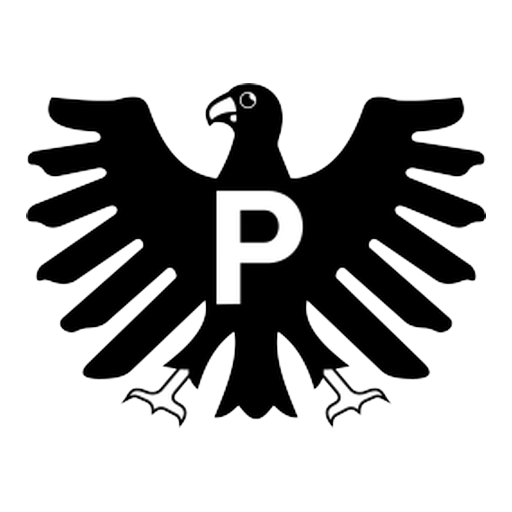
SC Preußen Münster has used the Prussian eagle as the defining element of its identity since the club's early years. Founded in 1906 as FC Preußen Münster, the club adopted the black eagle, an historic symbol of Prussia, to reflect both its name and the patriotic sentiment that inspired its founders. Early versions of the crest varied in artistic style, but consistently featured the eagle, often displayed within a simple shield, establishing one of the most recognisable identities in German football.
For much of the twentieth century, the club made only subtle refinements to its badge. As the club became SC Preußen Münster in 1921, the crest evolved with cleaner outlines and more balanced proportions while preserving its traditional black-and-white colour scheme and the iconic Prussian eagle. Rather than introducing radical redesigns, the club focused on modernising the artwork to suit changing printing and branding standards without losing its historic character.
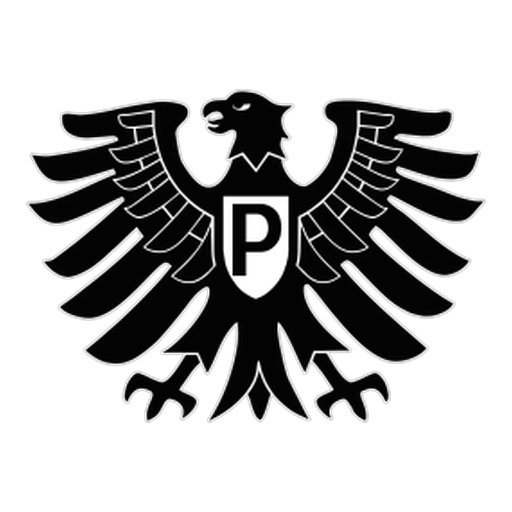
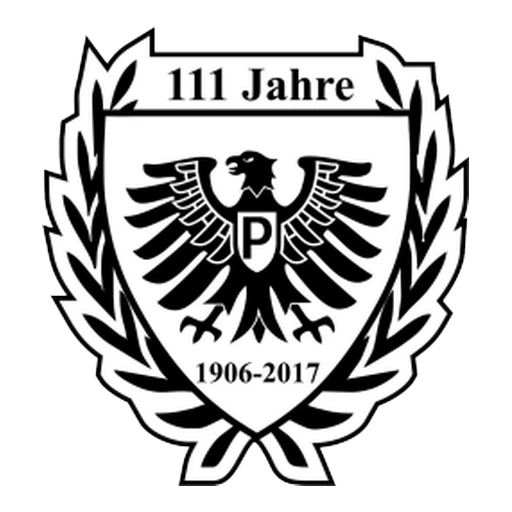
A more noticeable update arrived in 2008, when the eagle was redrawn with sharper lines and a more contemporary appearance while remaining faithful to the historic design. To celebrate the club's 111th anniversary in 2017, a special commemorative crest was introduced, incorporating the years 1906–2017, the text "111 Jahre", and a laurel wreath surrounding the traditional eagle. This anniversary logo was used only for the celebrations before the club returned to its standard identity.
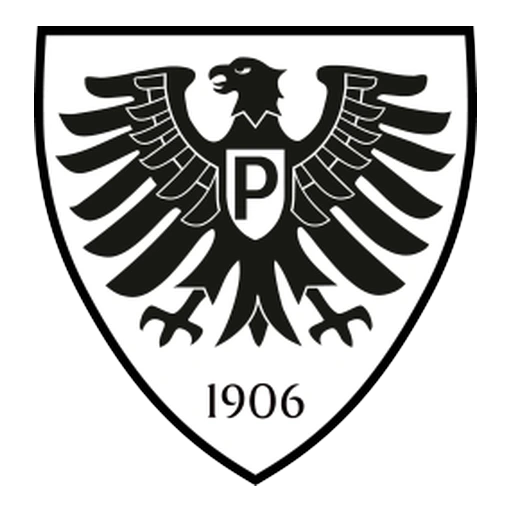
The current crest was introduced in 2018 as part of a wider brand refresh under the motto "Tradition mit Zukunft" ("Tradition with a Future"). Developed with a modern corporate identity in mind, the redesigned badge retains the historic Prussian eagle but simplifies its illustration, improves its geometry, and permanently places it within a more defined shield. The update enhanced clarity across digital and print media while deliberately preserving the club's century-old symbolism, ensuring that SC Preußen Münster's visual identity remains firmly connected to its heritage.
SC Preußen Münster Club History
SC Preußen Münster was founded on 30 April 1906 as FC Preußen Münster by students of the Johann-Conrad-Schlaun Grammar School in Münster. The club took its name from the former Kingdom of Prussia, reflecting the patriotic spirit of the era, while its iconic eagle emblem quickly became a defining symbol of its identity. Initially playing on a military parade ground at Loddenheide, the club rapidly progressed through the West German league system, earning promotion to the top regional division in 1908 and winning the Westphalian Championship in 1914. In 1921, the club adopted its current name, SC Preußen Münster, and claimed a second Westphalian title.
Following the Second World War, Preußen Münster emerged as one of West Germany's strongest clubs. During the late 1940s the club assembled one of the country's first professionally recruited squads, a bold approach at a time when German football remained officially amateur. The investment proved successful, culminating in the 1951 German Championship Final, where Preußen lost 2–1 to 1. FC Kaiserslautern after taking an early lead. Throughout the 1950s, the club established itself as a leading side in the Oberliga West and built a reputation as one of Germany's most ambitious football clubs.
The club's strong performances during the Oberliga era earned it selection as one of the 16 founding members of the Bundesliga in 1963. Preußen Münster made history by hosting the first sold-out Bundesliga match at the Preußenstadion but struggled throughout the inaugural campaign and were relegated after just one season. Despite several promotion challenges during the 1970s, financial difficulties prevented a return to the top flight, and the club gradually declined into the second and third tiers of German football.
The following decades were characterised by fluctuating fortunes. Preußen Münster won the German Amateur Championship in 1994 but spent most of the late twentieth and early twenty-first centuries competing in the third and fourth divisions. After relegation to the Oberliga in 2006, the club rebuilt under coach Roger Schmidt, laying the foundations for a gradual revival through youth development and financial stability. Promotions in the 2010s restored the club to the professional ranks.
SC Preußen Münster's fiercest rivals are Arminia Bielefeld and VfL Osnabrück, with the clashes against Bielefeld forming the historic Westphalian Derby. Together with Osnabrück, the three clubs make up the famous "Derby Triangle" (Derby-Dreieck) of north-west German football, with these fixtures renowned for passionate support, large travelling crowds and long-standing regional pride. Although SC Preußen Münster has developed more recent rivalries with clubs such as SC Paderborn 07, they do not match the historical significance or intensity of its traditional derbies against Arminia Bielefeld and VfL Osnabrück.