Historical Crests Toulouse FC
Name: Toulouse FC
Nickname(s): Les Violets (The Purples)
Founded: 1970
Stadium: Stadium de Toulouse
Capacity: 33,150
1970-1979

1979-1984
1984-1990
1990-1995
1995-2001
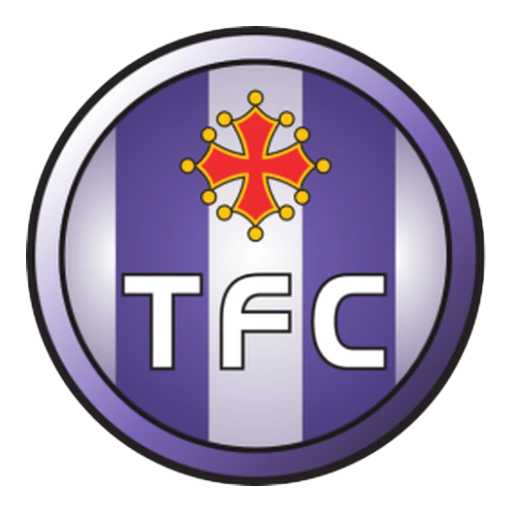
2001-2010
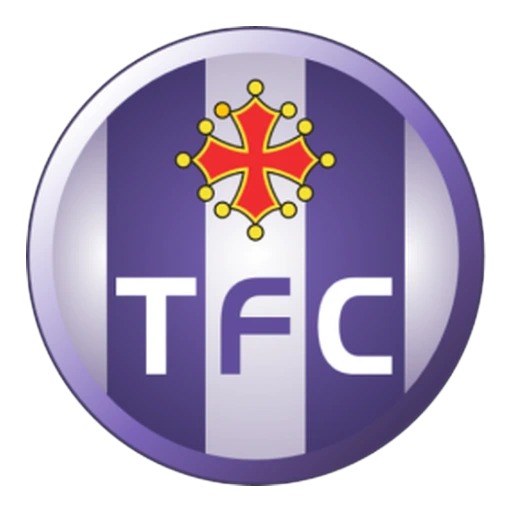
2010-2018
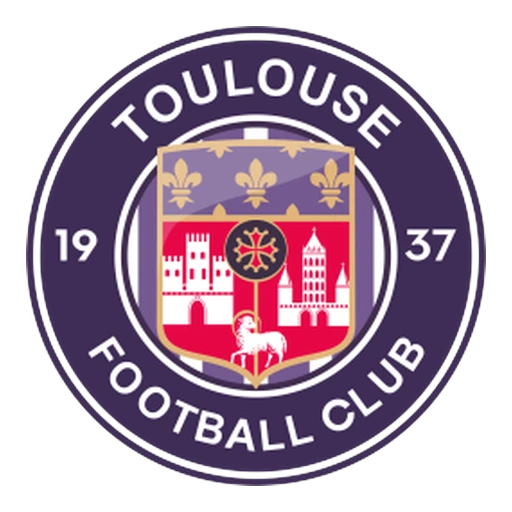
2018-2021
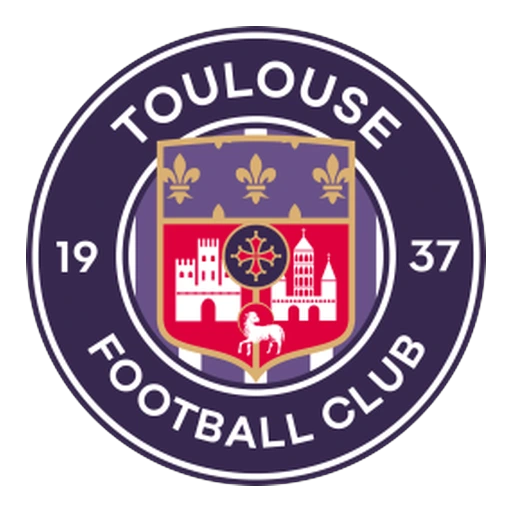
2021-Present
Toulouse FC Crest History
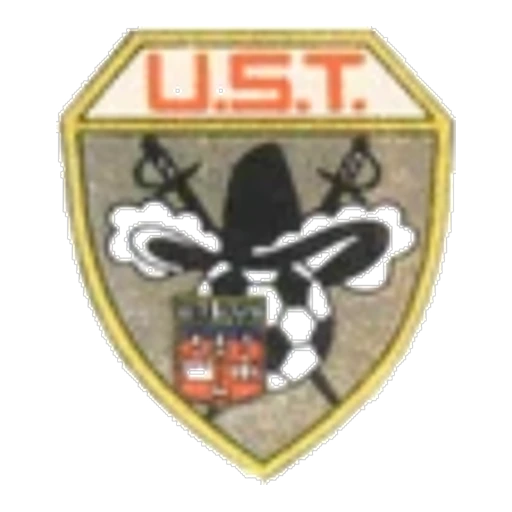
The first crest of the modern Toulouse Football Club, introduced in 1970, reflected the club's origins as the successor to Union Sportive Toulouse (UST). The badge took the form of a gold-edged shield featuring the initials UST across the top. At its centre appeared a black bee, symbolising the city of Toulouse and its industrious spirit, while the coat of arms of Toulouse was displayed near the bottom. The emblem established the club's identity following its foundation in 1970.
In 1979, Toulouse adopted a bold, modern logo inspired by contemporary graphic design. The crest abandoned traditional heraldry in favour of an abstract purple and yellow geometric design, accompanied by a stylised dot pattern beneath. While highly distinctive, the logo moved away from historical symbolism and represented the club's attempt to create a modern image during the late 1970s.
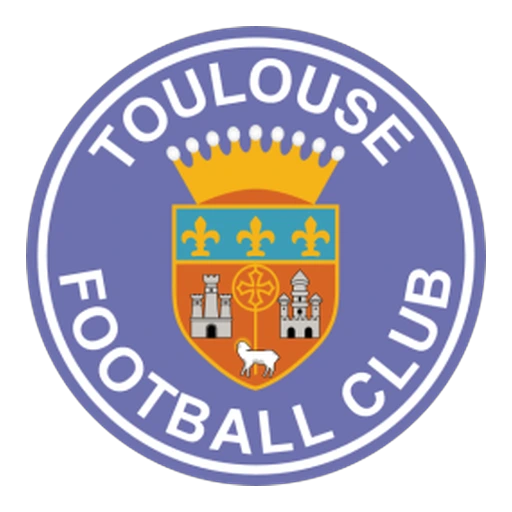
A return to tradition came in 1984 with a circular crest. The badge featured the words "Toulouse Football Club" around the edge and placed the coat of arms of Toulouse at the centre beneath a stylised crown. The redesign re-established the club's connection with the city and remained in use during one of Toulouse's strongest periods in Division 1.
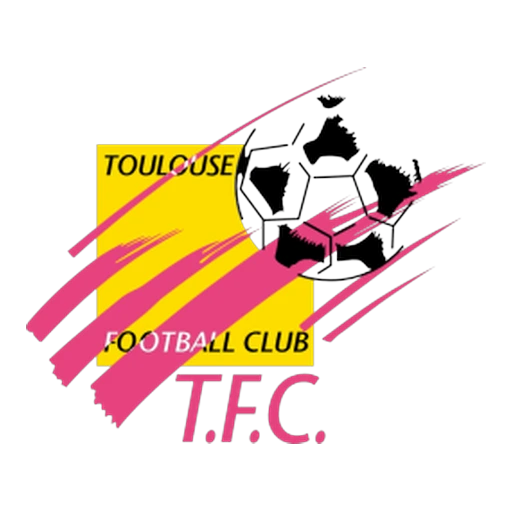
In 1990, the club introduced another modern identity. The badge featured energetic pink brush strokes, a football, and the silhouette of the Occitan cross, alongside the initials T.F.C. The dynamic design reflected the graphic style of the early 1990s while introducing the Occitan cross, an enduring symbol of the Occitan region and the city of Toulouse.
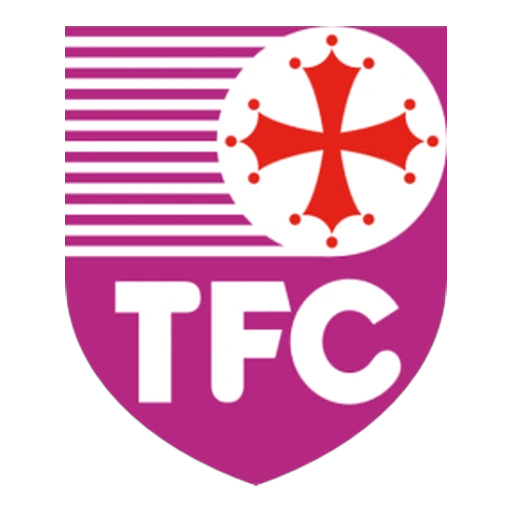
A completely new crest arrived in 1995. The shield-shaped badge featured the initials TFC in bold white lettering beneath the Occitan cross, set against horizontal purple stripes. The simplified design established the purple colour as the dominant element of the club's visual identity and remained in use until the club's financial collapse in 2001.
Following the club's administrative relegation and restructuring in 2001, Toulouse adopted a new circular purple badge. The crest displayed the Occitan cross above large TFC initials, divided by a central silver stripe. The logo symbolised the rebirth of the club after bankruptcy and accompanied Toulouse's rapid return to Ligue 1.
Minor refinements were made in 2010, mainly involving brighter colours, cleaner gradients, and updated typography while retaining the same circular design centred on the Occitan cross and TFC initials.
In 2018, Toulouse unveiled a completely redesigned crest that returned to a traditional round badge centred on the historic coat of arms of Toulouse. The shield incorporates the Occitan cross, the Basilica of Saint-Sernin, the Château Narbonnais, and the Paschal Lamb, all elements taken from the city's historic arms. The years 19 and 37 appear on either side, paying tribute to the original Toulouse FC founded in 1937, whose sporting heritage the current club embraces despite being legally founded in 1970. The redesign reflected a renewed emphasis on local identity and historical continuity.
A subtle update followed in 2021, preserving the overall composition while refining the typography, colours, and proportions. The current crest continues to highlight the coat of arms of Toulouse, the Occitan cross, and the reference to 1937, reinforcing the club's deep connection to the city and its footballing heritage while presenting a cleaner, more contemporary appearance.
Toulouse FC Club History
Founded in 1970, Toulouse Football Club was created following the collapse of Union Sportive Toulouse (UST), which had represented the city in professional football during the 1960s. The new club inherited UST's place in the French league system and quickly adopted the famous purple colours that would become its trademark. Although legally founded in 1970, Toulouse FC also embraces the heritage of the original Toulouse FC (1937–1967), one of the city's earlier professional clubs.
During the late 1970s and 1980s, Toulouse established itself in Division 1, becoming one of France's most competitive provincial clubs. Under coach Jacques Santini, the club regularly challenged for European qualification and developed a reputation for attractive football. Toulouse qualified for the UEFA Cup on several occasions and achieved one of the greatest results in its history during the 1986–87 UEFA Cup, eliminating Diego Maradona's Napoli in the first round after a dramatic penalty shootout. The club eventually exited the competition against Spartak Moscow, but the victory over Napoli remains one of the most celebrated nights in Toulouse's history.
The 1990s proved more difficult, with financial instability and inconsistent performances leading to relegation. In 2001, Toulouse FC suffered bankruptcy and was administratively relegated to the Championnat National (third tier). Under the leadership of president Olivier Sadran, the club completed one of the most remarkable recoveries in French football, achieving three consecutive promotions and returning to Ligue 1 by 2003.
Back in the top flight, Toulouse enjoyed one of its strongest modern periods. Led by striker André-Pierre Gignac, the club finished third in Ligue 1 during the 2006–07 season, qualifying for the UEFA Champions League for the first time. Although eliminated in the qualifying rounds by Liverpool, participation marked a significant milestone in the club's development. Toulouse also became known for producing outstanding young players through its academy, including Moussa Sissoko, Étienne Capoue, Wissam Ben Yedder, and Alban Lafont.
After relegation to Ligue 2 in 2020, Toulouse rebuilt under new ownership and a modern data-driven recruitment model. The club won the 2021–22 Ligue 2 title to secure promotion back to Ligue 1 and quickly re-established itself among France's top clubs.
The greatest achievement in the club's history came during the 2022–23 season, when Toulouse won its first major trophy, defeating FC Nantes 5–1 in the Coupe de France Final. The victory qualified the club for the 2023–24 UEFA Europa League, where Toulouse reached the knockout round play-offs and earned a memorable 3–2 victory over Liverpool during the group stage, one of the most famous European nights in the club's history.
Toulouse FC's principal rival is Montpellier HSC in the Derby d'Occitanie, reflecting the rivalry between two of the region's biggest clubs. Matches against Girondins de Bordeaux, historically known as the Derby de la Garonne, have traditionally been the club's fiercest encounters, while fixtures against Castres, Nîmes Olympique, and Rodez AF also carry regional significance.
Toulouse FC Pin
Your Dynamic Snippet will be displayed here... This message is displayed because you did not provide enough options to retrieve its content.