Historical Crests Stade Rennais FC
Name: Stade Rennais FC
Nickname(s): Les Rouges et Noirs (The Red and Blacks)
Founded: 1901
Stadium: Roazhon Park
Capacity: 29,778
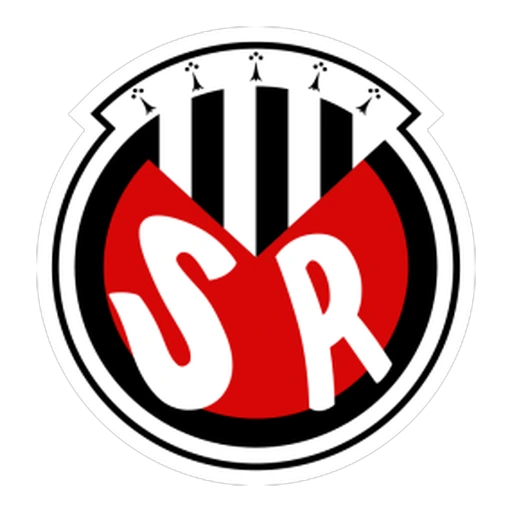
1965-1972
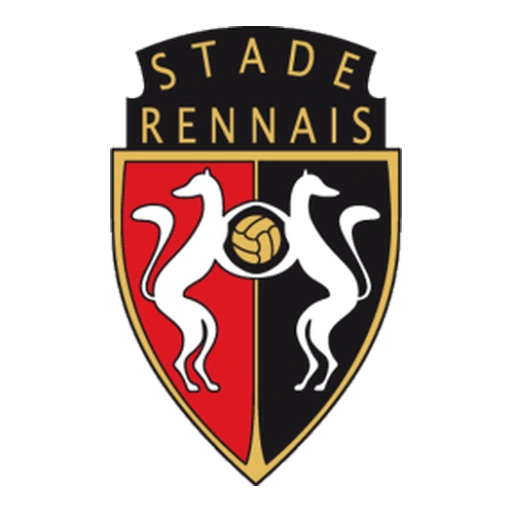
1972-1994
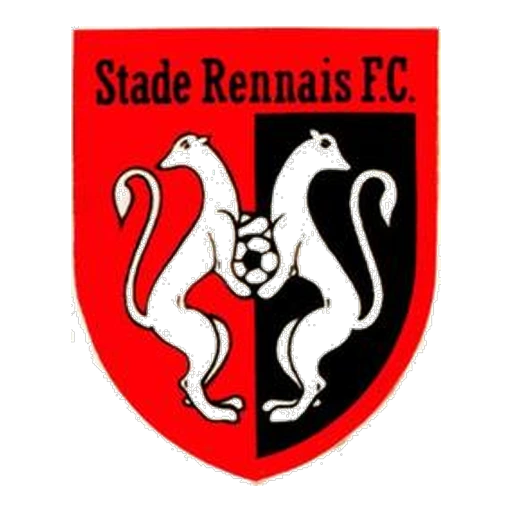
1994-1997
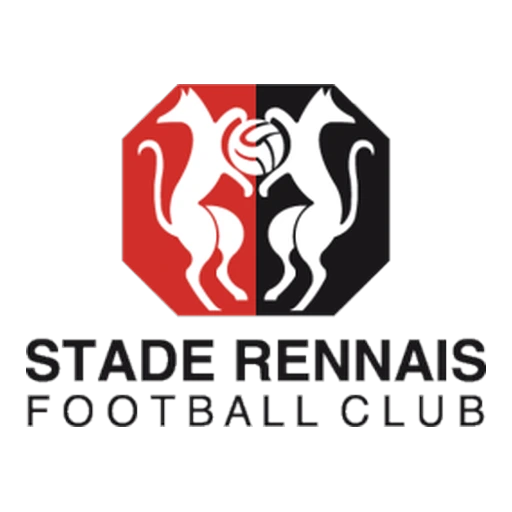
1997-2003
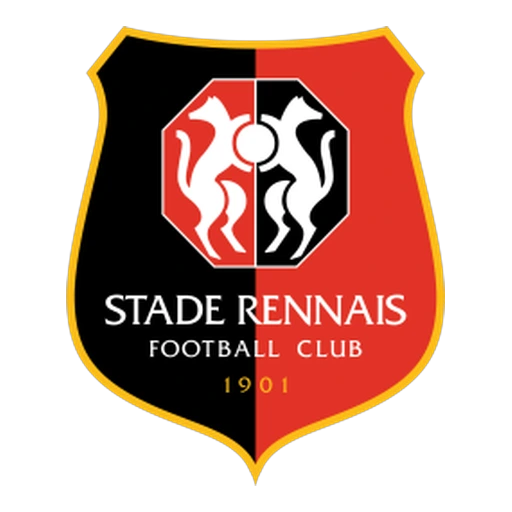
2003-Present
Stade Rennais FC Crest History
The first widely recognised modern crest of Stade Rennais, used from 1965 to 1972, featured a circular badge divided into black-and-white vertical stripes at the top and a red lower half. Large white intertwined initials SR dominated the centre, while ermine spots, the historic symbol of Brittany, appeared across the upper section. The badge reflected the club's Breton identity while retaining the traditional red-and-black colours.
In 1972, following Stade Rennais' growing success in French football, the club introduced a completely redesigned crest. The new badge adopted a shield divided vertically into red and black, featuring two rearing ermine stoats—one white and one black—facing each other. Between them stood a gold football, symbolising the sport itself. The club's name appeared across the top in gold lettering. The use of the ermine stoats reinforced Rennes' deep connection with Brittany, where the ermine is one of the region's most important heraldic symbols.
A refreshed version appeared in 1994, retaining the same overall composition but modernising the typography and proportions. The club name was written in full as "Stade Rennais F.C.", while the shield became slightly simpler and more balanced. The two stoats remained the dominant feature, continuing to represent the club's Breton heritage.
In 1997, Stade Rennais briefly adopted a minimalist corporate identity. The new logo featured a stylised red-and-black octagonal emblem containing simplified white and black stoats positioned around a football. The club name appeared beneath in modern typography. Although contemporary in appearance, many supporters felt the logo lacked the traditional character of earlier crests, and it remained in use for only six years.
In 2003, Stade Rennais unveiled its current crest, which returned to a classic shield while modernising the historic 1972 design. The badge is divided into red and black halves, with the white and black ermine stoats once again facing each other around a football. The club's name appears across the centre in white, while the founding year 1901 is displayed at the bottom. A gold outline completes the shield, giving the crest a more elegant appearance.
Stade Rennais FC Club History
Founded in 1901, Stade Rennais Football Club is one of the oldest and most prestigious football clubs in France. Established by a group of former students in the city of Rennes, the club quickly became a leading force in Breton football. Originally playing in blue and sky blue, Rennes adopted its famous red and black colours in 1904, inspired by the colours of the Cercle Paul Bert, one of the city's major sporting organisations. The club has since become one of Brittany's most successful football institutions.
Stade Rennais was a founding member of the French professional league in 1932, joining the inaugural Division 1 championship. Although the club spent many years alternating between the first and second divisions, Rennes established a reputation as a competitive side with a passionate following and a strong commitment to developing local talent.
The club enjoyed its first major successes in the 1960s under legendary coach Jean Prouff. Rennes won its first Coupe de France in 1965, defeating UA Sedan-Torcy, before lifting the trophy again in 1971 after overcoming Olympique Lyonnais. These victories secured the club's place among France's respected football institutions and marked the beginning of its modern history.
After periods of inconsistency during the 1970s and 1980s, Stade Rennais entered a new era following investment from businessman François Pinault and his family in 1998. The Pinault family's long-term ownership transformed the club into one of France's best-managed organisations, investing heavily in infrastructure, youth development, and recruitment while maintaining financial stability.
Rennes' greatest strength has become its world-renowned youth academy, widely regarded as one of the finest in Europe. The academy has produced numerous elite footballers, including Sylvain Wiltord, Yoann Gourcuff, Yann M'Vila, Ousmane Dembélé, Eduardo Camavinga, Mathys Tel, and Jérémy Doku, many of whom have gone on to play for Europe's biggest clubs and their national teams.
The club ended a 48-year wait for a major trophy by winning the 2019 Coupe de France, defeating Paris Saint-Germain on penalties after recovering from a two-goal deficit in the final. The victory remains one of the greatest moments in the club's history and secured qualification for the UEFA Europa League.
Throughout the 2020s, Stade Rennais established itself as one of France's strongest clubs outside Paris. Regular qualification for the UEFA Champions League, Europa League, and Europa Conference League, combined with consistent top-six Ligue 1 finishes, confirmed Rennes as a major force in modern French football. The club continues to combine ambitious recruitment with one of Europe's most productive youth academies while playing at the Roazhon Park, one of France's most atmospheric stadiums.
Stade Rennais' fiercest rivals are FC Nantes in the Derby Breton, one of the oldest and most passionately contested rivalries in French football. Matches against Stade Brestois 29, EA Guingamp, and FC Lorient are also significant Breton derbies, while fixtures against Angers SCO have developed into competitive regional encounters.
Stade Rennais FC Pin
Your Dynamic Snippet will be displayed here... This message is displayed because you did not provide enough options to retrieve its content.