The earliest known crest of Stade Lavallois, used during the 1920s, was extremely simple. It consisted of an orange circular badge featuring the intertwined black initials SL. Reflecting the minimalist style common among French clubs of the era, the emblem focused entirely on the club's initials and distinctive orange colour, which would later become synonymous with Stade Lavallois.
By 1960, the club had adopted a more formal identity with a black shield bordered in orange. The familiar SL initials appeared in orange at the centre, creating a stronger and more recognisable football crest while preserving the club's traditional colours.
In 1975, Stade Lavallois introduced a distinctive triangular shield in the club's famous tango (orange) and black colours. The initials SL appeared across the top, while a bold black chevron divided the badge. This emblem became closely associated with the club's golden era, when Laval established itself as one of France's strongest provincial clubs and competed in European football.
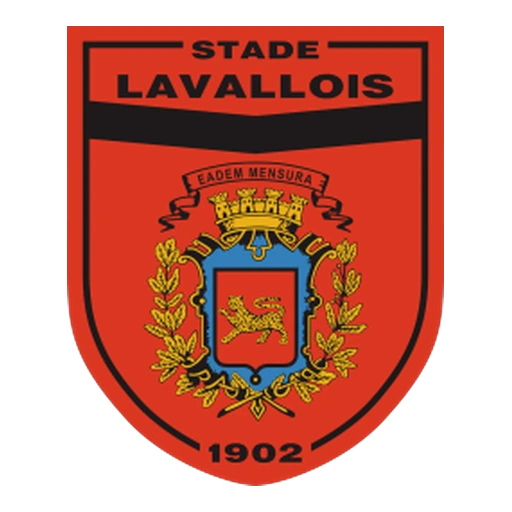
A major redesign arrived in 1986. The new crest adopted a red shield displaying the coat of arms of the city of Laval at its centre, surrounded by the words "Stade Lavallois" and the founding year 1902. By incorporating the city's official heraldry, the badge strengthened the club's civic identity and remained in use throughout the late 1980s and early 1990s.
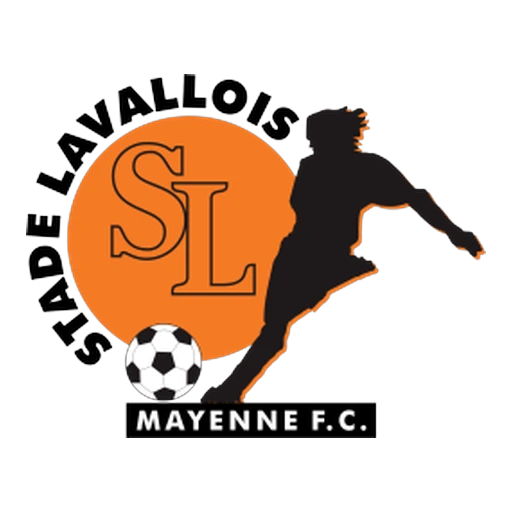
In 1995, the club introduced a more dynamic and modern emblem. The design featured a large orange SL monogram alongside the silhouette of a footballer in action, with a football positioned beneath. The inscription "Mayenne F.C." highlighted the club's representation of the wider Mayenne department. This logo accompanied Stade Lavallois for two decades and became familiar to supporters during both Ligue 1 and Ligue 2 campaigns.
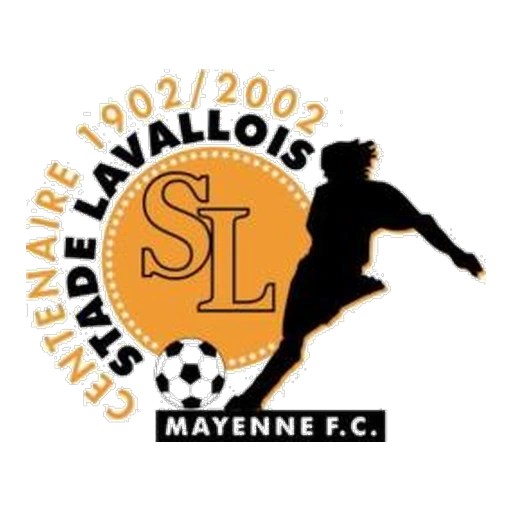
To celebrate the club's centenary in 2002, a special commemorative version of the crest was produced. It retained the 1995 design while adding the inscription "Centenaire 1902–2002" around the emblem to mark one hundred years of the club's history.
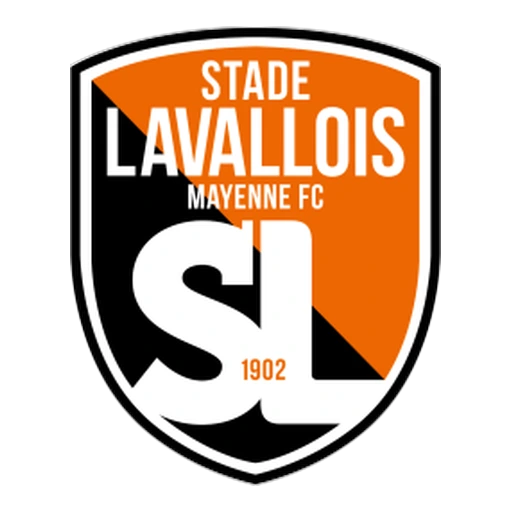
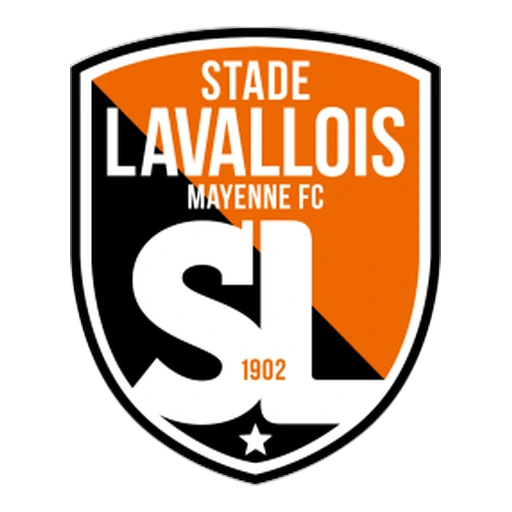
In 2015, Stade Lavallois adopted a completely redesigned badge inspired by modern football branding. The new crest returned to a traditional shield shape while prominently featuring the large SL initials in black against the club's orange-and-black colours. The club name appeared across the top, with the founding year 1902 included near the base. The redesign simplified the visual identity while reconnecting with the historic monogram used throughout the club's history.
In 2022, Stade Lavallois made a subtle update to its modern shield. While preserving the overall design introduced in 2015, the club refined the typography, outlines, and proportions to create a cleaner appearance. The most noticeable addition was a small white star positioned at the bottom of the shield beneath the SL monogram. Although not intended to represent a championship title, the star serves as a distinctive design element that further differentiates the updated crest. The badge continues to feature the club's traditional orange and black colours, the founding year 1902, and remains in use today.
Stade Lavallois Mayenne FC Club History
Founded in 1902, Stade Lavallois Mayenne Football Club is one of the oldest football clubs in western France. Based in the city of Laval, in the Mayenne department, the club was established by local sports enthusiasts and quickly became a leading force in regional football. Its distinctive tango (orange) colours, adopted in the early years of the club's history, have since become one of the most recognisable identities in French football.
For much of the first half of the 20th century, Stade Lavallois competed in regional and amateur competitions before gradually climbing the French football pyramid. The club turned professional in 1976, marking the beginning of its most successful era under legendary coach Michel Le Milinaire, who managed the team for over 30 years and transformed Laval into one of France's model provincial clubs.
The late 1970s and 1980s represented the golden age of Stade Lavallois. The club established itself as a regular Division 1 side and earned widespread admiration for its disciplined, attacking football despite operating with modest financial resources. The greatest achievement came in the 1982–83 season, when Laval finished fifth in Division 1 and qualified for the 1983–84 UEFA Cup, the club's first and only appearance in a major European competition.
In the 1983–84 UEFA Cup, Stade Lavallois enjoyed a memorable European campaign by eliminating Dynamo Kyiv, one of Europe's strongest clubs at the time, before being knocked out in the second round by Austria Wien. The victory over Dynamo Kyiv remains one of the greatest results in the club's history and secured Laval's place among the memorable underdog stories of French football.
Following relegation from the top flight in 1989, Stade Lavallois spent most of the following decades alternating between Ligue 2, the Championnat National, and, on occasion, the amateur divisions. Despite financial challenges and fluctuating fortunes, the club remained respected for its youth development and commitment to attractive football. Many talented players, including Mickaël Landreau, spent part of their youth careers at Laval before achieving success elsewhere.
After several years outside the professional game, Laval won promotion back to Ligue 2 in 2022 by winning the Championnat National. Since returning to professional football, the club has re-established itself as a competitive Ligue 2 side while continuing to rely on sensible management and strong local support at the Stade Francis-Le Basser.
Stade Lavallois' principal rivals are Le Mans FC in the Maine Derby, one of western France's oldest regional rivalries. Matches against Angers SCO and Tours FC have also carried regional significance, while encounters with SM Caen and EA Guingamp have become competitive fixtures through frequent meetings in Ligue 2.