Historical Crests Stade de Reims
Name: Stade de Reims
Nickname(s): Les Rouges et Blancs (The Red and Whites)
Founded: 1931
Stadium: Stade Auguste-Delaune
Capacity: 21,684
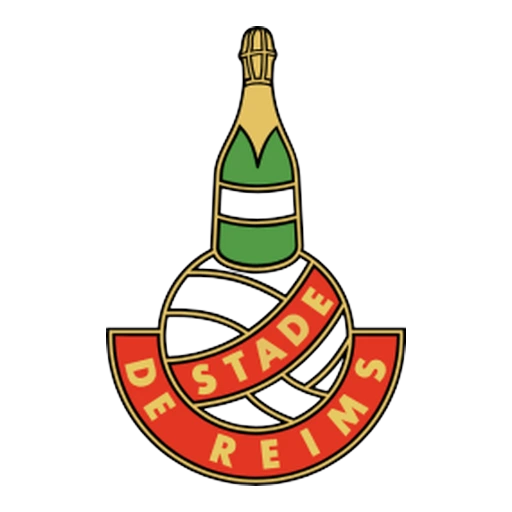
1931-1991
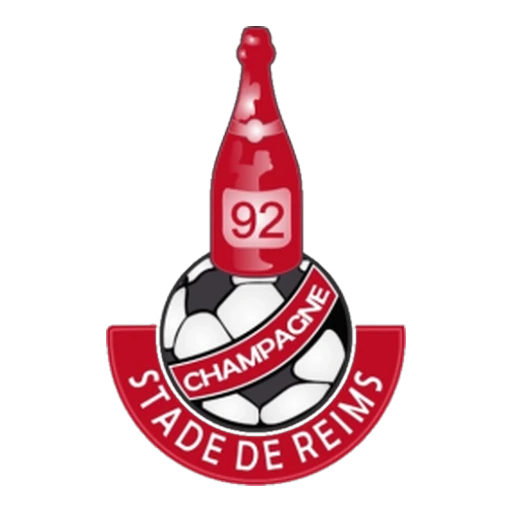
1991-1992
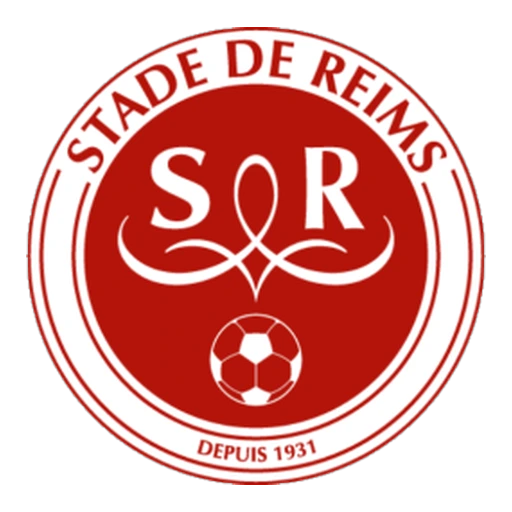
1999-2020
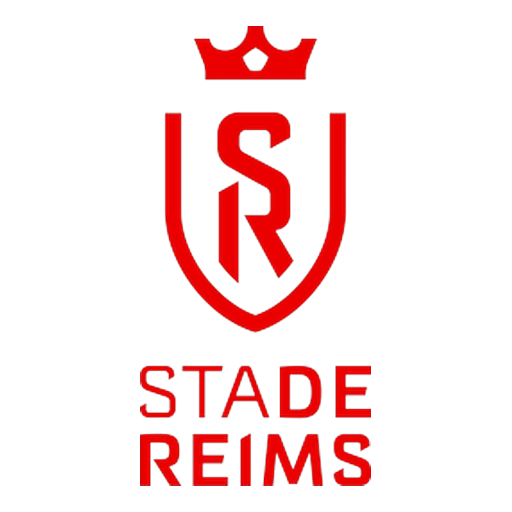
2020-Present
Stade de Reims Crest History
The original crest of Stade de Reims, introduced in 1931, became one of the most iconic symbols in French football. The badge featured a Champagne bottle standing upright behind a traditional football, celebrating Reims' position at the heart of France's famous Champagne region. A red ribbon bearing the club's name wrapped around the ball, combining regional pride with football identity. This emblem accompanied Stade de Reims throughout its golden era of the 1950s and 1960s, when the club dominated French football and became a European powerhouse.
In 1991, following the club's financial collapse and reorganisation, a slightly modernised version of the classic emblem was introduced. The new badge retained the Champagne bottle and football, but adopted cleaner lines and brighter colours. The bottle displayed the number 92, referring to the approaching anniversary of the club, while the word "Champagne" appeared across the football. Although short-lived, the crest preserved the club's historic connection to its region during a difficult period.
After Stade de Reims was re-established and returned to professional football, a completely new crest was unveiled in 1999. The design took the form of a red circular badge surrounded by a white border. At its centre appeared the elegant intertwined initials SR, inspired by the club's historic monogram, above a football, while "Depuis 1931" ("Since 1931") was added below. The simplified badge abandoned the Champagne bottle for the first time, focusing instead on the club's heritage and identity. It remained in use for more than two decades during Reims' return to Ligue 1.
In 2020, Stade de Reims introduced its current crest as part of a complete visual rebranding. The new emblem features a stylised shield incorporating the intertwined SR initials beneath a crown, symbolising the city of Reims' status as the traditional coronation city of the kings of France. The design is minimalist and modern, using the club's traditional red and white colours while paying tribute to both the club's history and the city's royal heritage.
Stade de Reims Club History
Founded in 1931, Stade de Reims was established following the merger of several local sporting organisations in the city of Reims, in France's Champagne region. Although football had been played in the city for decades beforehand, the creation of Stade de Reims marked the beginning of what would become one of the most successful clubs in French football history. From its earliest years, the club adopted its famous red and white colours and quickly established itself among the country's leading teams.
Stade de Reims entered its golden era during the 1950s and early 1960s, becoming the dominant force in French football. Under legendary coaches such as Albert Batteux, the club won six French league titles (1949, 1953, 1955, 1958, 1960, and 1962) and two Coupe de France trophies (1950 and 1958). Reims became renowned for its elegant, attacking style of play, producing legendary players including Raymond Kopa, Just Fontaine, Roger Piantoni, Robert Jonquet, and Armand Penverne.
The club also became one of Europe's first football powerhouses. Stade de Reims reached the European Cup Final in 1956, where it lost 4–3 to Real Madrid in one of the greatest matches in football history. The two clubs met again in the 1959 European Cup Final, with Real Madrid once more emerging victorious. Despite never winning the competition, Reims played a crucial role in establishing the prestige of European club football and remains one of France's most historic continental representatives.
After the golden era ended, the club gradually declined during the late 1960s and 1970s. Financial problems culminated in 1991, when Stade de Reims entered liquidation and lost its professional status. Forced to restart in the amateur divisions under a new structure, the club spent almost two decades rebuilding its reputation and climbing back through the French football pyramid.
The revival began in the early 2000s, with promotions bringing Reims back into professional football. In 2012, the club returned to Ligue 1 after a 33-year absence, restoring one of France's historic institutions to the top flight. Although relegated in 2016, Stade de Reims won the 2017–18 Ligue 2 title and immediately returned to Ligue 1, where it re-established itself as a competitive top-division side.
Since returning to Ligue 1, Reims has earned widespread praise for its excellent recruitment, youth development, and attractive football. The club has developed and showcased talented players such as Hugo Ekitiké, Axel Disasi, Yunis Abdelhamid, and Marshall Munetsi, while consistently competing in the upper half of the league despite operating with a modest budget.
Stade de Reims' principal rival is ES Troyes AC in the Derby de Champagne, reflecting the historic rivalry between the two largest clubs in the Champagne region. Matches against CS Sedan Ardennes have also traditionally carried regional importance, while encounters with FC Metz and RC Strasbourg have developed into competitive fixtures between historic clubs from eastern France.
Stade Reims Pin
Your Dynamic Snippet will be displayed here... This message is displayed because you did not provide enough options to retrieve its content.