Historical Crests Stade Brestois 29
Name: Stade Brestois 29
Nickname(s): Les Ty' Zefs (The Little West Winds)
Founded: 1950
Stadium: Stade Francis-Le Blé
Capacity: 15,931
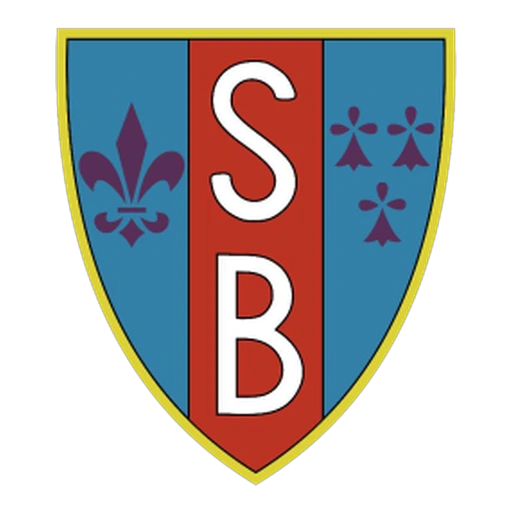
1960-1980

1980-1984
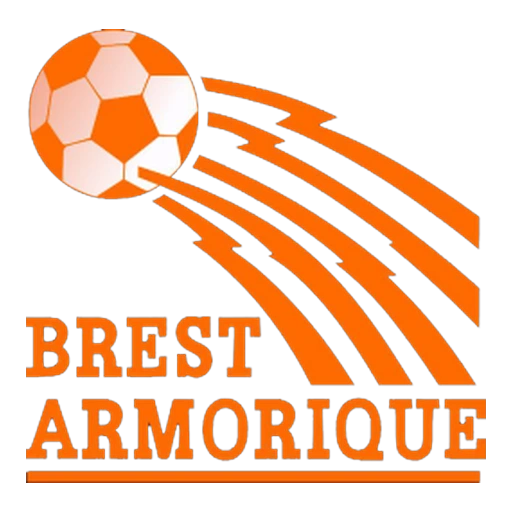
1984-1991
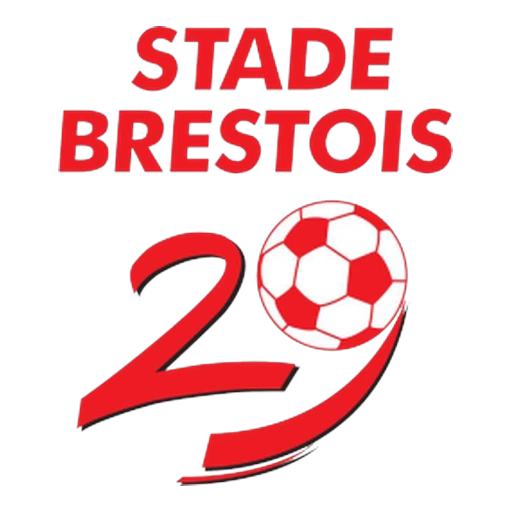
1991-1999
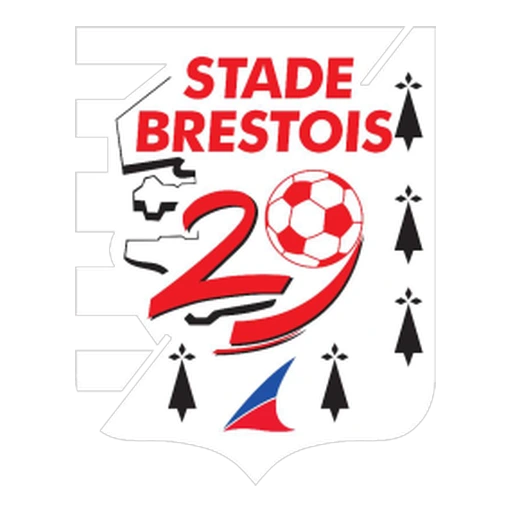
1999-2004
2004-2008
2008-2010
2010-2024
2024-Present
Stade Brestois 29 Crest History
The first crest used by Stade Brestois, introduced around 1960, reflected the club's Breton identity. The badge was a traditional shield divided into blue and red vertical sections, with the white initials SB running down the centre. On either side appeared regional symbols: a fleur-de-lis representing the historic influence of France and ermine spots, the traditional emblem of Brittany. This crest established the club's visual identity during its early decades.
In 1980, the club adopted a highly modern and abstract emblem. The new badge consisted of interlocking red and purple diamonds, moving away from traditional football symbolism in favour of a geometric design that reflected graphic design trends of the early 1980s. Although distinctive, it proved unpopular and remained in use for only four years.
Following the club's rebranding as Brest Armorique, a new logo was introduced in 1984. It featured an orange football with trailing motion lines, symbolising speed and attacking football, above the words "Brest Armorique." The design reflected the club's new identity after adopting the Armorique name and remained in use during Brest's rise to the French top flight.
In 1991, after returning to the name Stade Brestois 29, the club unveiled a bold new logo centred on a large red number "29", representing the department of Finistère. A football was incorporated into the design, while the club's name appeared above. The crest reinforced the club's strong regional identity and became closely associated with Brest throughout the 1990s.
From 1999 to 2004, the badge evolved into a white shield featuring the red 29, the outline of Finistère, the ermine spots of Brittany, and the Brest castle. The club name appeared prominently at the top, creating one of the most regionally symbolic crests in its history.
A refined version followed in 2004, adding horizontal red stripes across the upper part of the shield while preserving the map of Finistère, the ermine symbols, the castle silhouette, and the red 29. This update modernised the badge while keeping its distinctive Breton identity.
The 2008 revision made only minor adjustments to the typography and proportions, maintaining the same shield, regional symbols, and overall layout. It remained the club's identity during its return to professional football and promotion back to Ligue 1 in 2010.
In 2010, Stade Brestois introduced a completely redesigned crest. The new badge adopted a red shield outlined in black, featuring the large white initials SB above the number 29, with the founding year 1950 at the base. Above the initials appeared a stylised ermine, one of Brittany's oldest heraldic symbols, replacing the more complex regional imagery of previous crests. The simplified design reflected the club's modern ambitions while remaining firmly rooted in Breton heritage.
A subtle refinement arrived in 2024, preserving the overall shield, colours, and composition while updating the typography, outlines, and proportions.
Stade Brestois 29 Club History
Founded in 1950, Stade Brestois 29 was created through the merger of five local clubs in the city of Brest, including Armoricaine de Brest, AS Brestoise, Flamme Olympique, Milice Saint-Michel, and Jeunes d'Armor. The merger aimed to establish a strong club capable of representing the city and the Brittany region at the highest level of French football.
The club climbed steadily through the French football pyramid during the 1950s and 1960s before reaching the Division 1 for the first time in 1979. Under president François Yvinec, Brest enjoyed its most successful early period during the 1980s, becoming a regular top-flight club. Playing under the name Brest Armorique FC, the club became known for its attacking football and exciting players, including David Ginola, Corentin Martins, Stéphane Guivarc'h, Vincent Guérin, and Julio César.
Despite its progress on the pitch, financial problems struck the club in 1991. Brest was declared bankrupt, lost its professional status, and was administratively relegated to the amateur divisions. The club was re-established as Stade Brestois 29, beginning a long rebuilding process from the lower levels of French football.
After nearly two decades of recovery, Brest returned to professional football and earned promotion to Ligue 1 in 2010 under coach Alex Dupont. Although the club was relegated in 2013, it remained competitive in Ligue 2 and eventually secured promotion back to the top flight in 2019 under Jean-Marc Furlan.
The greatest achievement in the club's history came during the 2023–24 Ligue 1 season. Led by coach Éric Roy, Stade Brestois finished third, recording its highest-ever league finish and qualifying for the UEFA Champions League for the first time. The remarkable campaign was widely regarded as one of the biggest surprises in modern French football, achieved despite one of the league's smallest budgets.
Brest made its UEFA Champions League debut in the 2024–25 season, becoming the first club from western Brittany to compete in Europe's premier club competition. The club exceeded expectations by reaching the knockout phase play-offs, marking a historic European campaign that significantly raised its profile on the international stage.
Today, Stade Brestois 29 is recognised as one of Brittany's leading football clubs. Playing at the historic Stade Francis-Le Blé, the club is admired for its resilient spirit, strong community support, and ability to compete with France's biggest clubs despite limited financial resources.
Stade Brestois' principal rivals are En Avant Guingamp in the Breton Derby, one of the fiercest regional rivalries in French football. Matches against Stade Rennais and FC Lorient are also significant, while fixtures against SM Caen and Le Havre AC have developed into competitive encounters between clubs from north-western France.
Stade Brestois 29 Pin
Your Dynamic Snippet will be displayed here... This message is displayed because you did not provide enough options to retrieve its content.