Historical Crests Paris Saint-Germain FC
Name: Paris Saint-Germain FC
Nickname(s): Les Rouge et Bleu (The Red and Blues)
Founded: 1970
Stadium: Parc des Princes
Capacity: 47,929
1970-1972
1972-1982
1982-1990
1990-1992
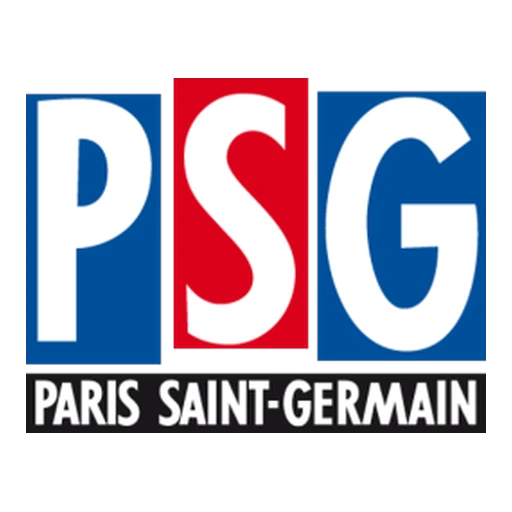
1992-1996
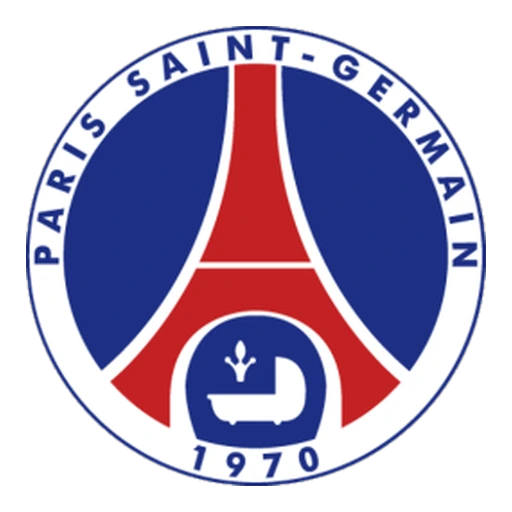
1996-2002
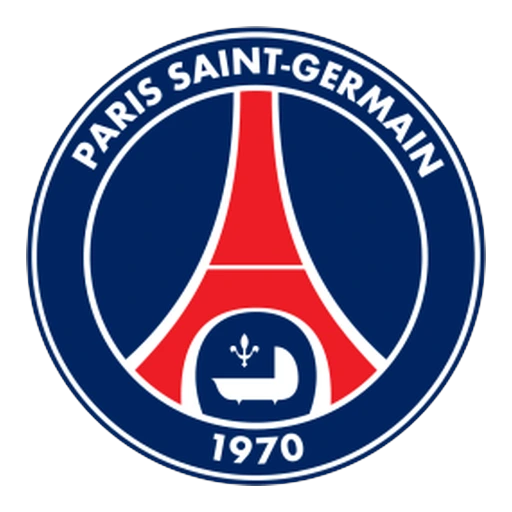
2002-2010
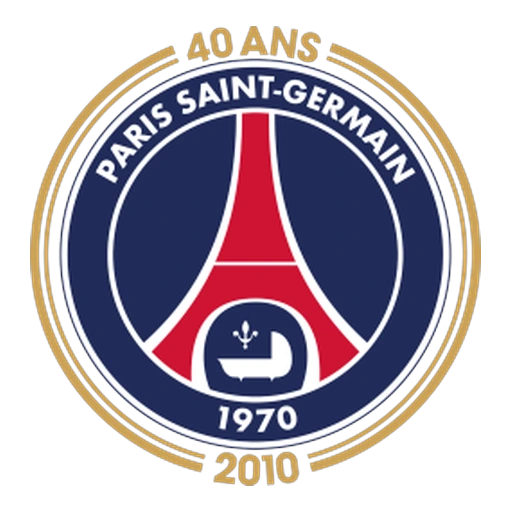
2010-2011
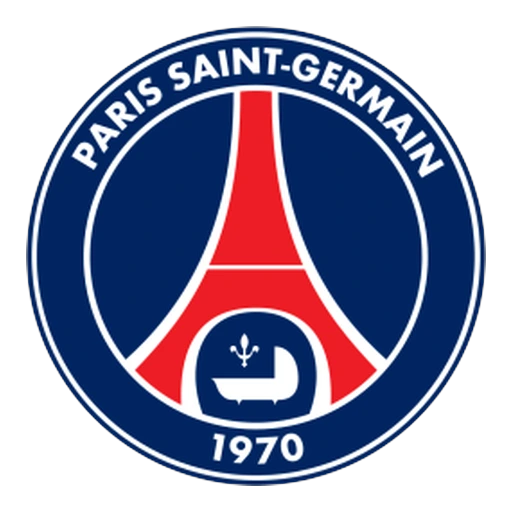
2011-2013
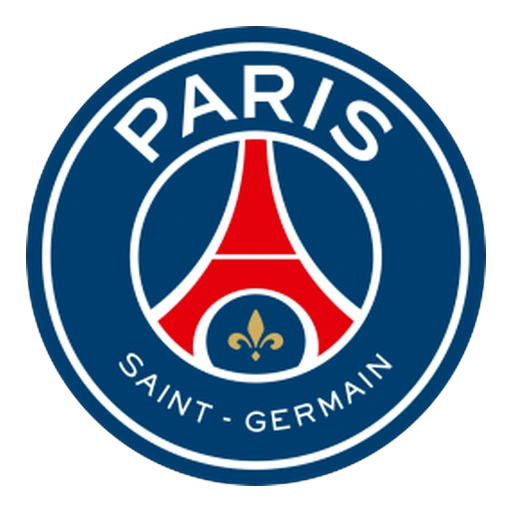
2013-2014
Paris Saint-Germain FC Crest History
The first crest of Paris Saint-Germain, introduced in 1970, reflected the club's creation through the merger of Paris FC and Stade Saint-Germain. The badge featured a blue football bearing a red sailing ship, taken from the coat of arms of Paris, symbolising the capital. Beneath it appeared the words "Paris St. Germain Football Club" in red. This simple emblem represented the union of the two founding clubs and remained in use until their separation in 1972.
Following the split from Paris FC in 1972, PSG adopted what would become one of the most iconic identities in world football. The new circular crest placed a large red Eiffel Tower at its centre, representing Paris, while a blue cradle containing a gold fleur-de-lis appeared beneath it. The cradle symbolised the birthplace of King Louis XIV in Saint-Germain-en-Laye, preserving the club's connection to its suburban origins. This elegant design established the visual identity that continues to define PSG today.
Between 1982 and 1990, under club president Francis Borelli, the crest received an unusual modification. The traditional circular badge was placed above a stylised illustration of the Parc des Princes, emphasising the club's home stadium and reinforcing its identity within Paris. Although distinctive, supporters never fully embraced the design, and the traditional circular crest eventually returned. (Club historical records)
In 1990, PSG reinstated the classic circular badge, once again featuring the Eiffel Tower, the cradle of Louis XIV, and the fleur-de-lis. The restoration reflected the club's desire to return to its historic identity after the experimental Borelli-era emblem.
A dramatic rebranding occurred in 1992 after Canal+ became the club's owner. The traditional crest was replaced by a bold typographic logo displaying the initials PSG in large blue, red, and white letters above the words Paris Saint-Germain. The minimalist design reflected contemporary branding trends but proved unpopular among many supporters because it abandoned the club's historic symbols.
In 1996, PSG returned to the famous circular crest featuring the Eiffel Tower and cradle, while the club's full name surrounded the emblem. Minor refinements improved the typography and proportions, restoring the traditional identity that supporters strongly associated with the club.The badge underwent another subtle update in 2002, with a darker blue background, cleaner lines, and the addition of the founding year 1970 beneath the cradle. The redesign modernised the emblem while remaining faithful to the classic concept that had become synonymous with Paris Saint-Germain.
To celebrate the club's 40th anniversary, a special commemorative crest was used during the 2010–11 season. A gold outer ring surrounded the traditional badge and included the inscription "40 Ans", marking forty years since PSG's foundation in 1970.
The standard crest returned in 2011, before another redesign followed in 2013 after the arrival of Qatar Sports Investments (QSI). The word "PARIS" became significantly larger, while "Saint-Germain" was reduced beneath it. The cradle was simplified into a stylised base and the fleur-de-lis became more prominent, placing greater emphasis on the global recognition of Paris while still acknowledging the club's historic origins in Saint-Germain-en-Laye.
Paris Saint-Germain Club History
Founded on 12 August 1970, Paris Saint-Germain Football Club (PSG) was created through the merger of Paris FC, a newly established club backed by the French Football Federation, and Stade Saint-Germain, a club based in Saint-Germain-en-Laye. The merger aimed to give the French capital a major professional football club capable of competing at the highest level. In 1972, following disagreements with the City of Paris, the two clubs separated. Paris FC retained its place in Division 1, while Paris Saint-Germain was administratively relegated to Division 3. PSG quickly rebuilt, earning back-to-back promotions and returning to the top flight in 1974, the same year it moved permanently into the Parc des Princes.
During the late 1970s and 1980s, PSG established itself among France's leading clubs. The team won its first major trophy, the Coupe de France, in 1982, successfully defending it in 1983. Under coach Gérard Houllier, Paris Saint-Germain captured its first-ever French league title in 1985–86, led by players such as Joël Bats, Luis Fernández, Dominique Bathenay, and Safet Sušić, the latter widely regarded as one of the club's greatest-ever footballers.
A new golden era began in the 1990s following the takeover by Canal+. PSG became one of Europe's strongest clubs, winning another Ligue 1 title in 1993–94, multiple domestic cups, and reaching several European semi-finals. The club's greatest continental success came in 1996, when Paris Saint-Germain defeated Rapid Wien to win the UEFA Cup Winners' Cup, becoming only the second French club to claim a major UEFA trophy. Stars including George Weah, David Ginola, Raí, Youri Djorkaeff, Leonardo, Bernard Lama, and Paul Le Guen helped define this successful period.
Following a quieter decade in the 2000s, PSG entered a transformative new era in 2011, when Qatar Sports Investments (QSI) acquired the club. Significant investment brought world-class players including Zlatan Ibrahimović, Thiago Silva, Edinson Cavani, Ángel Di María, Kylian Mbappé, Neymar Jr., and Lionel Messi, while coaches such as Carlo Ancelotti, Laurent Blanc, Thomas Tuchel, and Luis Enrique guided the club to unprecedented domestic dominance. PSG won numerous Ligue 1, Coupe de France, Coupe de la Ligue, and Trophée des Champions titles, becoming the most successful club in French football history in terms of major honours.
The club reached its first-ever UEFA Champions League Final in 2020, finishing as runners-up to Bayern Munich. Five years later, under Luis Enrique, Paris Saint-Germain won their first UEFA Champions League title in 2025, defeating Inter Milan 5–0 in the final. The following season, PSG successfully defended their European crown by defeating Arsenal on penalties after a 1–1 draw in the 2026 UEFA Champions League Final in Budapest. The victory made Paris Saint-Germain the first French club to win the Champions League twice and the first club to successfully defend the title since Real Madrid's three consecutive triumphs between 2016 and 2018, cementing PSG's place among Europe's elite.
Paris Saint-Germain's greatest rivalry is with Olympique de Marseille in Le Classique, the most prestigious and fiercely contested fixture in French football. The club also contests the Paris Derby with Paris FC, a rivalry rooted in the clubs' shared origins following their split in 1972, while matches against Olympique Lyonnais have developed into major domestic clashes during the twenty-first century.
Paris Saint-Germain
Your Dynamic Snippet will be displayed here... This message is displayed because you did not provide enough options to retrieve its content.