Historical Crests OGC Nice
Name: OGC Nice
Nickname(s): Les Aiglons (The Eaglets)
Founded: 1904
Stadium: Allianz Riviera
Capacity: 36,178
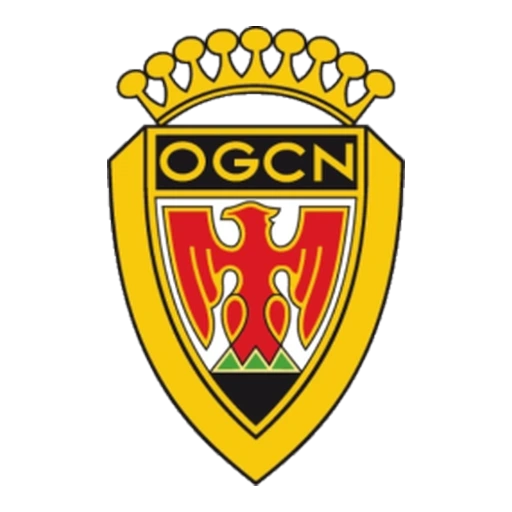
1948-1992
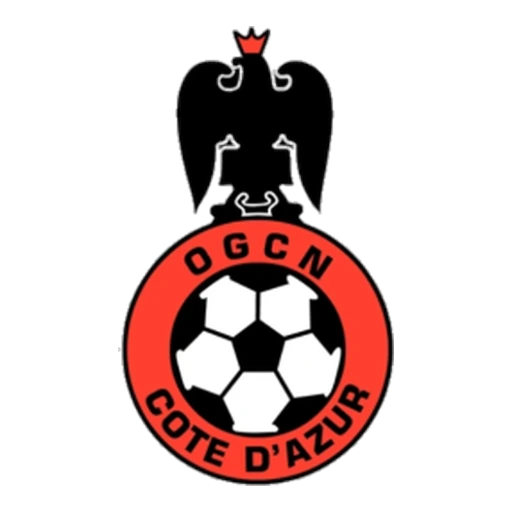
1992-2013
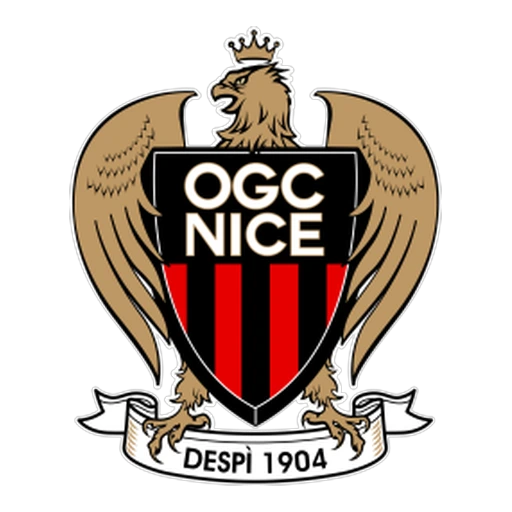
2013-Present
OGC Nice Crest History
The first widely recognised crest of OGC Nice, introduced in 1948, adopted a traditional heraldic shield inspired by the city's coat of arms. The badge featured a stylised red eagle set within a gold shield, with the initials OGCN displayed across a black banner at the top. A decorative golden crown completed the crest, symbolising the club's prestige, while the eagle reflected both the emblem of the city of Nice and the club's nickname, Les Aiglons (The Eaglets). This iconic badge accompanied the club through its most successful era during the 1950s.
In 1992, OGC Nice introduced a completely redesigned circular crest. The heraldic shield disappeared in favour of a bold black eagle perched above a classic black-and-white football. Around the red outer ring appeared the inscription "OGCN Côte d'Azur", highlighting the club's regional identity beyond the city of Nice. The cleaner, more modern design reflected the graphic trends of the early 1990s while retaining the eagle as the club's central symbol.
Since 2013, OGC Nice has used a crest that combines modern styling with references to its historic identity. Unveiled ahead of the club's move to the Allianz Riviera, the badge returned to a shield featuring the club's traditional red and black vertical stripes. A majestic golden eagle spreads its wings around the shield, symbolising strength, pride and the city of Nice, where the eagle is also an important civic emblem. Beneath the shield, a white scroll bears the inscription "Despì 1904" ("Since 1904" in the Niçois dialect), celebrating the club's origins while reinforcing its local heritage.
OGC Nice Club History
Founded in 1904 as the Gymnaste Club de Nice, OGC Nice began as a gymnastics and athletics club before establishing its football section in 1908. In 1924, the club adopted the name Olympique Gymnaste Club de Nice, becoming known simply as Le Gym. Following a merger with Gallia Football Athlétic Club de Nice in 1919, the club adopted the famous red and black colours that remain its identity today. OGC Nice was also one of the founding members of the French professional championship in 1932.
The club enjoyed its greatest period of success during the 1950s, becoming one of the dominant teams in French football. Nice won four Ligue 1 titles in 1951, 1952, 1956, and 1959, while also lifting the Coupe de France in 1952, 1954, and 1997. The 1951–52 season was particularly memorable, as OGC Nice completed the league and cup double. During this golden era, players such as Joaquín Valle, Victor Nurenberg, Pancho Gonzales, and Héctor De Bourgoing helped establish the club among France's elite.
Although major trophies became less frequent after the 1960s, Nice remained a respected force in French football. The club experienced periods of promotion and relegation but continued to produce talented players through its academy. Football legends including Hugo Lloris, Dominique Baratelli, Didier Digard, Malang Sarr, and Alexis Claude-Maurice all emerged from or developed at the club, while internationally renowned players such as Just Fontaine, Mario Balotelli, Hatem Ben Arfa, Wesley Sneijder, and Dante also represented Les Aiglons during their careers.
A new chapter began in 2011 with the arrival of president Jean-Pierre Rivère, followed by the move to the Allianz Riviera in 2013. The modern stadium and significant investment helped transform OGC Nice into one of Ligue 1's most ambitious clubs. Under coaches including Claude Puel, Lucien Favre, and Christophe Galtier, Nice regularly qualified for European competitions and established itself as a consistent challenger near the top of the French league. Since 2019, the club has been owned by INEOS, whose investment has further strengthened its infrastructure, academy, and long-term ambitions.
OGC Nice's principal rivalry is with AS Monaco in the Derby de la Côte d'Azur, one of the most prestigious rivalries in southern French football. Matches against Olympique de Marseille also generate intense interest due to the historic competition between the two Mediterranean clubs.
OGC Nice pins
Your Dynamic Snippet will be displayed here... This message is displayed because you did not provide enough options to retrieve its content.