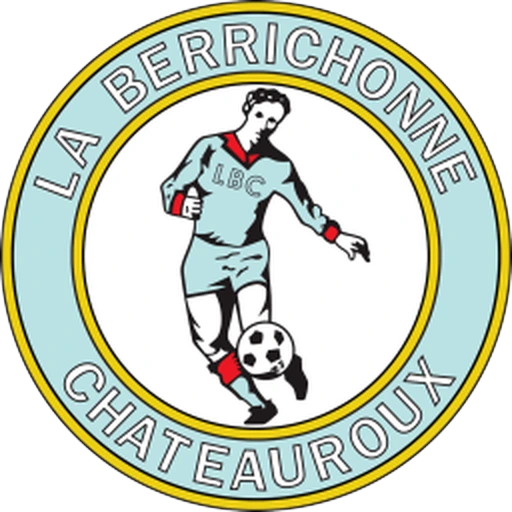
The first widely recognised crest of La Berrichonne de Châteauroux, introduced in 1935, featured a traditional circular badge centred on an illustration of a footballer wearing the club's colours. Surrounding the player were the words "La Berrichonne Châteauroux", emphasising both the club's name and its local identity. The design reflected the style of football emblems of the era by placing the sport itself at the heart of the badge and remained the club's symbol for more than five decades.
In 1990, the club adopted a completely modern identity. The illustrated footballer disappeared and was replaced by a stylised red football, crossed by a blue banner carrying the initials L.B.C. The simplified geometric design reflected the graphic trends of the early 1990s while maintaining the club's traditional red and blue colours.
A refreshed version followed in 2005. The overall concept remained the same, with the stylised football and L.B.C. banner retained, but the full name "La Berrichonne de Châteauroux" was added around the badge. The football graphic was given a textured appearance, creating a more dynamic and recognisable emblem while reinforcing the club's identity through the prominent display of its full name.
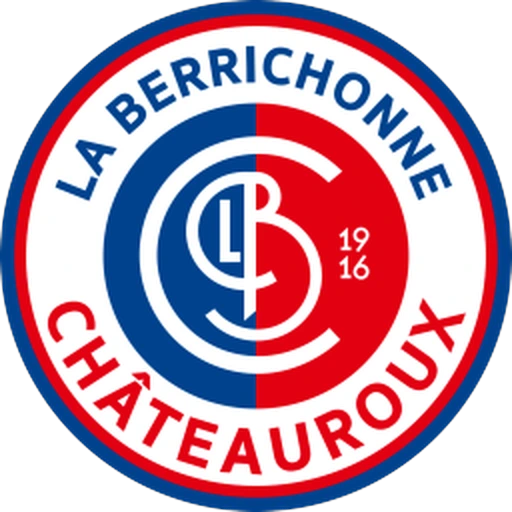
In 2017, La Berrichonne introduced its current crest, combining modern design with references to the club's history. The badge returned to a circular format, using the traditional red, blue and white colours. At its centre is an elegant interlocking "LB" monogram, accompanied by the founding year 1916. The full club name surrounds the emblem, creating a clean and balanced design that honours the club's heritage while presenting a contemporary visual identity.
La Berrichone de Châteauroux Club History
Founded in 1916, the football section of La Berrichonne de Châteauroux forms part of La Berrichonne, a multi-sports club established in 1883. Football had already been played within the organisation before the First World War, but the official football section was created in February 1916 under the leadership of Léon Talichet. In 1935, a merger with AS Châteauroux strengthened the club and introduced the famous red and blue colours that remain part of its identity today.
For much of its early history, La Berrichonne competed in the regional Centre leagues before gradually establishing itself on the national stage. Promotion to the Championnat de France Amateur (CFA) in 1949 marked an important step forward, and the club became one of the strongest amateur sides in central France. The opening of the Stade Gaston Petit in 1964 provided a modern home and supported the club's growing ambitions.
Professional status arrived in 1990, beginning the most successful era in the club's history. Under the presidency of Michel Denisot, Châteauroux won the Championnat National in 1994, earning promotion to Division 2. Three years later, the club claimed the 1996–97 Division 2 title, securing promotion to Ligue 1 for the first—and so far only—time in its history. Although the stay in the top flight lasted just one season, it remains one of the club's greatest achievements.
Another memorable chapter followed during the 2003–04 Coupe de France, when La Berrichonne reached its first major national final. Although the club lost 1–0 to Paris Saint-Germain, PSG had already qualified for Europe through the league, allowing Châteauroux to enter the 2004–05 UEFA Cup. The club's first appearance in European competition remains one of the highlights of its history. Throughout this period, La Berrichonne also developed several notable players, including Didier Deschamps, Florent Malouda, Sébastien Roudet, and Gaël Givet, strengthening its reputation for youth development.
La Berrichonne's principal rivalry is with Bourges Foot 18 in the Berry Derby, reflecting the historic sporting rivalry between the two largest clubs in the Berry region. Matches against US Orléans are also among the club's most competitive regional fixtures.