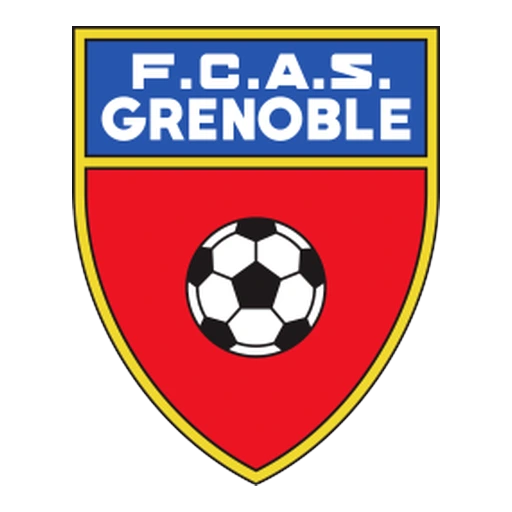
The earliest crest shown, used by FC Association Sportive Grenoble between 1977 and 1981, took the form of a traditional shield. The badge featured the club name across a blue header, while a black-and-white football occupied the centre of a red field. Its straightforward design reflected the football aesthetics of the era and focused primarily on the club's name and the sport itself.
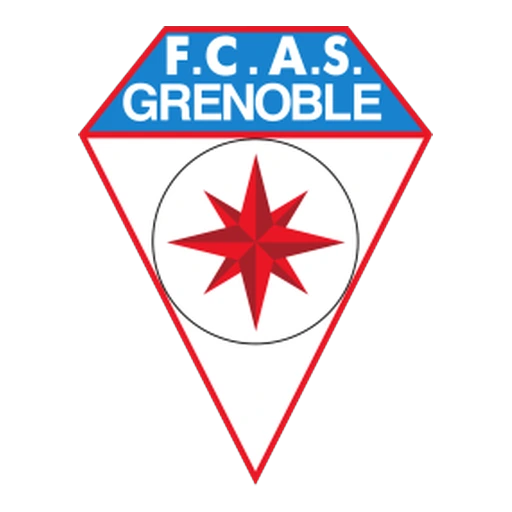
In 1981, the club introduced a striking triangular crest. The words F.C.A.S. Grenoble appeared across the top, while an eight-pointed red compass rose dominated the centre. The compass symbol represented direction, ambition and progress, giving the club a distinctive visual identity unlike most French clubs at the time.
A further redesign followed in 1984, when the club became FCG. The new circular badge featured the initials F.C.G. above a stylised lion, a historic symbol associated with Grenoble and the Dauphiné region. Although relatively simple, the emblem reinforced the club's local identity during the remainder of the 1980s.
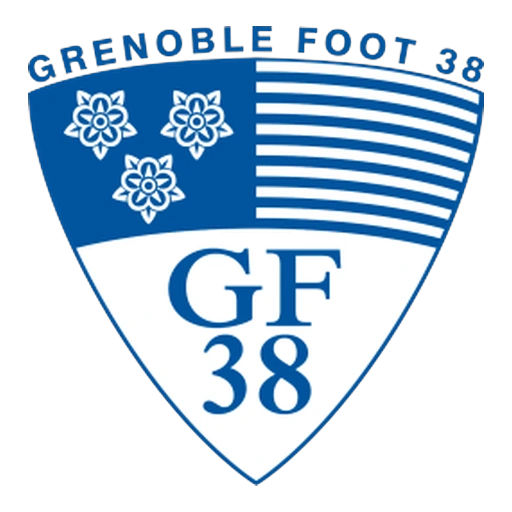
With the creation of Grenoble Foot 38 in 1997, a completely new crest was unveiled. The shield incorporated several symbols of the city and department: three roses taken from the coat of arms of Grenoble appeared in the upper left corner, while horizontal stripes represented the surrounding Alpine mountains. The initials GF38 dominated the lower half, with 38 referring to the Isère department, whose official French department code is 38. The design established the identity of the newly formed club while celebrating its local heritage.
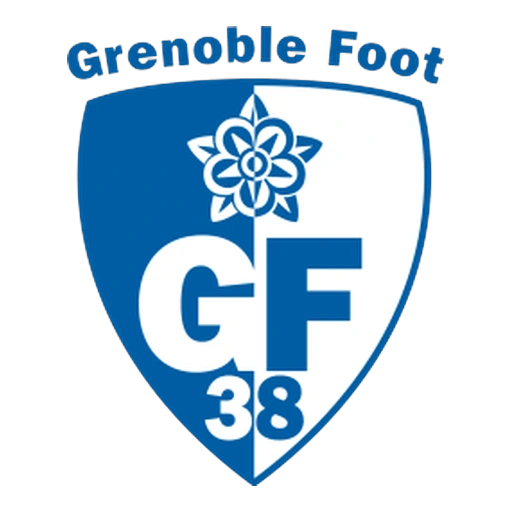
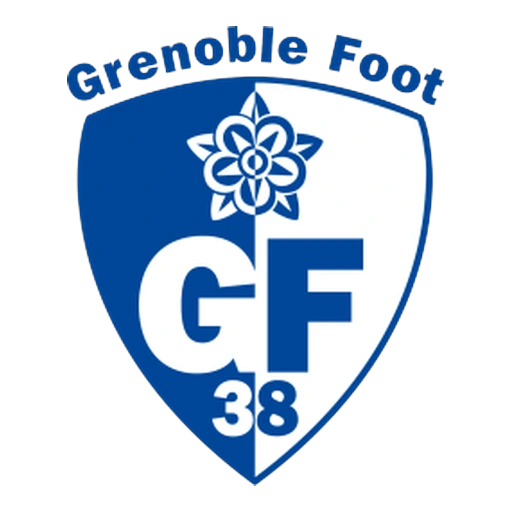
In 2001, the badge was modernised with a cleaner and more minimalist shield. The three roses were retained above a large GF38 monogram, while the words Grenoble Foot were placed across the top. The redesign simplified the earlier crest, improving legibility while preserving the club's strongest civic symbols.
Since 2018, Grenoble Foot 38 has used a refined version of the 2001 crest. The overall shield shape and layout remain unchanged, but the typography has been updated, the colours slightly refreshed and the lines simplified for improved clarity across digital and print media. The three roses continue to symbolise the city of Grenoble, while the GF38 monogram and the departmental number 38 remain central to the club's identity, linking the badge firmly to both the city and the Isère region.
Grenoble Foot 38 Club History
Founded in 1997, Grenoble Foot 38 (GF38) was created through the merger of Olympique Grenoble Isère (OGI) and Norcap Olympique, continuing a football tradition in Grenoble that dates back to 1892 with the original Football Club de Grenoble. The new club adopted the name Grenoble Foot 38, with 38 referring to the Isère department, and began its journey in the Championnat de France Amateur (CFA).
The club progressed rapidly under coach Alain Michel, earning promotion to Division 2 in 2001. Grenoble spent seven consecutive seasons in the second tier before achieving one of the greatest milestones in its history by finishing third in Ligue 2 during the 2007–08 season. Promotion to Ligue 1 ended a 45-year absence from the French top flight. Playing in the newly opened Stade des Alpes, GF38 enjoyed a memorable first season back in the elite, finishing thirteenth and reaching the 2008–09 Coupe de France semi-finals, the furthest the club has ever progressed in the competition.
Despite this success, financial problems soon overshadowed the club's progress. Following relegation from Ligue 1 in 2010, Grenoble entered administration the following year after the collapse of its Japanese owner, Index Holdings. The professional club was liquidated in 2011, forcing GF38 to restart in CFA2 (the fifth tier). Under former captain Olivier Saragaglia, Grenoble began a patient rebuilding process, earning immediate promotion before spending several seasons narrowly missing out on further advancement. One of the club's most memorable moments during this period came in the 2014–15 Coupe de France, when amateur Grenoble eliminated Olympique de Marseille on penalties in front of more than 18,000 spectators at the Stade des Alpes.
The revival continued with promotion to the Championnat National in 2017, followed a year later by promotion to Ligue 2. Since returning to professional football, Grenoble has established itself as a competitive and well-organised club, regularly challenging for the promotion play-offs while maintaining financial stability. The club has also continued its tradition of developing talented players, with Youri Djorkaeff, Olivier Giroud, Sofiane Feghouli, and Florian Thauvin all having connections to football development in Grenoble during different stages of their careers.
Grenoble Foot 38's principal rivalry is with FC Annecy in the Alpes Derby, reflecting the long-standing sporting rivalry between the neighbouring Alpine cities.