Historical Crests Angers SCO
Name: Angers SCO
Nickname(s): Les Scoïstes (The SCO Supporters)
Founded: 1919
Stadium: Stade Raymond-Kopa
Capacity: 17,835
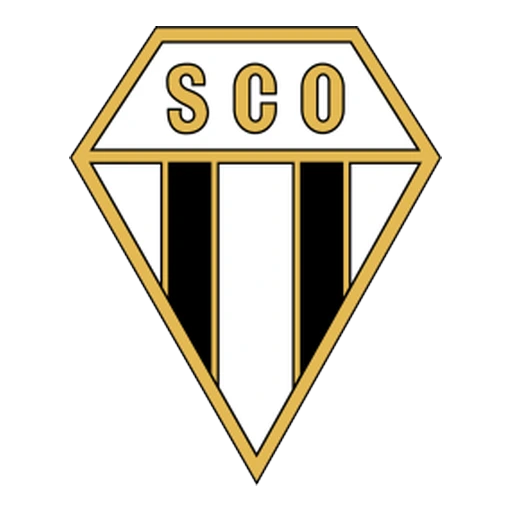
1919-1994

1994-2004
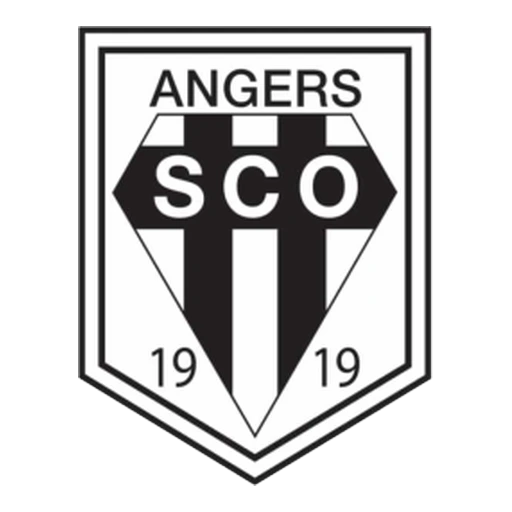
2004-2011
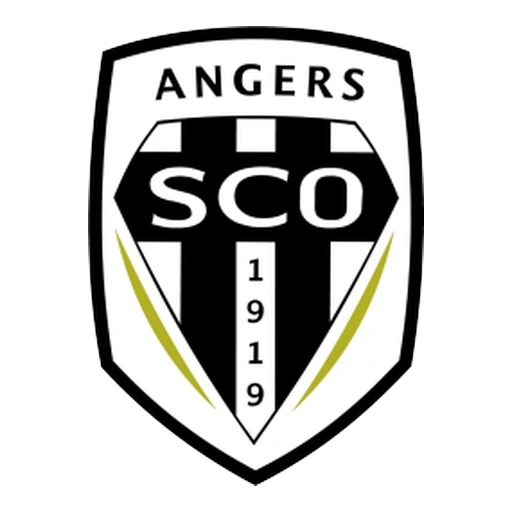
2011-2021
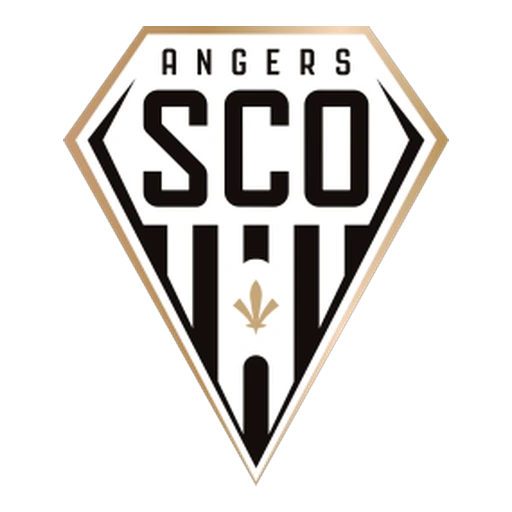
2021-Present
Angers SCO Crest History
The original crest of Angers Sporting Club de l'Ouest (Angers SCO), introduced in 1919, established the club's visual identity for most of the 20th century. The badge took the form of a gold-outlined diamond containing the initials SCO across the top and the club's famous black-and-white vertical stripes below. Inspired by the traditional colours of the city of Angers, the elegant and minimalist design became one of the most recognisable emblems in French football and remained virtually unchanged for 75 years.
In 1994, Angers SCO adopted a more modern logo to coincide with the professionalisation of the club's image. The traditional diamond disappeared in favour of a rectangular design featuring the word "Angers" above a stylised SCO set against black, white, and grey blocks. Two red vertical stripes were added to the composition, while the words "Football Professionnel" appeared beneath. Although contemporary in appearance, the logo proved unpopular with many supporters because it moved away from the club's historic identity.
The club returned to a more traditional design in 2004. The new crest restored the familiar shield and the iconic black-and-white vertical stripes, while prominently displaying Angers SCO across the top. The founding year 1919 was split on either side of the lower shield. This redesign successfully reconnected the club with its heritage while presenting a cleaner and more modern appearance.
A refined version followed in 2011 after Angers returned to greater stability. The shield became more rounded, the typography was modernised, and the founding year 1919 was placed vertically down the centre of the badge. Two subtle gold accents were added to either side of the shield, giving the crest a more dynamic look while retaining the club's traditional colours and striped identity.
In 2021, Angers SCO unveiled its current crest as part of a comprehensive rebranding. The badge returned to the classic diamond shape that had defined the club for decades, combining it with modern typography and simplified black-and-white stripes. A gold outline pays tribute to the club's historic colours, while a fleur-de-lis near the base references the city's historic coat of arms and the heritage of Anjou.
Angers SCO Club History
Founded in 1919, Angers Sporting Club de l'Ouest (Angers SCO) was established in the city of Angers, in the historic province of Anjou. The club quickly adopted its famous black-and-white colours and became one of western France's leading football institutions. After developing through the regional leagues, Angers turned professional in 1945 and soon established itself as a regular competitor in the French national championships.
The club enjoyed its first golden era during the 1950s and 1960s. Under coach Jean Snella, Angers became a respected force in the top flight, regularly finishing in the upper half of the Division 1 table. Legendary players such as Jean Deloffre, Stéphane Bruey, and Marc Berdoll helped establish SCO as one of France's most competitive provincial clubs. During this period, Angers also earned a reputation for developing talented footballers through its youth system.
Although Angers never won the French championship, the club reached the Coupe de France Final twice. The first came in 1957, when SCO finished as runners-up to Toulouse FC, and the second in 2017, when Angers narrowly lost 1–0 to Paris Saint-Germain after an unfortunate own goal in the closing minutes. The 2017 final marked the club's greatest achievement in modern times and highlighted its return among France's elite.
The following decades brought periods of instability. Financial problems and relegations saw Angers spend much of the 1980s, 1990s, and early 2000s moving between the second and third divisions. Despite these difficulties, the club maintained a strong local identity and continued to produce notable players, including Raymond Kopa, who began his football career in Angers before becoming one of France's greatest-ever footballers. In 2017, the club renamed its home ground Stade Raymond-Kopa in his honour.
A new era began under president Saïd Chabane and coach Stéphane Moulin, who led Angers back to Ligue 1 in 2015 after a 21-year absence. Moulin became the longest-serving coach in the club's history and transformed SCO into one of Ligue 1's most organised and respected teams. Angers remained in the top flight for seven consecutive seasons, regularly exceeding expectations despite operating with one of the league's smallest budgets.
Following relegation in 2023, Angers responded immediately by finishing as runners-up in Ligue 2 during the 2023–24 season, securing an instant return to Ligue 1. The club continues to build on its reputation for disciplined football, sensible financial management, and youth development while remaining one of the historic representatives of western France.
Angers SCO's principal rival is FC Nantes, with meetings often referred to as the Derby de l'Ouest (West Derby). Fixtures against Stade Lavallois, Le Mans FC, and Tours FC have also developed into significant regional rivalries over the years.
Angers SCO
Your Dynamic Snippet will be displayed here... This message is displayed because you did not provide enough options to retrieve its content.