Historical Crests De Graafschap
Name: De Graafschap
Nickname(s): Super Farmers
Founded: 1954
Stadium: De Vijverberg (Doetinchem)
Capacity: 12,600
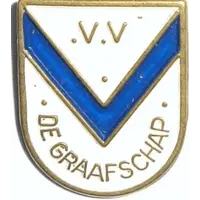
1950s
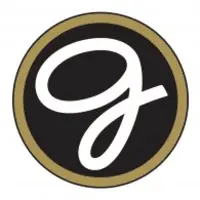
1970s

1980s
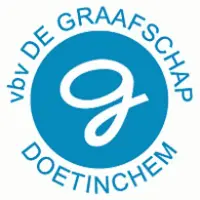
1990s
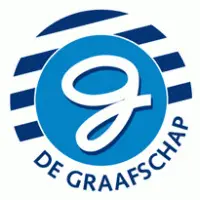
2024-Present
De Graafschap Crest History
The earliest crests used during the 1950s and 1960s were relatively simple and featured traditional football-inspired shield designs incorporating the club's name and colours. These early badges established the visual identity that would remain associated with De Graafschap for decades.
During the 1970s, as the club achieved its first promotions to the Eredivisie, a more distinctive crest emerged. The badge adopted a stronger shield format and gave greater prominence to the club's blue-and-white identity. This period marked the beginning of De Graafschap's emergence as a recognised name in Dutch professional football.
Throughout the 1980s and 1990s, the crest underwent several refinements. While maintaining the traditional colours and shield shape, the club gradually modernised its appearance. The emphasis remained on simplicity, reflecting the working-class and regional character of the club and its supporters, known as the Superboeren ("Super Farmers").
A significant redesign arrived around the turn of the century. The club introduced a more contemporary badge featuring a stylised "G" as its central element. The design incorporated sweeping blue lines and a modern shield shape, creating a cleaner and more professional identity suitable for the modern era of football branding. This crest became closely associated with De Graafschap's promotions, Eredivisie campaigns and continued status as one of the most respected provincial clubs in the Netherlands.
The modern crest retained the club's traditional blue-and-white colour scheme while simplifying many of the decorative elements found in earlier badges. The stylised "G" served both as a reference to the club's name and as a symbol of the wider Graafschap region.
In 2024, the club introduced a refined version of its logo. The redesign modernised the graphics while remaining faithful to the established identity. The familiar blue-and-white shield and stylised "G" were retained, ensuring continuity with the club's recent history while improving the badge's appearance across digital and commercial platforms.
De Graafschap Club History
Founded on 1 February 1954, De Graafschap is based in Doetinchem. The club's nickname, Superboeren ("Super Farmers"), reflects both the agricultural character of the region and the deep connection between the team and its supporters.
De Graafschap was established through the merger of local clubs VV Doetinchem and De Graafschap, creating a professional football club capable of competing in the newly developing Dutch league system.
Throughout the 1950s and 1960s, De Graafschap competed mainly in the lower divisions of Dutch football. The club steadily built its reputation as a tough and determined provincial side, known for its passionate support and strong community ties.
A major breakthrough arrived in the 1970s, when De Graafschap achieved promotion to the Eredivisie for the first time. The club established itself as a competitive presence at the highest level and became known for its ability to challenge larger and wealthier opponents despite operating with comparatively modest resources.
The 1990s represented one of the club's most successful periods. Under coach Fritz Korbach, De Graafschap secured promotion and enjoyed several consecutive seasons in the Eredivisie. The club developed a reputation for attacking football and passionate home support, making De Vijverberg one of the most intimidating venues in Dutch football.
One of the defining features of De Graafschap's history has been the extraordinary bond between the club and its supporters. The atmosphere at De Vijverberg, often referred to as "De Heksenketel" ("The Witch's Cauldron"), is regarded as one of the best in the Netherlands. Even during periods in the Eerste Divisie, the club has consistently attracted crowds that rival or exceed those of many Eredivisie teams.
Throughout the 2000s and 2010s, De Graafschap continued its familiar pattern of promotions and relegations. While sustained top-flight stability proved difficult to achieve, the club remained a respected and competitive force in Dutch football.
The club reached the KNVB Cup Final in 2015, one of the greatest achievements in its history. Although defeated by FC Groningen, the run demonstrated De Graafschap's ability to compete with some of the strongest teams in the country.
Historically, De Graafschap's fiercest rivalries are with Vitesse, Go Ahead Eagles, Heracles Almelo and FC Twente. Matches against these clubs often carry strong regional significance and generate some of the most intense atmospheres in Dutch football outside the traditional major rivalries.
De Graafschap Pins
Your Dynamic Snippet will be displayed here... This message is displayed because you did not provide enough options to retrieve its content.