Colo Colo Crest History
The crest history of Colo-Colo reflects the development of one of Chile's most important football institutions. Although the designs have changed considerably since the club's foundation in 1925, the identity has gradually become centred on the portrait of the Mapuche leader Colo Colo, from whom the club takes its name.
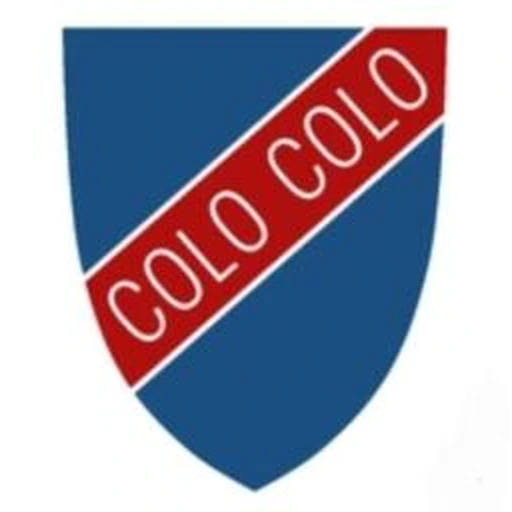
The original 1925–1947 crest was extremely simple. It consisted of a dark blue shield crossed diagonally by a red band carrying the words COLO COLO in white. There was no portrait or additional symbolism, giving the newly founded club a straightforward and easily recognisable identity.
The name itself, however, already carried considerable meaning. The club was named after Colo Colo, a Mapuche leader associated with resistance against the Spanish during the sixteenth-century Arauco War. This connection would eventually become the defining feature of the club's visual identity.
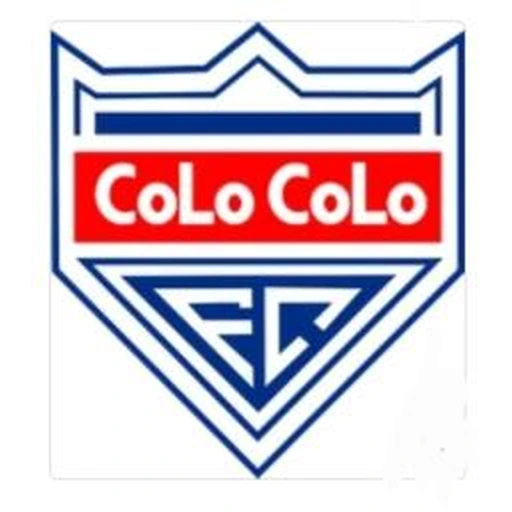
In 1947, Colo-Colo introduced a completely redesigned badge. The 1947–1951 version retained the shield format but used a much more elaborate geometric construction in blue, white and red. The club name appeared prominently inside a horizontal red rectangle, while stylised letters and angular lines filled the lower section.
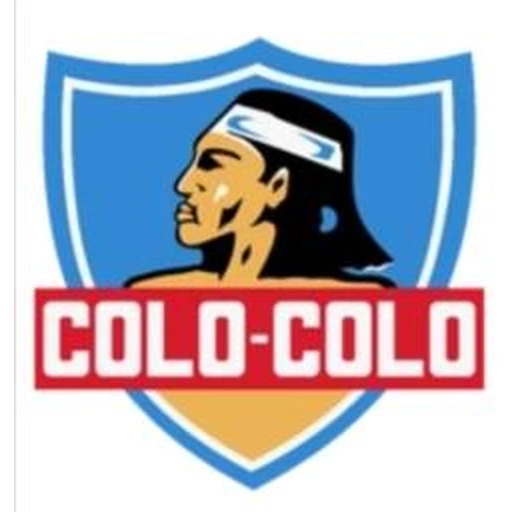
The most important transformation occurred in 1951, when the portrait of the Mapuche chief was incorporated into the crest for the first time. The 1951–1973 badge featured the profile of an Indigenous warrior with long black hair and a white headband inside a blue shield.
A red horizontal panel carrying COLO-COLO crossed the lower part of the portrait, while a gold section completed the bottom of the shield. This design established the basic visual formula that has represented the club ever since.
The portrait gave Colo-Colo one of the most distinctive identities in South American football. Rather than relying on initials or conventional football imagery, the club's badge directly represented the historical figure whose name had been chosen by its founders.
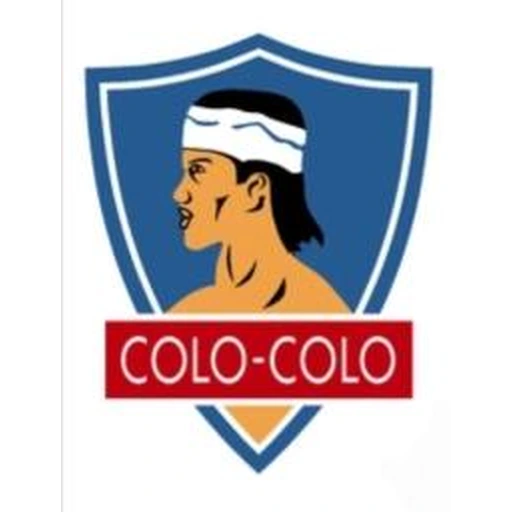
A slightly modified version appeared in 1973. The overall composition remained unchanged, but the portrait, shield and lettering were redrawn. These changes refined the appearance without altering the fundamental identity established in 1951.
The 1974–1980 crest continued this evolution. The blue shield became more clearly defined and the portrait was simplified, while the red COLO-COLO banner remained positioned across the lower part of the design.
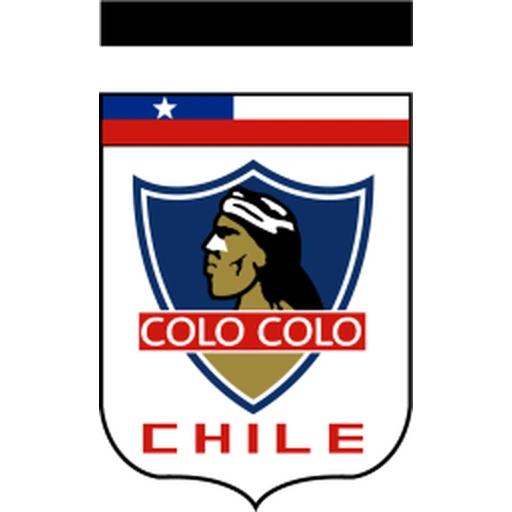
A special alternative badge also appeared in 1974. This version placed the familiar Colo-Colo shield within a larger white emblem decorated with elements of the Chilean flag, the word CHILE, and a prominent black horizontal section above it. It was an additional representation rather than a permanent replacement for the principal club crest.
In 1980, Colo-Colo introduced the design that remains the foundation of its present identity. The shield became broader and cleaner, with a dark blue field surrounded by a strong blue border.
The portrait of Colo Colo remained at the centre, now rendered in a more defined profile with black hair, a white headband and natural skin tones. The red banner carrying the club's name was enlarged and placed prominently across the lower section.
A small golden triangular section at the bottom of the shield completed the composition. The resulting badge retained all of the principal elements introduced in 1951 while making them bolder and easier to reproduce.
The club has used this basic design from 1980 to the present, with only relatively minor graphical refinements. Differences in the portrait, typography, outlines and colour shades have appeared over time, but Colo-Colo has avoided a fundamental redesign.
In 1992, a commemorative variation appeared following the club's historic triumph in the 1991 Copa Libertadores. The badge retained the familiar portrait and red name banner but was presented with a lighter background and modified colouring. Such versions have complemented rather than permanently replaced the standard crest.
Another important element associated with Colo-Colo is the black mourning band. Although it is not normally incorporated directly into the main crest, black has held a special place in the club's identity since the death of founder and captain David Arellano in 1927. Colo-Colo traditionally wears a black band above the badge on its white shirt in his memory.
Colo Colo Club History
Club Social y Deportivo Colo-Colo was founded on 19 April 1925 in Santiago by a group of players who broke away from Magallanes. The driving force behind the new club was David Arellano, who wanted to introduce more modern training methods and a more professional approach to Chilean football.
The founders chose the name Colo-Colo in honour of the famous Mapuche leader associated with resistance against the Spanish during the Arauco War. The choice gave the club a distinctly Chilean identity from its beginning and later inspired the nickname El Cacique — The Chief.
Colo-Colo quickly established itself as an important force in Chilean football. The club completed its 1925 Metropolitan League campaign undefeated, immediately demonstrating the potential of Arellano's new project.
In 1927, Colo-Colo became the first Chilean club to undertake a major tour of Europe. The journey was intended to expose the players to European football and promote Chilean football abroad, but it also produced the greatest tragedy in the club's early history.
During a match against Real Unión Deportiva in Valladolid, David Arellano suffered a severe abdominal injury following a collision. He died on 3 May 1927, aged only 24. His death profoundly shaped Colo-Colo's identity, and the club subsequently adopted a black mourning band on its shirt in permanent remembrance of its founder.
When Chile established its professional national championship in 1933, Colo-Colo was one of the eight founding members. The club therefore played a central role in the transition of Chilean football from the amateur era to organised professionalism.
Colo-Colo won its first professional Primera División championship in 1937, completing the season unbeaten. Another title followed in 1939, establishing the club as one of the dominant forces of the early professional era.
Further championships arrived during the 1940s and 1950s. The club's success helped build a national following that extended far beyond Santiago, gradually turning Colo-Colo into one of the best-supported sporting institutions in Chile.
The 1948 South American Championship of Champions, organised in Santiago with Colo-Colo as one of the driving forces, was another important moment. The international tournament brought leading South American clubs together and is regarded as an important precursor to the competition that eventually became the Copa Libertadores.
Colo-Colo continued collecting domestic championships through the following decades, but the 1973 team occupies a particularly important place in club history. Featuring players such as Carlos Caszely, Francisco Valdés and Elías Figueroa, Colo-Colo reached the final of the Copa Libertadores.
After drawing the first two final matches against Argentina's Independiente, Colo-Colo lost the deciding playoff and narrowly missed becoming the first Chilean winner of South America's principal club competition. Despite the defeat, the 1973 side became one of the most celebrated teams in Chilean football history.
A new era developed during the 1980s under coach Arturo Salah, with Colo-Colo winning several domestic trophies and strengthening its position as Chile's leading club. At the same time, construction continued on a permanent stadium that would become central to the club's identity.
The Estadio Monumental David Arellano was definitively inaugurated in 1989 in the Santiago district of Macul. Named after the club's founder, the stadium finally gave Colo-Colo a major home of its own after decades of playing many important matches at other venues.
The greatest achievement in Colo-Colo's history followed only two years later. Under Croatian coach Mirko Jozić, the club embarked on an extraordinary 1991 Copa Libertadores campaign.
Colo-Colo defeated Boca Juniors in a dramatic semi-final before meeting Paraguay's Olimpia in the final. After a goalless first leg in Asunción, Colo-Colo won the return match 3–0 at the Estadio Monumental on 5 June 1991.
The victory made Colo-Colo the first Chilean club to win the Copa Libertadores, a distinction it continues to hold. The triumph remains one of the defining moments not only in Colo-Colo's history but in Chilean club football as a whole.
The international success continued. Later in 1991, Colo-Colo contested the Intercontinental Cup against European champions Red Star Belgrade in Tokyo. Although the Chileans lost the match, their appearance confirmed their new status on the international stage.
In 1992, Colo-Colo added two more international trophies by winning the Recopa Sudamericana and the Copa Interamericana. This period established the early 1990s as the most successful international era in the club's history.
Domestically, Colo-Colo remained one of Chile's principal forces throughout the 1990s. Its rivalry with Universidad de Chile became increasingly central to the national game. Their meetings are known as the Superclásico, the country's most prominent football rivalry.
The rivalry represents more than sporting competition. Colo-Colo developed an enormous popular following across Chile, while Universidad de Chile built its own powerful identity and support base. Matches between them regularly became some of the largest and most emotionally charged events on the Chilean football calendar.
Colo-Colo also maintains important historical rivalries with Universidad Católica and Cobreloa. The latter became particularly intense as Cobreloa emerged as a major challenger to Colo-Colo's domestic dominance from the late 1970s onward.
Despite its sporting stature, the beginning of the twenty-first century brought a severe institutional crisis. Heavy debts eventually led Colo-Colo to be declared bankrupt in 2002, creating one of the most difficult periods in the club's history.
Remarkably, the team continued competing while the organisation underwent financial restructuring. Management of the professional football operation eventually passed to Blanco y Negro S.A., allowing the club to stabilise financially without losing its historical identity.
Sporting success soon returned. A talented generation emerged during the mid-2000s, including players such as Matías Fernández, Claudio Bravo, Arturo Vidal, Jorge Valdivia and Humberto Suazo, several of whom would later become major figures for the Chilean national team.
Under coach Claudio Borghi, Colo-Colo achieved an unprecedented run of four consecutive Chilean championships across the Apertura and Clausura tournaments of 2006 and 2007.
The club also reached the final of the 2006 Copa Sudamericana, where it faced Mexico's Pachuca. Colo-Colo narrowly missed adding another major continental trophy, but the campaign confirmed the strength of one of the club's finest modern generations.
Colo-Colo continued winning national championships during the following decades, further extending its position as Chile's most successful domestic league club. This record is the foundation of another famous nickname, Eterno Campeón,The Eternal Champion.
The club's enormous support is equally important to its identity. Colo-Colo is traditionally regarded as the most widely supported football club in Chile, with followers throughout the country rather than being restricted to a particular Santiago neighbourhood.
This national following has helped transform the club into a symbol of popular Chilean football culture. The white shirt, black shorts, portrait of the Mapuche chief and permanent black mourning band for David Arellano have become instantly recognisable elements of Chilean sport.