Nickname(s):La Academia(The Academy), Albicelestes(The Sky Blue and Whites
Founded:1897
Stadium:Estadio Municipal Luis Navarro Avilés
Capacity:3,500
1897-1998
2000-2006
2012-2019
2019-Present
CD Magallanes Crest History
The crest history of Club Deportivo Magallanes reflects both the club's status as one of the pioneers of Chilean football and the maritime imagery associated with its name. Founded in 1897, Magallanes is one of Chile's oldest football clubs, and its visual identity has traditionally been built around sky blue and white, together with imagery inspired by the explorer Ferdinand Magellan and his historic voyages.
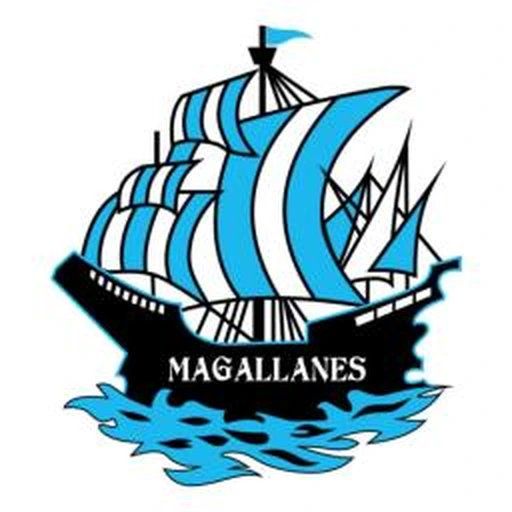
The earliest crest shown, used from 1897 to 1998, was dramatically different from a conventional football badge. Its central feature was a large sailing ship, shown moving across blue waves. The vessel's sails were coloured in alternating sky-blue and white, immediately connecting the maritime symbol with the club's traditional colours.
The name MAGALLANES appeared prominently across the dark hull of the ship. Rather than using initials or a traditional heraldic shield, the club therefore built its early identity around a direct visual reference to Magellan and maritime exploration. This distinctive ship also helped inspire the nickname Carabeleros, referring to the caravels associated with the great voyages of exploration.
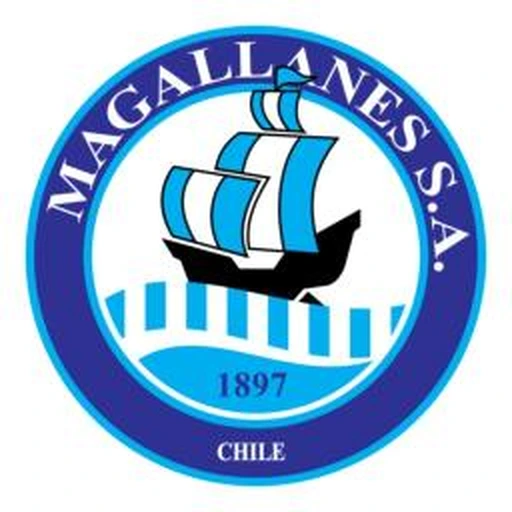
Around 2000, the club introduced a much more compact and modern identity. The 2000–2006 crest placed a simplified sailing ship inside a circular badge surrounded by a dark-blue ring. MAGALLANES S.A. appeared around the upper part of the ring, with CHILE at the bottom.
The foundation year 1897 was included beneath the ship, while vertical sky-blue and white stripes appeared in the lower part of the central field. Although the design was completely different in structure, it retained the three most important elements of the earlier identity: the ship, the club colours and the foundation year.
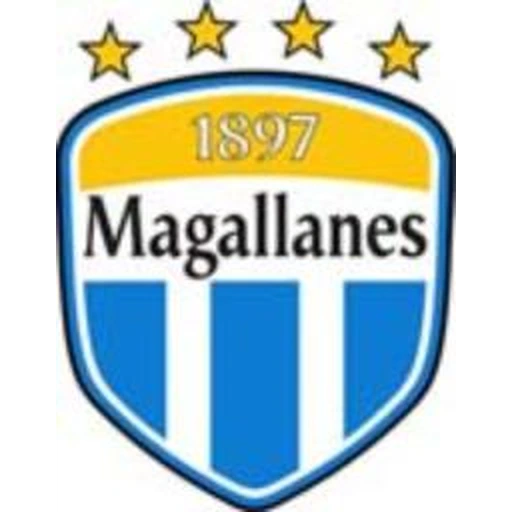
A major redesign appeared by 2012. The maritime imagery was removed entirely and Magallanes adopted a much more conventional football shield. The 2012–2019 badge featured a rounded blue-edged shield with 1897 displayed in a gold upper section and the name Magallanes prominently written across a white central band.
The lower part of the shield contained alternating sky-blue and white vertical stripes, bringing the club's traditional playing colours to the forefront of the crest. Four gold stars were positioned above the badge, representing Magallanes' four Chilean Primera División championships.
These stars commemorate an especially important part of the club's history. Magallanes won the first three professional Chilean championships in 1933, 1934 and 1935, becoming the country's first professional football dynasty, before adding a fourth league championship in 1938.
In 2019, the crest was redesigned again. The 2019–present version retained the shield concept but adopted a more angular and geometric shape. A gold panel at the top contains 1897, while a bold horizontal section immediately below displays MAGALLANES in black capital letters.
The lower part of the modern shield continues to feature the historic sky-blue and white vertical stripes, now presented in a cleaner and more symmetrical arrangement. Gold sections along the sides provide additional contrast and connect visually with the championship stars above the badge.
The four stars remain an essential part of the modern identity, preserving the memory of the club's four national championships and particularly the extraordinary three consecutive titles won during the formative years of professional football in Chile.
CD Magallanes Club History
Club Deportivo Magallanes was founded on 27 October 1897 in Santiago, originally under the name Atlético Escuela Normal. The club later adopted the name Magallanes and became one of the pioneering institutions of Chilean football. With roots extending back to the nineteenth century, La Academia occupies an important place in the development of the sport in Chile.
Magallanes became one of the country's leading clubs during the early decades of the twentieth century. Its reputation for organised and technically accomplished football helped establish the nickname La Academia — The Academy, a name that remains closely associated with the club today.
The most important period in Magallanes' history began with the introduction of professional football in Chile in 1933. Magallanes was one of the eight founding members of the new professional league and immediately established itself as its dominant force.
Magallanes won the inaugural Chilean professional championship in 1933, making the club the first professional league champion in Chilean football history. It successfully defended the title in 1934 and again in 1935, becoming the first club to win three consecutive professional Chilean championships.
This extraordinary sequence made Magallanes the dominant team of the first years of Chile's professional era. The club added a fourth Primera División championship in 1938, establishing a record of early success that is still represented by the four stars above its modern crest.
Magallanes also played a central role in the development of one of Chilean football's most famous rivalries. During the 1920s, disagreements within the club led a group of players to leave Magallanes and establish Colo-Colo in 1925. The resulting rivalry became known as the Clásico de la Chilenidad, one of the oldest traditional rivalries in Chilean football.
For a period, meetings between Magallanes and Colo-Colo were among the country's most important football matches. The rivalry represented not only competition between two successful clubs but also the historical connection created by Colo-Colo's origins in a split from Magallanes.
After its championship-winning era, Magallanes gradually lost its position among Chile's dominant clubs. The growth of Colo-Colo, Universidad de Chile and Universidad Católica changed the balance of national football, while Magallanes increasingly struggled to reproduce the achievements of the 1930s.
The club nevertheless remained an important member of Chilean professional football for much of the twentieth century. Its distinctive sky-blue and white colours became firmly established, while the historic sailing-ship imagery associated with the name Magallanes contributed to the nickname Carabeleros.
By the second half of the twentieth century, Magallanes increasingly moved between the country's different professional divisions. Financial difficulties and sporting instability eventually took the club far from the Primera División, and it spent many years competing outside the national spotlight.
One of the lowest points came when Magallanes dropped into the third tier of Chilean football. For a club that had won the country's first professional championship and dominated the beginnings of the national league, the decline demonstrated how dramatically its position within Chilean football had changed.
A gradual recovery began during the twenty-first century. Magallanes returned to the Primera B and started rebuilding its sporting structure, although promotion back to the top division remained elusive for many years.
The breakthrough finally arrived in 2022, one of the most remarkable seasons in the club's modern history. Magallanes won the Primera B championship, securing promotion to the Primera División and ending a 36-year absence from Chile's top flight.
The same year brought an even greater achievement. Magallanes reached the final of the Copa Chile, defeating Unión Española to win the competition for the first time. The victory gave the historic club a major national trophy more than eight decades after its great championship era.
Magallanes continued its revival at the beginning of 2023 by defeating Colo-Colo in the Supercopa de Chile. Winning a national trophy against the club created from the famous 1925 split added particular historical significance to the achievement.
Success in the Copa Chile also returned Magallanes to international competition. In 2023, the club participated in the Copa Libertadores qualifying rounds and subsequently the Copa Sudamericana, marking a rare return to the continental stage for one of Chilean football's oldest institutions.
The return to the Primera División proved difficult, however. Magallanes was relegated at the end of the 2023 season, returning to Primera B after only one campaign in the top flight. Even so, the sequence of promotion, Copa Chile victory, Supercopa triumph and continental football represented an extraordinary revival.