Historical Crests Calcio Padova
Name: Calcio Padova
Nickname(s): I Biancoscudati (The White-Shielded)
Founded: 1910
Stadium: Stadio Euganeo (Padova)
Capacity: 34,420
Calcio Padova Crest History
Padova's badge has always revolved around a single emblem: the white shield with a red cross. This symbol is so closely associated with the club that it gave rise to one of Italian football's most distinctive nicknames, I Biancoscudati ("The White-Shielded").
The origins of the crest lie in the history of the city of Padua itself. The red cross on a white field is derived from the city's historic coat of arms and has been a symbol of Padua for centuries.
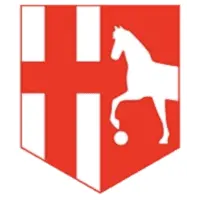
By the 1990s, Padova adopted a crest that modernised the traditional design while preserving its historic symbolism. The badge prominently featured the famous white shield and red cross. The right side of the 1990s badge did not simply feature a generic horse. It depicted the famous Gattamelata monument, one of the most celebrated landmarks in Padua. The statue, created by the Renaissance sculptor Donatello, stands in Piazza del Santo and portrays the Venetian military commander Erasmo da Narni, better known as Gattamelata, mounted on horseback
A significant redesign arrived in 2011, coinciding with the club's centenary celebrations. The new crest featured a more modern interpretation of the traditional shield, with cleaner lines and updated graphics intended to reflect the club's ambitions in contemporary football. Although the white shield and red cross remained central, the overall appearance was more streamlined and modern than previous versions. The redesign generated considerable discussion among supporters, many of whom remained deeply attached to the historic simplicity of the classic Biancoscudati emblem.
The club's financial collapse in 2014 and subsequent rebirth created another important chapter in its visual history. Following the establishment of a successor organisation and the eventual recovery of the historic club identity, Padova sought to reconnect more closely with its traditions.
This process culminated in the introduction of a new crest in 2016. The redesign represented a return to the club's historic roots and placed greater emphasis on the iconic white shield and red cross. The badge adopted a cleaner and more elegant appearance, reducing unnecessary graphic elements while restoring the prominence of the symbol most closely associated with Padova's identity. The result was a crest that balanced modern branding requirements with the traditions cherished by supporters.
Calcio Padova Club History
Founded on 29 January 1910 in the city of Padua, the club has spent more than a century representing one of Italy's most historic and culturally significant cities.
Padova first enjoyed success in the early decades of Italian football, but the club's greatest era arrived during the 1950s under the leadership of legendary coach Nereo Rocco. Widely regarded as one of the most influential managers in football history, Rocco transformed Padova into one of the strongest provincial clubs in Italy.
The pinnacle of this period came during the 1957–58 season when Padova achieved a remarkable third-place finish in Serie A, the highest league position in the club's history.
One of the highlights of the post-war era came in 1967 when Padova reached the Coppa Italia Final. Although the club narrowly missed out on lifting the trophy, the run remains one of the most memorable cup campaigns in its history and demonstrated Padova's ability to compete with the country's elite sides.
A major revival arrived in the early 1990s. After decades away from Serie A, Padova secured promotion to the top division in 1994, ending a thirty-two-year absence. The achievement was celebrated throughout the city and marked one of the most important moments in modern club history.
Padova successfully survived its first season back in Serie A, however, relegation followed in 1996, bringing an end to the Biancoscudati's brief return to the top flight.
The early twenty-first century proved challenging. Financial pressures eventually culminated in a major crisis in 2014 when the club was declared bankrupt, bringing an end to the original corporate entity after more than a century of existence.
Football in Padua survived through the creation of a successor organisation known as Biancoscudati Padova. The new club immediately embraced the traditions, colours and identity of the historic Padova and quickly achieved promotion from Serie D. In 2015, the organisation successfully recovered the historic name Calcio Padova, restoring continuity with the club founded in 1910.
Padova currently plays its home matches at the Stadio Euganeo, although many supporters still retain a strong emotional attachment to the historic Appiani Stadium, where some of the club's greatest achievements were celebrated.
The club's fiercest rivalry is with LR Vicenza. Matches between the two sides are known as the Derby del Veneto and rank among the most passionate rivalries in northern Italy. Other important rivalries exist with Hellas Verona FC and Venezia FC.
Padova Pins
Your Dynamic Snippet will be displayed here... This message is displayed because you did not provide enough options to retrieve its content.