Skip to Content

Historical Crests Brighton & Hove Albion FC

Name: ​Brighton & Hove Albion FC
Nickname(s): ​The Seagulls
Founded: ​1901
Stadium: ​Amex Stadium (Brighton)
Capacity: ​30,750


Brighton & Hove Albion FC Crest History
Founded in 1901, Brighton & Hove Albion Football Club has used several different badges throughout its history, but no symbol has become more closely associated with the club than the seagull. Today, the seagull is the defining feature of Brighton’s identity and reflects both the club’s coastal location and the nickname that has become synonymous with the Seagulls.
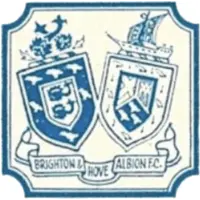
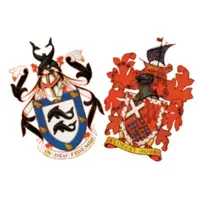
During the club’s early decades, Brighton did not have a consistent crest displayed on its playing shirts. Like many English clubs of the period, the team often played without a formal embroidered badge, occasionally using civic heraldry associated with the towns of Brighton and Hove. These early designs incorporated elements from the local coats of arms, including martlets, ships and other traditional Sussex symbols that reflected the club’s strong connection to the local community.
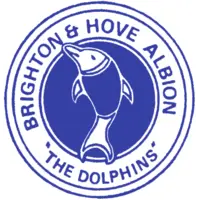
A more distinctive visual identity emerged during the 1970s when Brighton adopted a dolphin-themed badge. The dolphin was chosen to represent the club’s seaside location and was accompanied by the nickname “The Dolphins.” Although the design was unique, it never fully resonated with supporters and remained in use for only a short period.
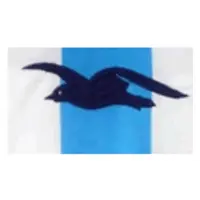
The turning point in Brighton’s badge history came through the club’s rivalry with Crystal Palace. During matches between the two clubs in the mid-1970s, Palace supporters regularly chanted “Eagles” in reference to their nickname. Brighton fans responded with chants of “Seagulls,” and the nickname quickly gained popularity among the club’s supporters. The seagull soon replaced the dolphin as Brighton’s preferred symbol and became an official part of the club’s identity.
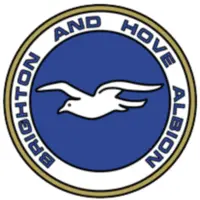
In 1977, Brighton introduced a new circular crest featuring a flying white seagull against a blue background. This badge became one of the most iconic in the club’s history and was worn during some of Brighton’s most memorable moments, including promotion to the First Division in 1979 and the club’s run to the 1983 FA Cup Final. For many supporters, this remains the classic Brighton badge and represents the club’s rise to national prominence.
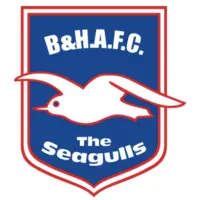
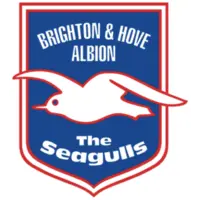
Following the financial difficulties and uncertainty of the 1990s, Brighton introduced a redesigned crest in 1998. The new badge adopted a shield-shaped format and featured a larger, more detailed seagull. The redesign symbolised a new era for the club as it rebuilt its fortunes and worked towards securing a permanent home following the loss of the Goldstone Ground.
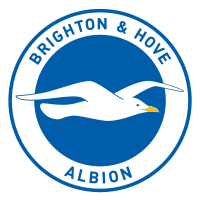
A further transformation came in 2011 when Brighton moved into the American Express Stadium. To mark the beginning of a new chapter, the club unveiled its current crest. The design returned to a simple circular format inspired by the popular 1977 badge, featuring a bold white seagull set against a blue background with the club name surrounding the outer ring. The modernised design was intended to combine tradition with a cleaner and more contemporary visual identity.


Brighton & Hove Albion FC Club History
Brighton & Hove Albion Football Club was founded in 1901 and quickly established itself as a competitive side in the Southern League. One of the club’s earliest achievements came in 1910 when Brighton defeated Aston Villa to win the FA Charity Shield. In 1920, the club became a founder member of the Football League Third Division, beginning its long association with the English league system.
For much of the twentieth century, Brighton competed in the lower divisions while playing at the Goldstone Ground, their home from 1902 until 1997. The club’s first major success came under manager Alan Mullery, who guided Brighton to promotion to the First Division in 1979. Four years later, the Seagulls reached the 1983 FA Cup Final, narrowly missing out on one of the greatest upsets in English football history against Manchester United.
The club entered a period of decline during the late 1980s and 1990s, culminating in severe financial difficulties and the sale of the Goldstone Ground in 1997. Brighton came close to losing its Football League status in the 1996–97 season but survived after a dramatic final-day draw against Hereford United, a match widely regarded as one of the most important in the club’s history.
After temporary spells at Priestfield Stadium and the Withdean Stadium, Brighton secured a permanent home with the opening of the American Express Stadium in 2011. The move marked the beginning of a new era and helped fuel the club’s rapid rise through the divisions.
In 2017, Brighton secured promotion to the Premier League for the first time since 1983. Under managers including Chris Hughton, Graham Potter and Roberto De Zerbi, the club established itself as one of England’s most progressive teams. Brighton reached another historic milestone in 2023 by qualifying for European competition for the first time through the UEFA Europa League.
Brighton’s principal rivalry is with Crystal Palace, a fixture known as the M23 Derby. 


Brighton & Hove Albion FC pin

Your Dynamic Snippet will be displayed here... This message is displayed because you did not provide enough options to retrieve its content.