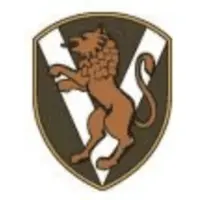
During the club's early decades, Brescia used relatively simple monograms and shield-based emblems typical of Italian football at the time.
The city of Brescia is famously known as Leonessa d'Italia ("The Lioness of Italy"), a title earned after the heroic popular uprising against Austrian rule during the Ten Days of Brescia in the spring of 1849. Although the nickname refers to a lioness, the animal traditionally depicted in both civic and football symbolism has generally been represented as a lion. This historical connection eventually became the foundation of Brescia Calcio's visual identity.
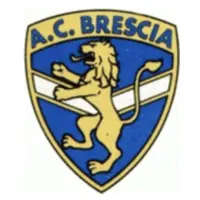
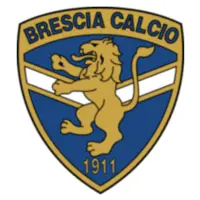
A major milestone arrived in 1965, when Brescia introduced its first official crest following promotion to Serie A. The badge featured a blue shield displaying a golden rampant lion, the heraldic symbol associated with the city of Brescia, positioned above a white inverted chevron. The lion celebrated the city's historic title as the Lioness of Italy, while the white chevron echoed the famous white "V" that had long appeared on the club's shirts. This design established the foundation for virtually every Brescia crest that followed and marked the beginning of the club's modern visual identity.
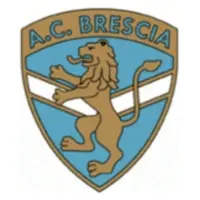
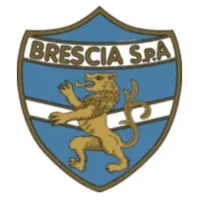
During the 1970s, the badge underwent several refinements. The shield became more elongated, the lion was redrawn with greater detail, and a curved banner carrying the club's name was added. Later in the decade, Brescia adopted a more modern shield shape while retaining the lion and chevron motif. These updates reflected changing graphic trends while preserving the symbols that supporters had already embraced.
The lion became increasingly prominent during the 1980s as the crest appeared more regularly on shirts and club branding. A blue shield outlined in gold featuring the lion at its centre became strongly associated with the club and helped establish the animal as Brescia's defining symbol. The combination of blue and gold created an elegant appearance while maintaining a strong civic character.
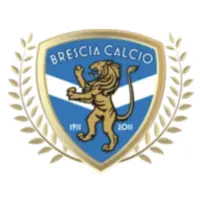
A major redesign was introduced in 2011 to celebrate Brescia Calcio's centenary. Marking one hundred years since the club's foundation, the new crest retained the traditional lion while significantly modernising the overall design. The badge adopted a more refined appearance, with a thick golden shield profile and laurel branches surrounding the emblem. These additions were intended as a celebration of the club's hundred-year history.
The typography was also redesigned. Earlier lettering was replaced with a font inspired by the era in which Brescia Calcio was founded, strengthening the connection to the club's origins. The centenary redesign sought to honour tradition while updating the badge for modern football.
Perhaps the most significant aspect of the 2011 redesign was the complete reworking of the lion itself. Club designers sought to correct what they viewed as inaccuracies in previous versions of the animal. The new lion featured visible claws, stronger musculature and a more dynamic tail. The intention was to create a fiercer and more powerful figure, one better suited to representing both the football club and the proud history of Brescia.
A further evolution arrived in 2017 following a change in ownership and the club's rebranding as Brescia Calcio Football Club (BSFC). Because the previous crest was legally tied to the Corioni family's ownership of the club, Brescia introduced a completely new logo while preserving its historic symbolism. The redesigned badge abandoned the traditional shield format in favour of a modern, minimalist emblem centred on a stylised white lion's head. The lion was merged with the club's iconic inverted white chevron, creating a single graphic symbol that combined Brescia's civic identity with one of the most recognisable elements of its playing kit. Above the design appeared the initials BSFC, standing for Brescia Football Club. While significantly more contemporary than previous crests, the logo retained a clear connection to the city's historic lion and the club's traditional blue-and-white colours
Brescia Calcio Club History
Brescia Calcio was founded in 1911.The club quickly established itself within the national football system and became one of the founding participants of Serie A when the modern championship was introduced in 1929.
Brescia's traditional colours are blue and white, earning the team the nicknameI Biancazzurri ("The White and Blues"). The club also became famous for the distinctive white "V" displayed on its shirts, a symbol that remains one of the most recognisable elements of its identity.
One of the most significant achievements in the club's history came in 1994 when Brescia won the Anglo-Italian Cup. The triumph represented an important international success and highlighted the club's growing stature during the 1990s.
The most celebrated period in Brescia's modern history began at the turn of the twenty-first century. In 2000, the club signed legendary Italian footballer Roberto Baggio, bringing one of the greatest players of his generation to Brescia. Baggio spent the final years of his career at the club and helped guide the team through one of the most successful eras in its history.
During this period, Brescia became known for attracting and developing exceptional talent. Future stars such as Andrea Pirlo, Luca Toni and Pep Guardiola all spent important stages of their careers with the club.
Following Baggio's retirement in 2004, Brescia faced a more challenging period. The club experienced multiple promotions and relegations as it sought to re-establish itself permanently in Serie A.
The club played its home matches at the Stadio Mario Rigamonti, a stadium named in honour of the Brescia-born footballer who tragically lost his life in the 1949 Superga air disaster. The ground became a symbol of the club's traditions and hosted countless memorable moments throughout its history.
Brescia's fiercest rivalry is with Atalanta BC. Matches between the two sides are known as the Derby Lombardoand are rooted in a rivalry between the neighbouring cities of Brescia and Bergamo that stretches back to the Middle Ages. Encounters between the clubs are among the most passionate in northern Italy and represent one of Lombardy's most important football rivalries. Other notable rivalries exist with Hellas Verona FC and US Cremonese.
A dramatic chapter unfolded in 2025 when severe financial difficulties brought an end to the original Brescia Calcio organisation. After more than a century of competition, the club was excluded from professional football due to administrative and financial issues, effectively ending the existence of the institution founded in 1911. The collapse shocked Italian football and left one of the country's oldest clubs without a place in the professional pyramid.
However, football in Brescia did not disappear. Shortly after the collapse, Union Brescia was established to ensure that the city retained a professional football club. The new organisation emerged through the relocation and rebranding of Feralpisalò, a club from nearby Salò, under the leadership of businessman Giuseppe Pasini. Union Brescia adopted the traditional blue-and-white colours, moved into the Stadio Mario Rigamonti and embraced many of the symbols and traditions historically associated with Brescia football.
While Union Brescia is not legally the same entity as Brescia Calcio, many supporters view it as the spiritual continuation of the city's footballing heritage. The club has openly embraced the responsibility of carrying forward Brescia's traditions and has expressed the ambition of eventually recovering the historic name, honours and symbols associated with the club founded in 1911. As a result, Union Brescia represents both a new beginning and a bridge between Brescia's past and future.