Nickname(s):Verdão (The Big Green), Porco (The Pig)
Founded:1914
Stadium:Allianz Parque
Capacity:43,713
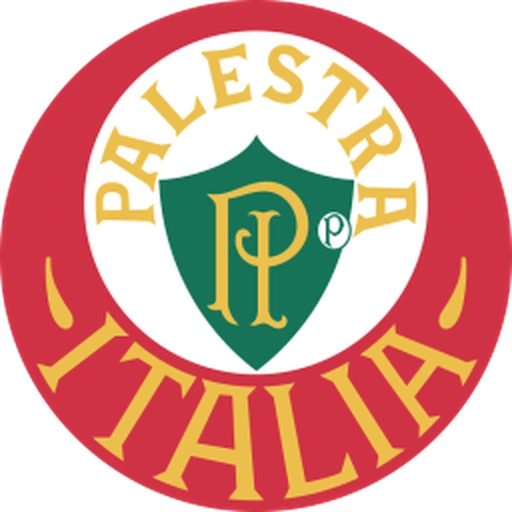
1914-1916
1916-1917
1917-1918
1918-1938
1938-1940
1940-1942
1942-1951
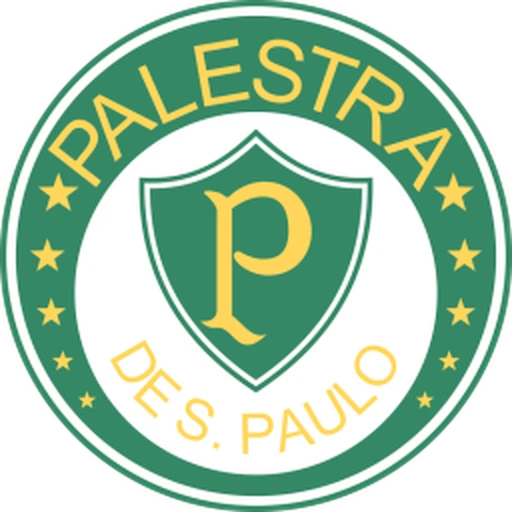
1942
1951-1959
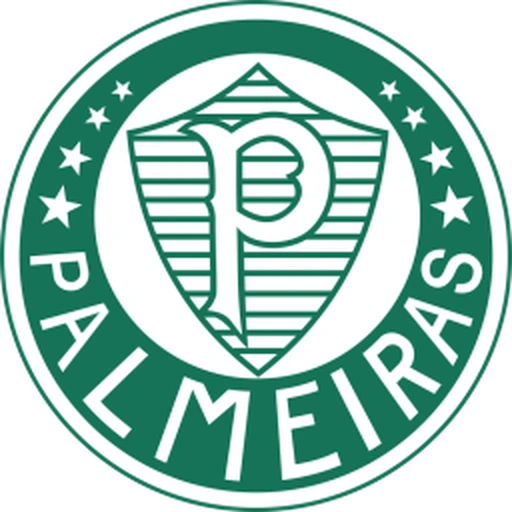
1959-1969
1969-1973
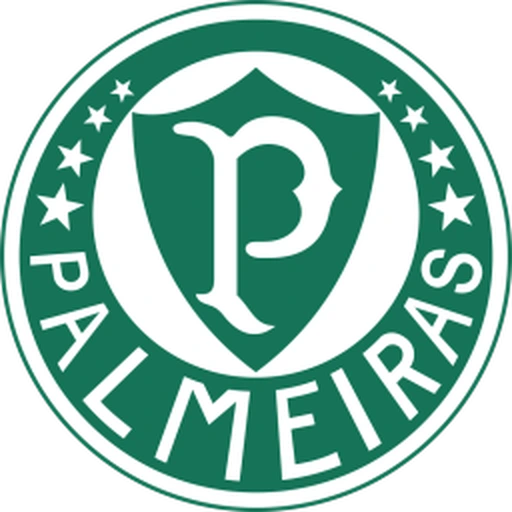
1973-1989
1989-1993
1993-1998
1999-2012
2012-2018
2018-Present
SC Palmeiras Crest History
The crest history of Sociedade Esportiva Palmeiras reflects one of the most important transformations in Brazilian football: the club's evolution from the Italian-rooted Palestra Italia into Palmeiras. Throughout this history, the letter P, the colour green and circular forms have provided continuity, while the change of name in 1942 created a decisive break with the club's original identity.
The original 1914–1916 crest strongly expressed the club's Italian heritage. A large red circular badge contained the words PALESTRA ITALIA in gold, surrounding a white central field with a green shield. Inside it appeared an elaborate gold monogram based around the letter P, accompanied by smaller lettering. The use of red, white and green directly reflected the colours of Italy.
Between 1916 and 1917, Palestra Italia adopted a radically simpler badge. The elaborate lettering disappeared and was replaced by a white cross on a red shield, again making direct use of colours strongly associated with the club's Italian origins.
The 1917–1918 crest introduced a symbol that would become fundamental to the club's later identity. A dark green shield contained a large stylised white P, establishing both the letter and the green colour as central elements of the club's visual language.
From 1918 to 1938, the shield was replaced by a circular design. The badge featured intertwined green and red letters, principally forming the Palestra monogram, on a white background surrounded by a thin green circle. The combination retained the Italian tricolour while moving toward a much cleaner identity.
Between 1938 and 1940, the colours were reversed. The circular field became solid green and the monogram appeared predominantly in white with a red element incorporated into the lettering. This gave the badge a stronger and more recognisably green appearance.
The 1940–1942 crest simplified the concept further. A large red P appeared against a dark green circular field. It was one of the last badges used under the Palestra Italia name before political circumstances forced the club to abandon its Italian identity.
In 1942, Brazil's entry into the Second World War led to pressure on institutions associated with the Axis powers. Palestra Italia changed its name to Sociedade Esportiva Palmeiras, and the club's visual identity changed with it. The 1942–1951 crest retained the circular format but now consisted simply of a large white P on a green field. The red associated with the Italian tricolour disappeared from the principal badge.
A special 1942 design explicitly marked the new identity. It combined the historic Palestra-style shield and letter P with the words PALESTRA and DE S. PAULO around the surrounding circular band. This transitional design visually connected the club's Palestra origins with the new Palmeiras era.
From 1951 to 1959, Palmeiras used another extremely simple circular emblem. A large white P occupied a green central field surrounded by white and green rings. Although minimalist, it preserved the symbol that linked the new Palmeiras identity with the club's Palestra past.
A major step toward the modern crest came in 1959. The 1959–1969 badge introduced a more elaborate circular composition with the name PALMEIRAS around the lower part of the outer ring. The central shield contained the traditional P, while decorative elements around it created the basic structure from which the modern badge would develop.
Between 1969 and 1973, the centre of the crest was redesigned with a more geometric shield and striped detailing behind the letter P. The outer circle retained the Palmeiras name and the surrounding stars, strengthening the badge's connection with the successful club of the Academia era.
The 1973–1989 crest simplified the central design once more. The shield became darker and cleaner, with a prominent white P, while the circular outer structure and PALMEIRAS lettering remained. By this stage, the fundamental components of the modern crest were firmly established.
From 1989 to 1993, the crest was accompanied by a series of stars above it. A prominent red central star, flanked by lighter stars, reflected the practice of displaying important sporting achievements around the badge rather than altering its established structure.
The 1993–1998 version removed the external stars and presented the Palmeiras crest in a cleaner form. The central shield, surrounding stars and large PALMEIRAS lettering were retained, producing a design very close to the badge recognised today.
Between 1999 and 2012, four gold stars were displayed above the crest. The underlying badge remained largely unchanged, demonstrating how stable Palmeiras' visual identity had become by the end of the twentieth century.
The 2012–2018 crest removed the external stars again and refined the artwork. Darker green, cleaner outlines and more consistent typography gave the historic circular badge a more modern appearance without fundamentally changing its composition.
Since 2018, Palmeiras has generally used the familiar circular crest accompanied by a single red star above it. The star commemorates the club's victory in the 1951 Copa Rio, a tournament that occupies an important place in Palmeiras' international history.
SC Palmeiras Club History
Sociedade Esportiva Palmeiras was founded on 26 August 1914 in São Paulo as Palestra Italia, created primarily by members of the city's large Italian immigrant community. The new club quickly became an important sporting institution for Italian Brazilians, adopting colours inspired by Italy and establishing a football identity that would eventually develop into one of the most successful in South America.
Palestra Italia played its first official matches in 1915 and rapidly became competitive in São Paulo football. Its first major breakthrough came in 1920, when the club won the Campeonato Paulista for the first time. Further state championships followed, establishing Palestra among the major forces of the increasingly powerful São Paulo football scene.
The club's rivalry with Corinthians became central to its identity. Known as the Derby Paulista, the rivalry developed during the early decades of the twentieth century and became one of Brazil's fiercest football contests. Palmeiras and Corinthians came to represent two enormous communities of supporters in São Paulo, and their meetings regularly became defining matches in state and national competitions.
A decisive moment arrived in 1942, after Brazil entered the Second World War against the Axis powers. Organisations associated with Italy faced increasing political pressure, forcing Palestra Italia to change its name. After briefly becoming Palestra de São Paulo, the club adopted the name Sociedade Esportiva Palmeiras.
The transformation was immortalised by the Arrancada Heroica (Heroic Advance). In September 1942, Palmeiras entered the decisive Campeonato Paulista match against São Paulo carrying the Brazilian flag and playing under its new name. Palmeiras led 3–1 when São Paulo abandoned the match, securing the state championship. The episode became one of the defining stories of Palmeiras' identity and symbolised the transition from Palestra Italia to Palmeiras.
Palmeiras achieved an important international triumph in 1951, when São Paulo and Rio de Janeiro hosted the Copa Rio. Palmeiras defeated Juventus of Italy in the decisive stage at the Maracanã. The competition was one of the most significant international club tournaments of its era and occupies a particularly important place in Palmeiras history.
The 1960s and 1970s produced one of the greatest periods in the club's history. Palmeiras assembled technically gifted teams collectively remembered as the Academia de Futebol (Football Academy). During an era dominated internationally by Pelé's Santos, Palmeiras became one of the few Brazilian clubs capable of consistently challenging them.
The first Academia generation featured players such as Djalma Santos, Julinho Botelho, Dudu and Ademir da Guia. Palmeiras won major national competitions during the 1960s, including the Taça Brasil in 1960 and 1967 and the Torneio Roberto Gomes Pedrosa in 1967 and 1969.
A second great Academia side emerged in the early 1970s, again built around the legendary Ademir da Guia. Palmeiras won consecutive Campeonato Brasileiro titles in 1972 and 1973, confirming its position among the dominant clubs of the period. Ademir da Guia became one of the greatest symbols in club history and remains closely associated with the elegance and technical quality of the Academia era.
After this golden period, Palmeiras experienced a long decline in major honours. The drought became particularly painful as rivals continued to win trophies, and the club went more than 16 years without a major title. That difficult period finally ended in spectacular fashion in 1993.
Backed by a successful partnership with Italian company Parmalat, Palmeiras assembled an outstanding generation featuring players such as Evair, Edmundo, César Sampaio, Zinho and Roberto Carlos. In the 1993 Campeonato Paulista final, Palmeiras defeated Corinthians and ended the long trophy drought. The victory remains one of the most emotional championships in the club's history.
The 1990s brought sustained success. Palmeiras won the Campeonato Brasileiro in 1993 and 1994, additional state championships and the Copa do Brasil in 1998. The decade culminated in the club's greatest South American achievement to that point.
In 1999, Palmeiras won the Copa Libertadores for the first time. Coached by Luiz Felipe Scolari and featuring players including Marcos, César Sampaio, Alex and Evair, Palmeiras defeated Deportivo Cali in the final after a penalty shoot-out. Goalkeeper Marcos became one of the defining figures of the campaign and later one of the greatest idols in club history.
The following decade brought dramatic changes. Palmeiras suffered relegation from Série A in 2002, but immediately won Série B in 2003 and returned to the top division. Another relegation followed in 2012, despite Palmeiras having won the Copa do Brasil earlier that same year. Once again, the club responded by winning Série B and returning immediately to Série A.
The opening of Allianz Parque in 2014 marked the beginning of a new era. Built on the site of the historic Palestra Itália stadium, the modern arena significantly strengthened the club commercially while retaining a direct connection with its historic home.
Palmeiras soon returned to the top of Brazilian football. The club won the Copa do Brasil in 2015 and captured the Campeonato Brasileiro in 2016, its first national league championship in more than two decades. Another Brazilian title followed in 2018.
The arrival of Portuguese coach Abel Ferreira in 2020 began one of the most successful periods in Palmeiras history. Palmeiras won the 2020 Copa Libertadores, defeating fellow Brazilian club Santos 1–0 in the final at the Maracanã through a late goal from Breno Lopes.
Palmeiras then successfully defended its South American crown in the 2021 Copa Libertadores. Facing Flamengo in Montevideo, Palmeiras won 2–1 after extra time, with Deyverson scoring the decisive goal. The victory gave Palmeiras its third Libertadores title and confirmed the club as one of the dominant South American teams of the era.
Success continued domestically. Palmeiras won the Campeonato Brasileiro in both 2022 and 2023, while also collecting further Campeonato Paulista and Supercopa honours. This sustained success transformed the Abel Ferreira era into another historic cycle comparable, in terms of trophies and dominance, with the great Academia teams of earlier decades.
Beyond Corinthians, Palmeiras has major rivalries with São Paulo FC and Santos FC, completing the traditional group of São Paulo's four major clubs. The meeting with São Paulo is known as the Choque-Rei, while matches against Santos are traditionally called the Clássico da Saudade. Nevertheless, the Derby Paulista against Corinthians remains the club's most intense and culturally significant rivalry.