Nickname(s):La Academia Cruceña(The Santa Cruz Academy),Los Celestes(The Sky Blues)
Founded:1946
Stadium:Estadio Ramón Tahuichi Aguilera
Capacity:38,000
1946
1951
1956
1980
1984-1996
1997
1998
1999-2001
2003-2006
2007-2010
2010-2016
2017-2019
2020-Present
Club Blooming Crest History
The crest history of Club Blooming shows a highly distinctive identity built around sky blue, a football placed over a red cross-like symbol and a royal crown. Although the club experimented with several very different designs during its early decades, these elements gradually came together and have defined Blooming's identity since the 1980s.
The earliest emblem shown, dating from 1946, was very different from the modern crest. It consisted of a traditional black-and-white football positioned over a red cross-shaped symbol, with the name “Blooming” written underneath. Despite its simplicity, this first emblem introduced the football-and-cross motif that would eventually become the centrepiece of the club's modern badge.
In 1951, Blooming adopted a much more elaborate shield. A royal crown appeared above the badge for the first time, while the name BLOOMING occupied the upper section. The shield contained several separate panels incorporating the red cross, a rising sun and a football, with Santa Cruz written underneath. This design introduced the crown that would later become another permanent element of Blooming's identity.
A radical departure followed in 1956. The club used a large sky-blue shield featuring the words “Blooming Transportista” above a winged tyre. The inscription Club Social Deportivo appeared below. This unusual emblem reflected a particular period in the club's development but shared little visually with either its original or modern identity.
By 1980, Blooming had begun bringing its historic symbols together. A circular badge contained a smaller sky-blue shield featuring the football and red cross, while a crown appeared immediately above it. The word BLOOMING curved around the upper part of the outer circle. This represented an important transitional step toward the modern crest.
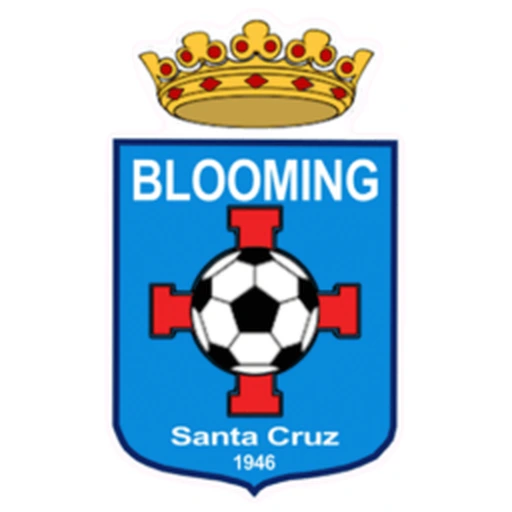
The 1984–1996 design established the basic structure that continues today. A rectangular shield with a rounded lower section was coloured sky blue and topped by a golden crown. The name BLOOMING appeared across the top, while the central football was placed over the familiar red cross. The year 1946 and the words SANTA CRUZ completed the design.
In 1997, the crest was simplified slightly. The overall structure remained almost identical, but the shield became lighter in colour and some of the lettering was removed from the lower section. The crown, football, red symbol and Blooming name remained dominant.
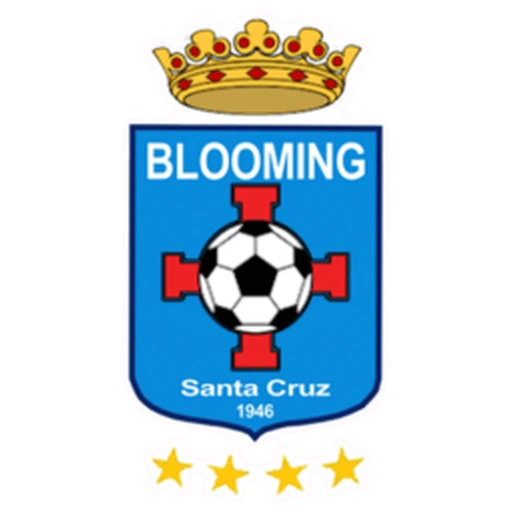
The 1998 version retained the same composition but used darker and more muted colouring. It appears as a comparatively detailed interpretation of the badge, with Santa Cruz and 1946 again incorporated beneath the central symbol.
Between 1999 and 2001, Blooming returned to a cleaner version of the established crest. The white shield contained a large sky-blue central area, while the crown sat prominently above it. The football and red cross remained at the centre, with Santa Cruz 1946 positioned underneath.
The 2003–2006 crest strengthened the use of Blooming's characteristic sky blue. Much more of the shield was filled with blue, while the outer border and lettering became cleaner and more modern. By this point, the fundamental identity of the badge had become firmly established.
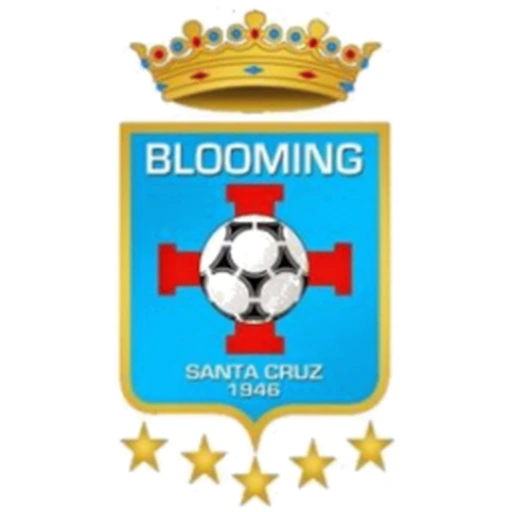
Between 2007 and 2010, the crest was refined again and five gold stars were introduced beneath the shield. These represented Blooming's five Bolivian top-flight championships, turning the club's sporting achievements into a permanent part of its visual identity.
The 2010–2016 version introduced a prominent gold border around the sky-blue shield. The crown was redesigned with more decorative detailing, while the five championship stars remained underneath.
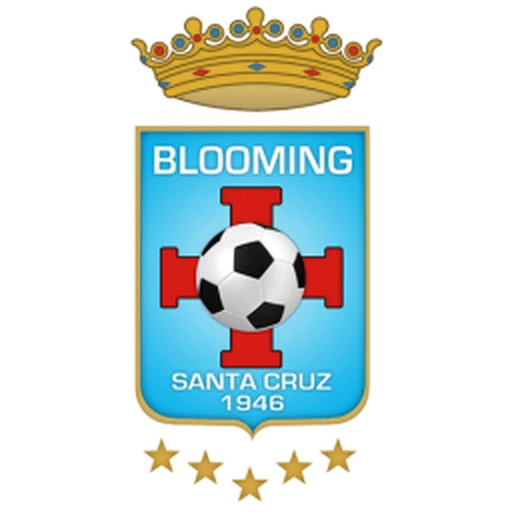
Between 2017 and 2019, the same fundamental design continued. The football was given a more three-dimensional appearance and minor adjustments were made to the crown, lettering and proportions. The five stars continued to appear beneath the crest.
The 2020–Present crest preserves virtually all of the elements that have come to define Blooming. A bright sky-blue shield with a gold outline carries the name BLOOMING, the traditional football and red cross motif, and the inscription SANTA CRUZ 1946. A detailed royal crown sits above the shield, while five gold stars are displayed below.
The modern badge therefore combines symbols from several different periods of Blooming's history. The football and red cross originate from the club's earliest 1946 emblem, while the crown first appeared in the 1951 design. Combined with the sky-blue colouring, Santa Cruz reference and five championship stars, these elements have developed into one of the most distinctive club identities in Bolivian football.
Club Blooming Club History
Club Blooming was founded on 1 May 1946 in Santa Cruz de la Sierra, Bolivia. The club was created by a group of young friends and students at a time when organised football in Santa Cruz was developing rapidly. Blooming adopted sky blue as its defining colour, giving rise to the nickname Los Celestes. Over the following decades, the club would grow into one of the most important football institutions in eastern Bolivia.
During its early years, Blooming competed primarily in the regional competitions of Santa Cruz. Bolivian football was still strongly organised around departmental associations, and the club gradually established itself among the leading teams of the region. Its rise helped strengthen Santa Cruz's position within a football landscape historically dominated by clubs from La Paz and other high-altitude cities.
Blooming became part of Bolivia's developing national football structure and was one of the clubs involved when the modern professional national league, the Liga de Fútbol Profesional Boliviano, was established in 1977. This gave the club a regular platform to compete against Bolivia's strongest teams.
The late 1970s and early 1980s produced the first great period in Blooming's history. After becoming an increasingly competitive national side, the club captured its first Bolivian league championship in 1984. It was a landmark achievement for both Blooming and football in Santa Cruz.
Blooming successfully defended its position at the summit by winning another national championship in 1985. Consecutive titles established La Academia Cruceña as one of Bolivia's major clubs and transformed the mid-1980s into the first golden era in its history.
Domestic success also brought opportunities in the Copa Libertadores, allowing Blooming to represent Bolivia against leading clubs from across South America. The club's most remarkable continental campaign came in 1985, when Blooming progressed all the way to the semi-final stage of the Copa Libertadores. It remains one of the most important international achievements in the club's history.
Blooming's identity became increasingly connected with the Estadio Ramón Tahuichi Aguilera, the major football stadium in Santa Cruz de la Sierra. The ground is shared by several clubs but is particularly associated with the city's great rivalry between Blooming and Oriente Petrolero.
Matches between the two clubs are known as the Clásico Cruceño. The rivalry developed into one of Bolivia's most important derbies, dividing much of Santa Cruz between Blooming's sky-blue supporters and the green-and-white followers of Oriente. As both clubs became national powers, the fixture grew far beyond its regional origins.
After the successes of the 1980s, Blooming experienced a less consistent period before emerging strongly again during the late 1990s. The breakthrough came in 1998, when the club won another Bolivian championship, ending a thirteen-year wait for a national title.
Blooming followed that success by winning another championship in 1999, producing a second period of consecutive national triumphs. The achievements confirmed that the club had successfully returned to the upper levels of Bolivian football and reinforced its reputation as one of the country's traditional powers.
The fifth major league championship represented on Blooming's modern crest arrived in 2005. By capturing the 2005 Apertura, the club added another national title and completed the collection of five championship stars that subsequently became an important feature beneath its badge.
Throughout these successful periods, Blooming also became a regular Bolivian representative in South American competition, making multiple appearances in the Copa Libertadores and Copa Sudamericana. Although the club has never captured a major CONMEBOL trophy, its 1985 Libertadores run remains a particularly celebrated chapter.