The first modern Royal Francs Borains crest appeared in 2000, featuring a traditional green shield displaying the club's initials together with football-inspired elements. Retaining the club's historic green-and-white colours, the badge reflected the identity of the original Royal Francs Borains and became closely associated with the club during its final years under matricule 167.
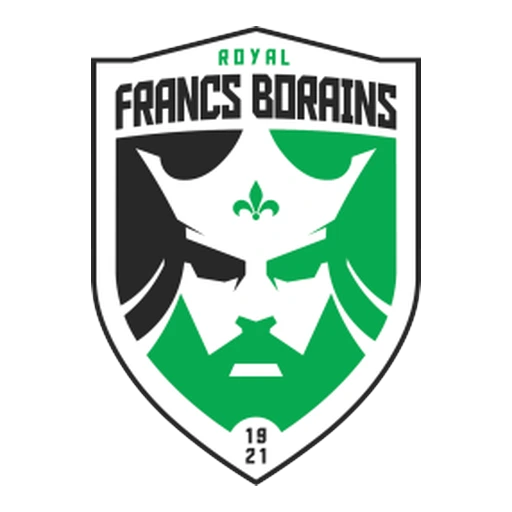
A major redesign arrived in 2021, when Royal Francs Borains unveiled a completely new visual identity. Created to modernise the club's image while celebrating the centenary of organised football in Boussu, the new crest adopted a cleaner, contemporary shield featuring numerous references to the region's history. At its centre is the figure of Clovis, the Frankish king from whom the club derives its name, inspired by a former miner, player and coach who was affectionately known as Clovis. The badge also incorporates a fleur-de-lis, symbolising the Frankish heritage and the club's royal status, while the upper edge of the shield is shaped like a slag heap (terril) in tribute to the Borinage's mining past. The traditional green, white and black colours were retained to honour the historic clubs of Boussu-Bois and Élouges that contributed to the Francs Borains identity.
Royal Francs Borains Club History
Founded in 1949, Royal Francs Borains represents the historic mining region of the Borinage in Hainaut Province. The club traces its roots to SC Boussu-Bois, founded in 1922, which later became Royal Francs Borains following a merger during the 1980s. In 2008, the club adopted the name Boussu Dour Borinage, but severe financial difficulties eventually threatened its future.
A new chapter began in 2014, when the club continued under matricule 5192 after acquiring the registration number of Charleroi Fleurus. At the same time, it revived the historic Royal Francs Borains name, colours and identity, preserving football in the Borinage despite the loss of the original matricule. Starting in the Belgian Fourth Division, the re-established club immediately challenged for promotion and gradually rebuilt its position within Belgian football.
The club's revival gathered momentum during the late 2010s. Promotion to the Belgian Third Amateur Division was followed by further progress through the national leagues, while investment in the club's infrastructure and youth development strengthened its long-term ambitions. In 2020, Francs Borains secured promotion to the Belgian First Amateur Division after finishing top of the league when the season was curtailed due to the COVID-19 pandemic.
The greatest achievement of the modern club came in 2022–23, when Royal Francs Borains finished third in the Belgian National Division 1 and secured promotion to the Challenger Pro League, marking the club's return to professional football for the first time under its new identity. The promotion represented the culmination of almost a decade of rebuilding and restored top-level professional football to the Borinage region.
The club's principal rivalries are with neighbouring Hainaut clubs RAAL La Louvière, RSC Charleroi, RFC Mons (historically) and RFC Seraing, fixtures shaped by regional pride and the industrial heritage of Wallonia. The rivalry with Mons, in particular, reflected the long-standing battle for footballing supremacy in the Mons–Borinage area before the disappearance of the original club.