Historical Crests K Beerschot VA
Name: K Beerschot VA
Nickname(s): De Mannekes (The Little Men)
Founded: 1921
Stadium: Olympisch Stadion
Capacity: 12,771
1960-1968
1968-1991
1991-1993
1993-1995
1995-1999
1999-2011
2011-2013
2013-2019
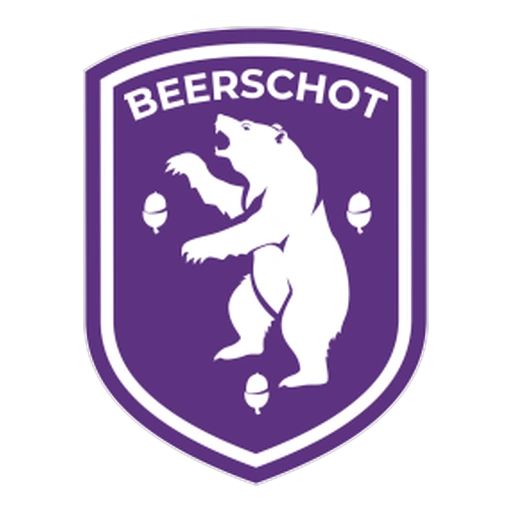
2019-Present
K Beerschot VA Crest History
The first modern Beerschot crest appeared in 1960, featuring a traditional purple heraldic round shield bearing the inscription "Royal Beerschot Athletic Club Antwerp." in a white round cirlce. The badge was topped by a royal crown, reflecting the club's Koninklijke (Royal) designation, while the distinctive purple-and-white colours reinforced Beerschot's long-established identity.
In 1968, the crest received its first notable update. The crest became an oval shield, the inscription "K. Beerschot V.A.V.", the royal crown and the club's iconic purple-and-white colours, the design was refined with cleaner proportions and improved detailing, giving the badge a more balanced and contemporary appearance.
In 1991, the crest underwent another refinement, with subtle adjustments to the shield, typography and crown while preserving the club's traditional identity. The update modernised the emblem without altering the classic elements that supporters had come to associate with Beerschot.
A further redesign followed in 1993.
In 1995, Beerschot unveiled another updated version of its traditional emblem. The shield adopted more stylised lines, while the royal crown received revised detailing. Despite these refinements, the crest remained firmly rooted in the club's historic purple-and-white identity.
A major redesign arrived in 1999 following the merger of K. Beerschot V.A.C. and K.F.C. Germinal Ekeren, creating Germinal Beerschot. The new crest combined elements of both clubs, retaining Beerschot's iconic purple while incorporating red and yellow from Germinal Ekeren. The royal crown remained above the badge, symbolising the continuation of Beerschot's proud tradition despite the merger.
In 2011, after the club adopted the name Beerschot A.C., the crest was simplified to place greater emphasis on Beerschot's historic identity. References to Germinal were removed, purple once again became the dominant colour, and the overall design moved closer to the club's traditional emblem.
Following the bankruptcy of Beerschot A.C. in 2013, KFCO Wilrijk adopted the Beerschot identity and became KFCO Beerschot Wilrijk. A new crest was introduced featuring a modern purple shield inspired by the historic Beerschot badge. The royal crown was retained, while contemporary typography marked the beginning of a new era without abandoning the club's historic visual identity.
In 2019, after officially adopting the name K Beerschot V.A., the club unveiled a refined version of its crest. The badge retained the traditional purple shield and royal crown while incorporating cleaner lines, updated typography and improved proportions.
K Beerschot VA Club History
Founded on 3 September 1899 as Beerschot Athletic Club, Beerschot is one of Belgium's most historic football clubs. Established in the Kiel district of Antwerp, the club quickly adopted its famous purple and white colours and became a prominent force in Belgian football. After receiving the Koninklijke (Royal) designation, the club became known as Koninklijke Beerschot Voetbal en Atletiek Club (K. Beerschot V.A.C.), a name that would become synonymous with success for much of the twentieth century.
Beerschot established itself among Belgium's elite after gaining promotion to the First Division in 1907. The club enjoyed its greatest period of success during the interwar years, winning seven Belgian league championships and developing a reputation for attractive football. Throughout much of the twentieth century, Beerschot remained one of the country's leading clubs and a regular contender for domestic honours.
The club's growing success also fuelled an intense rivalry with fellow Antwerp side Royal Antwerp. Known as the Antwerp Derby (Derby van 't Stad), meetings between the two clubs became some of the oldest and fiercest fixtures in Belgian football. Dividing the city of Antwerp between north and south, the rivalry was built on local pride, tradition and the battle to be recognised as the city's leading football club.
Following decades of success, financial difficulties during the 1980s and 1990s marked the beginning of the club's decline. Beerschot was relegated from the First Division in 1981 after 66 consecutive seasons in the top flight and struggled to recover its former status. Mounting financial problems ultimately led to the bankruptcy of K. Beerschot V.A.C. in 1999.
Later that year, K.F.C. Germinal Ekeren merged with the Beerschot identity to form Germinal Beerschot. Although the new club continued under Germinal Ekeren's registration number, it relocated to the Olympisch Stadion, adopted Beerschot's traditional purple colours and embraced much of the historic club's identity. Success returned with victory in the 2004–05 Belgian Cup, while the Antwerp Derby continued to rank among the country's most anticipated fixtures.
In 2011, the club was renamed Beerschot A.C. in an effort to restore the historic Beerschot name. However, continuing financial problems resulted in a second bankruptcy in 2013, bringing another chapter of the club's history to an end.
The Beerschot tradition was revived almost immediately when KFCO Wilrijk adopted the Beerschot identity, becoming KFCO Beerschot Wilrijk. Backed by thousands of loyal supporters, the club achieved four promotions in five seasons before returning to professional football. In 2019, it officially adopted the name K Beerschot V.A., strengthening its connection with the historic club while preserving its colours, traditions and home at the Olympisch Stadion.
Promotion to the Belgian Pro League followed in 2020, while an immediate return to the top flight was secured by winning the 2023–24 Challenger Pro League title after relegation in 2022.
The club's fiercest rivalry remains the Antwerp Derby against Royal Antwerp, one of the oldest and most passionate rivalries in Belgian football.
Beerschot Pins
Your Dynamic Snippet will be displayed here... This message is displayed because you did not provide enough options to retrieve its content.