The first modern club crest appeared during the 1960s, featuring a circular badge displaying blue-and-black diagonal stripes. The design also incorporated the Royal Crown, reflecting the club's royal designation (Koninklijke Voetbalvereniging).
In 1972, Club Brugge introduced a completely redesigned circular crest that established the foundation of the club's modern identity. The new badge featured the famous blue-and-black diagonal stripes enclosed within a white ring bearing the inscription "Club Brugge K.V.", while a royal crown was placed above the emblem to reflect the club's royal designation.
A significant departure came in 1980, when Club Brugge replaced its traditional circular crest with a bold shield-shaped badge. Retaining the club's famous blue-and-black stripes and the royal crown, the new design adopted a cleaner, more modern appearance intended to reflect Club Brugge's growing stature following its domestic dominance and run to the 1978 European Cup Final. Although innovative for its time, the shield proved unpopular with many supporters and remained in use for only three seasons.
In 1983, the club returned to a circular crest inspired by its historic badge. The familiar blue-and-black striped centre, white ring bearing the club's name and royal crown were all reinstated, creating the foundation of the modern emblem. This successful return to tradition has remained the basis of Club Brugge's identity ever since, with only subtle refinements in the decades that followed.
A major redesign arrived in 1995, when the club reintroduced a bold red outer ring, creating a stronger contrast with the traditional blue-and-black colours. The typography was refined and the badge adopted a more balanced, symmetrical appearance, establishing the foundation of the modern crest.
Minor updates followed in 2011 and 2012, with cleaner typography, improved proportions and simplified colours designed for digital media. The overall composition remained unchanged, preserving the circular badge, diagonal stripes and royal crown that had become synonymous with the club.
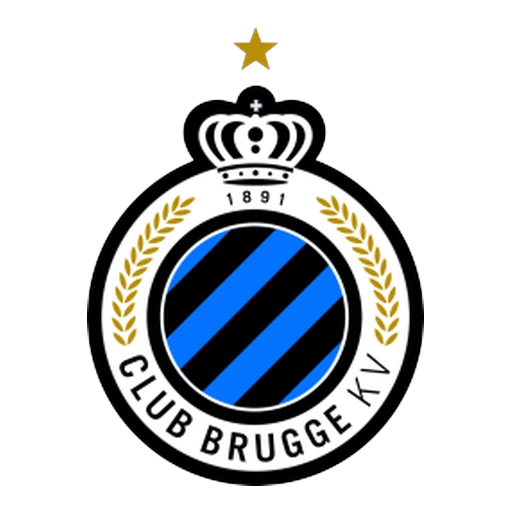
In 2012, Club Brugge introduced a refined version of its traditional crest featuring a white outer ring surrounding the familiar blue-and-black striped centre. The club name was displayed in a cleaner, modern typeface, while the royal crown was subtly redrawn with sharper details and improved proportions. The white border gave the badge a brighter and more contemporary appearance, improving its visibility across digital media while preserving the iconic circular design that had defined Club Brugge's identity since the early 1970s.
In 2016, after winning its tenth Belgian league championship under the modern title system, Club Brugge added a gold star above the crown in accordance with Belgian football tradition, where one star represents ten league titles. The star remains part of the official crest and symbolises the club's sustained domestic success.
Club Brugge K.V. Club History
Founded on 13 November 1891, Club Brugge KV is one of Belgium's oldest and most successful football clubs. Originally established as Brugsche Football Club, the club adopted the name Football Club Brugeois in 1897 before becoming Club Brugge following the gradual Dutchification of Belgian football after the Second World War. Throughout its history, the club has represented the city of Bruges and has become synonymous with success in Belgian football.
Club Brugge enjoyed its first major successes during the early twentieth century, winning its first Belgian Championship in 1919–20. The club established itself as a regular contender in the national league throughout the interwar period, but it was after the Second World War that Brugge truly emerged as one of Belgium's dominant football clubs.
The arrival of Austrian coach Ernst Happel in 1974 transformed the club into a European powerhouse. Under Happel, Club Brugge won multiple Belgian First Division titles and reached the 1976 UEFA Cup Final, where it narrowly lost to Liverpool. Two years later, the club achieved its greatest European success by reaching the 1978 European Cup Final, once again facing Liverpool at Wembley Stadium. Although defeated 1–0, Club Brugge became the first, and still only, Belgian club to reach the final of the European Cup in its modern format.
Throughout the 1980s, 1990s and 2000s, Club Brugge remained one of Belgium's leading clubs, consistently competing for domestic honours while regularly qualifying for European competitions. The club won numerous league championships, Belgian Cups and Belgian Super Cups, establishing an intense rivalry with RSC Anderlecht as the country's two most successful clubs.
A new golden era began during the 2010s. Under coaches including Michel Preud'homme, Ivan Leko, Philippe Clement and later Nicky Hayen, Club Brugge reclaimed its position at the summit of Belgian football. The club won multiple Belgian Pro League titles and became a regular participant in the UEFA Champions League, earning impressive results against some of Europe's biggest clubs.
The highlight of the club's modern European resurgence came in the 2022–23 UEFA Champions League, when Club Brugge reached the Round of 16 for the first time in its history. Further success followed in the 2023–24 UEFA Europa Conference League, where the club reached the semi-finals, reaffirming its reputation as Belgium's strongest representative in European competition.
Today, Club Brugge KV plays its home matches at the Jan Breydel Stadium, which it shares with local rivals Cercle Brugge.
The club's fiercest rivalry is the Bruges Derby against Cercle Brugge, while matches against RSC Anderlecht, often referred to as Belgium's biggest football rivalry, frequently decide domestic honours. Encounters with KAA Gent, Racing Genk and Standard Liège also rank among the country's most significant fixtures. With more than a century of success, a rich European pedigree and one of the largest supporter bases in Belgium, Club Brugge remains one of the giants of Belgian football.