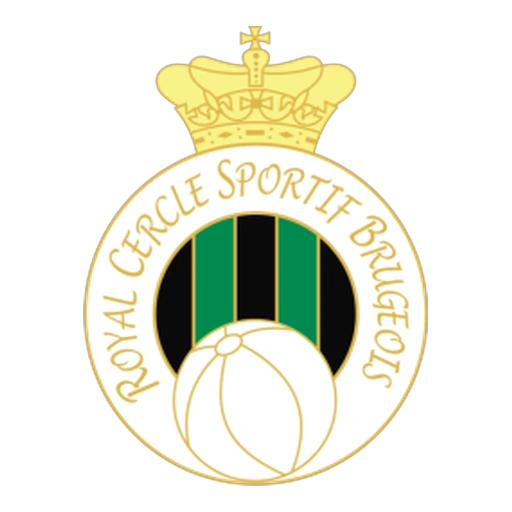
The club's first known emblem, introduced around 1899, featured an elaborate Art Nouveau design displaying the full French club name, Cercle Sportif Brugeois. A royal-style crown sat above a shield containing the club's green-and-black vertical stripes and a football, reflecting the decorative graphic style that was common among Belgian sporting clubs at the turn of the twentieth century.
After receiving the honorary "Royal" title in 1924, the crest was updated to become Royal Cercle Sportif Brugeois. While the overall composition remained largely unchanged, the addition of the royal designation strengthened the club's prestige and officially recognised its twenty-five years of existence. This elegant heraldic badge represented Cercle Brugge throughout one of the club's most successful periods, including several Belgian championship titles.
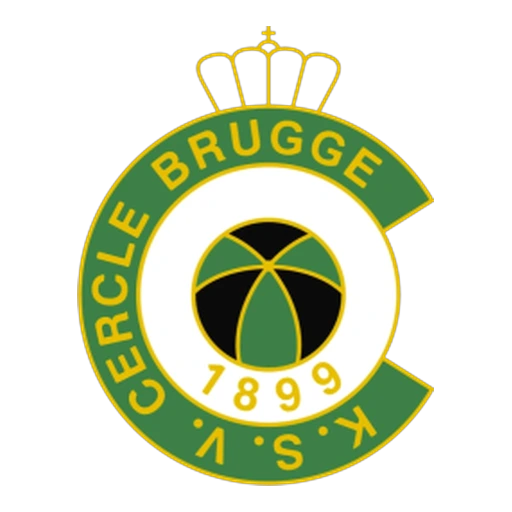
During the late 1960s, the club embraced the growing use of Dutch in Belgian football and adopted the name Koninklijke Sportvereniging Cercle Brugge. This transition also marked a significant redesign of the crest. The ornate shield gave way to a modern circular composition centred around a bold black letter "C" surrounding a stylised football, while the royal crown remained as a symbol of the club's history. This design introduced the visual identity that would define Cercle Brugge for decades.
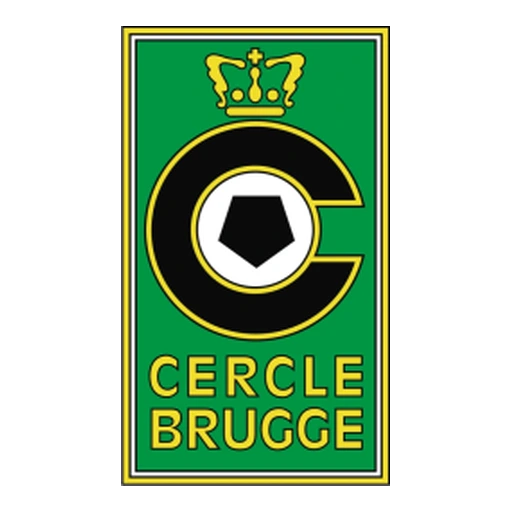
Throughout the 1970s and 1980s, several variations of the new concept appeared. Some versions incorporated rectangular shields, while others experimented with circular borders, typography and simplified football graphics. Despite these stylistic changes, the key elements—the royal crown, the prominent black "C", the football and the club's green-and-black colours—remained constant, reinforcing a strong and consistent visual identity.
From the 1990s onwards, Cercle Brugge progressively simplified its crest to suit modern branding. Decorative details were gradually removed, resulting in cleaner shapes and improved legibility while preserving the traditional symbolism. The large black "C" enclosing the football became the unmistakable hallmark of the club, allowing the crest to remain instantly recognisable across both print and digital media.
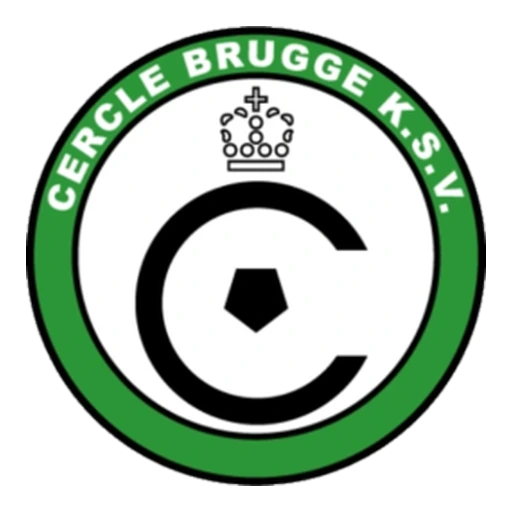
In 2022, Cercle Brugge unveiled a comprehensive redesign inspired by its historic emblems. The club retained the iconic "C", football and royal crown but redrew every element using modern geometric forms and balanced proportions. The simplified flat design improved versatility across digital platforms while deliberately paying tribute to the classic badges that had represented Cercle throughout much of the twentieth century.
Cercle Brugge K.S.V. Club History
Founded in 1899, Cercle Brugge Koninklijke Sportvereniging is one of Belgium's oldest football clubs and one of the founding members of the Belgian Football Association. Established as Cercle Sportif Brugeois by former pupils of the Saint Francis Xavier Institute in Bruges, the club quickly developed into one of the country's leading football institutions. In 1924, Cercle was granted the honorary title "Royal" (Koninklijke) in recognition of its twenty-five years of existence, becoming Koninklijke Sportvereniging Cercle Brugge.
The club enjoyed its first golden era during the first half of the twentieth century. Cercle Brugge won its first Belgian Championship in 1911, followed by additional league titles in 1927 and 1930, establishing itself as one of Belgium's dominant clubs between the World Wars. The club also lifted its first Belgian Cup in 1927, completing a historic domestic double that remains one of the greatest achievements in its history.
Following the Second World War, Cercle experienced a prolonged period of fluctuating fortunes. Although the club remained an important name in Belgian football, it alternated between the First and Second Divisions on several occasions during the 1950s, 1960s and 1970s. Despite these challenges, Cercle maintained a strong local identity and continued to produce talented players through its respected youth academy.
The club returned to prominence during the 1980s. After securing promotion back to the top flight, Cercle won the Belgian Cup in 1985, defeating Beveren in the final to lift the trophy for the second time. The triumph qualified the club for the UEFA Cup Winners' Cup, providing one of the most memorable European campaigns in the club's modern history.
Throughout the 1990s and early 2000s, Cercle Brugge established itself as a consistent First Division club. Although further league titles remained elusive, the club regularly competed for European qualification and strengthened its reputation for attractive football and youth development.
During this period, Cercle continued to share the Jan Breydel Stadium with city rivals Club Brugge, whose rivalry forms one of the oldest and fiercest derbies in Belgian football. Known as the Bruges Derby (Brugse Stadsderby), the fixture dates back more than a century and reflects the contrasting identities of the two clubs: Club Brugge evolved into Belgium's most successful and internationally recognised side, while Cercle remained deeply rooted in tradition, community values and player development. Although Club Brugge has enjoyed far greater sporting success in recent decades, the derby remains the defining match of Cercle's season and continues to generate enormous passion among supporters.
A new chapter began in 2017, when French club AS Monaco acquired a majority stake in Cercle Brugge. The partnership provided greater financial stability and introduced a development model focused on young international talent. In 2018, Cercle secured promotion back to the Belgian First Division A after winning the promotion play-offs, marking the club's return to the highest level of Belgian football.