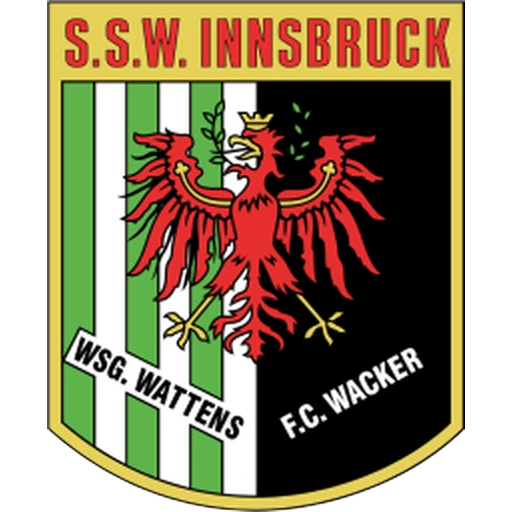
Founded in 1913 as FC Wacker Innsbruck, the club originally used a simple black-and-green emblem reflecting its traditional colours. Following the merger between FC Wacker Innsbruck and WSG Wattens in 1971, a completely new crest was introduced for the newly formed Spielgemeinschaft Swarovski Wacker Innsbruck (SSW Innsbruck). The shield combined the coats of arms and identities of both clubs, featuring the Tyrolean eagle, green-and-white stripes representing Wattens, and the names of both founding clubs. The redesign symbolised the partnership that ushered in the most successful period in Tyrolean football history.
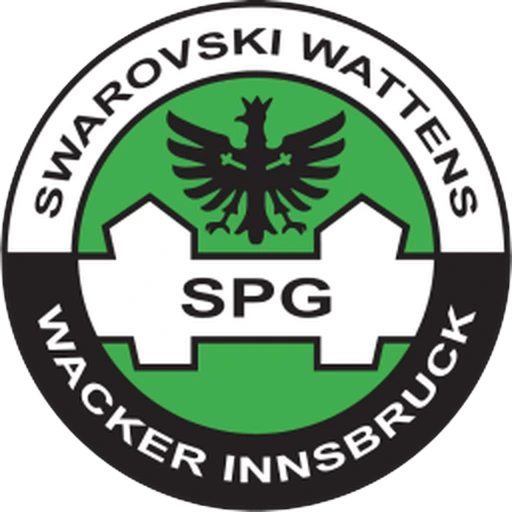
In 1979, after the cooperation between the two clubs was restructured, SSW Innsbruck adopted a new circular crest. The badge featured a stylised black eagle above the initials SPG, surrounded by the names Swarovski Wattens and Wacker Innsbruck. Simpler and more modern than its predecessor, the design reflected the continuing partnership while placing greater emphasis on the joint identity that had dominated Austrian football throughout the 1970s.
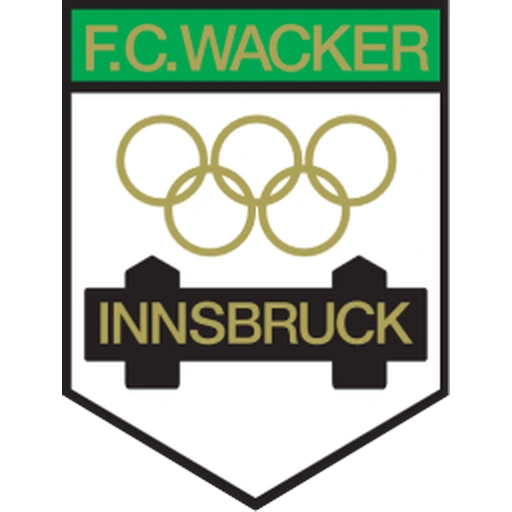
A major change came in 1986, when the professional team was reorganised following the creation of FC Swarovski Tirol. The club introduced a completely new shield displaying the Olympic rings beneath the name FC Wacker Innsbruck, symbolising Innsbruck's status as a two-time Winter Olympic host city. The modern white shield reflected the city's identity while distancing itself from the previous Swarovski-Wattens partnership.
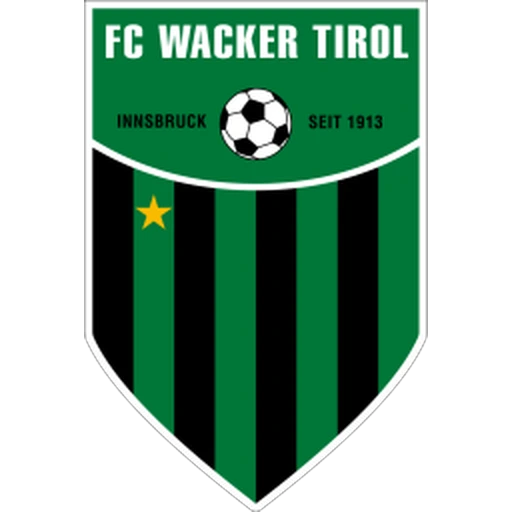
Following the collapse of FC Tirol Innsbruck and the foundation of the modern club in 2002, a new crest was introduced in 1999 for FC Wacker Tirol. The shield returned to the club's traditional black-and-green vertical stripes, incorporating a football, the founding year 1913, and the name FC Wacker Tirol. The redesign deliberately re-established the historic colours associated with Wacker while creating a fresh identity for the newly founded club. In 2007, after the club officially changed its name back to FC Wacker Innsbruck, the crest was adapted by replacing "Tirol" with "Innsbruck", while preserving the overall design.
In 2014, the club returned to its roots by unveiling a redesigned crest inspired by the original Wacker emblem. The new shield featured the historic black-and-green vertical stripes with a circular FCW monogram at its centre, creating a cleaner and more traditional appearance. Club officials described the redesign as "Back to the roots", restoring the visual identity most closely associated with Wacker's history and supporters.
Later that same year, the club simplified the badge even further by adopting a minimalist circular monogram displaying the intertwined FCW initials in green on a black background. Inspired directly by the club's original founding emblem, the redesign abandoned decorative elements in favour of a timeless symbol that reflects the club's traditional colours and heritage.
FC Wacker Innsbruck Club History
Founded in 1913, FC Wacker Innsbruck is one of Austria's most historic football clubs and has long been regarded as the traditional football club of Tyrol. Established in Innsbruck, the club quickly became one of the region's leading teams and developed a passionate following thanks to its distinctive black-and-green colours. During the post-war decades, Wacker established itself as a regular competitor in the Austrian top flight.
A defining moment in the club's history came in 1971, when FC Wacker Innsbruck merged with WSG Wattens to form SSW Innsbruck (Spielgemeinschaft Swarovski Wacker Innsbruck). Backed by the Swarovski company, the new club dominated Austrian football throughout the 1970s, winning multiple Austrian Bundesliga titles and Austrian Cups. The partnership brought unprecedented success to Tyrolean football and established Innsbruck as one of Austria's leading football cities.
The club underwent further organisational changes in 1986, becoming FC Swarovski Tirol. Despite the new name, the team remained highly successful, winning additional league championships and domestic cups while regularly representing Austria in European competitions. During this period, the club faced renowned opponents such as Real Madrid, Ajax, Inter Milan, Liverpool, Valencia and Glasgow Rangers, enhancing its reputation on the continental stage.
In 1993, the club was renamed FC Tirol Innsbruck, continuing the tradition of success by winning three consecutive Austrian Bundesliga titles between 2000 and 2002. However, severe financial problems led to bankruptcy in 2002, forcing the club to cease operations despite being the reigning Austrian champions.
Following the collapse of FC Tirol Innsbruck, supporters founded a new club in 2002, reviving the historic name FC Wacker Tirol. Starting in the lower divisions, the club embraced the heritage of the original Wacker Innsbruck and steadily climbed the Austrian football pyramid. In 2007, the club officially regained the historic name FC Wacker Innsbruck, symbolising the continuation of the original club's traditions and identity.
Throughout the 2000s and 2010s, Wacker alternated between the Austrian Bundesliga and the 2. Liga, earning a reputation for developing talented young players while facing recurring financial challenges. Despite several promotions and relegations, the club retained one of Austria's most loyal fanbases and remained a symbol of Tyrolean football.
Financial difficulties again affected the club in the early 2020s. In 2022, FC Wacker Innsbruck was denied a licence for professional football and was forced to restart in the Tyrolean League, the fifth tier of Austrian football. Despite this setback, supporters remained firmly behind the club, and Wacker embarked on another rebuilding process with the ambition of returning to the professional game.
The club's fiercest rivalry is the Tyrolean Derby against WSG Tirol (formerly WSG Wattens), a fixture rooted in the historic partnership and eventual separation of the two clubs. Matches against Austria Salzburg are also fiercely contested, while historic encounters with Rapid Wien, Austria Wien and Sturm Graz remain among the most significant in the club's history.