Nickname(s):La Academia(The Academy),El Primer Grande (The First Great)
Founded:1903
Stadium:Estadio Presidente Perón (El Cilindro)
Capacity:55,000
1903-1912
1912-1918
1918-1920
1920-1928
1928-1929
1929-1934
1934-1936
1936-1941
1941-1950
1950-1967
1967-1974
1974-1990
1990-1995
1995-1998
1998-1999
1999-2001
2001-2006
2003
2004-2006
2006-2009
2007
2009-2014
2012
2013
2014-Present
Racing Club de Avellaneda Crest History
The crest history of Racing Club de Avellaneda reflects the transformation of the club from an institution strongly influenced by the visual traditions of early Argentine football into one identified almost entirely by its famous sky-blue and white vertical stripes. Over more than a century, Racing experimented with monograms, decorative emblems and numerous shield shapes, but the colours of La Academia ultimately became the constant feature.
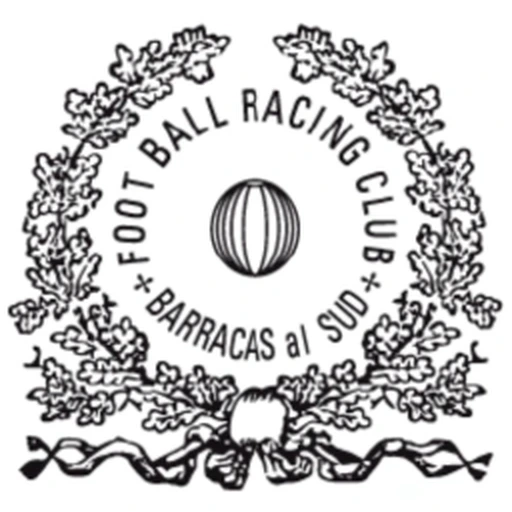
The first crest, used from 1903 to 1912, was an elaborate black-and-white emblem bearing the name “Foot Ball Racing Club” and a reference to Barracas al Sud, the former name of the area that later became Avellaneda. A football appeared at its centre, surrounded by an ornate floral composition. The design reflected the decorative style commonly found on sporting emblems during the early twentieth century.
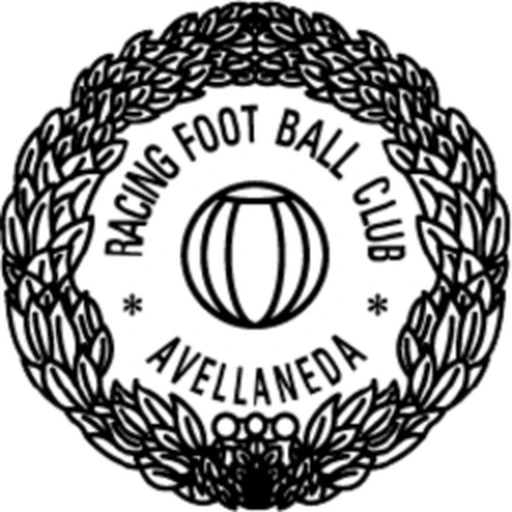
Between 1912 and 1918, this concept was simplified into a circular badge. The words “Racing Foot Ball Club – Avellaneda” surrounded a football, while a laurel wreath enclosed the entire composition. This version clearly connected the club with Avellaneda while maintaining the football as its central symbol.
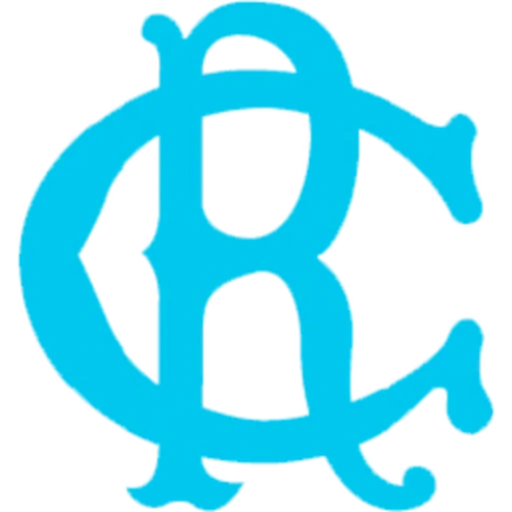
A completely different identity appeared in 1918. The 1918–1920 crest consisted solely of an intertwined monogram formed from the letters of Racing Club, rendered in sky blue. It was one of the earliest occasions on which the colour that would become inseparable from Racing's identity dominated the badge.
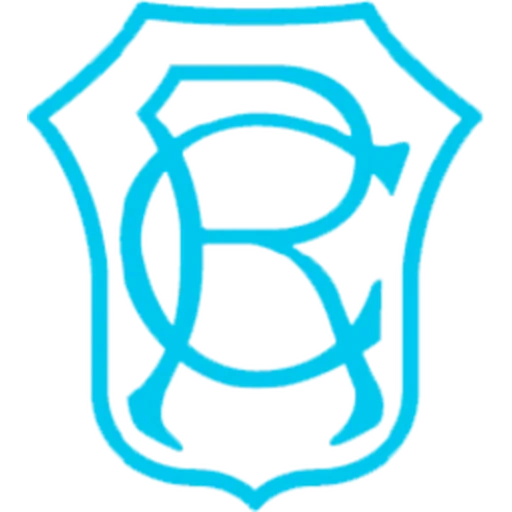
The 1920–1928 version retained the monogram concept but placed the intertwined letters inside an irregular outlined shield. The design remained extremely minimalist and relied primarily on the club's initials rather than stripes or written names.
In 1928, Racing introduced the visual feature that would define almost every subsequent crest: vertical sky-blue and white stripes. The 1928–1929 badge was a traditional shield containing alternating stripes bordered by a grey outline. There was no lettering, allowing the club colours themselves to identify Racing.
Between 1929 and 1934, the striped shield was incorporated into a much more elaborate gold ornamental frame. The words “Racing Club” appeared above the shield and “Avellaneda” below it. A similar composition remained between 1934 and 1936, although the central shield was modified and the word “Racing” appeared directly across its upper section.
A major simplification occurred in 1936. The 1936–1941 crest abandoned the decorative surround and returned to a standalone striped shield. A rectangular sky-blue header containing the word “RACING” was placed above the vertical stripes. This established the basic structure that has remained the foundation of Racing's crest ever since.
The 1941–1950 version refined this formula with a cleaner shield shape and a more prominent blue upper panel. The white word RACING contrasted strongly against the sky-blue background, while three broad vertical sections formed the lower part of the badge.
Between 1950 and 1967, the upper section changed again. Instead of the full club name, the initials “RC” appeared across the top of a more angular shield. The traditional sky-blue and white stripes nevertheless remained dominant.
The full RACING inscription returned in 1967–1974, producing a cleaner and more balanced crest. The 1974–1990 version then introduced darker outlines and a stronger black border around both the shield and upper name panel, giving the badge considerably more visual weight.
During the 1990–1995 period, the crest became more minimalist again. The heavy border disappeared and the shield used a brighter sky blue. The word RACING remained prominently displayed above three white vertical stripes.
Several subtle refinements followed. The 1995–1998 version introduced a darker outline, while the 1998–1999 and 1999–2001 designs experimented with heavier black borders and slightly different shield shapes. Despite these changes, the underlying composition remained virtually unchanged.
The 2001–2006 crest returned to a lighter and cleaner appearance. Its simple sky-blue outline, white stripes and RACING name panel reinforced the visual identity that had now been associated with the club for generations.
In 2003, Racing celebrated its centenary with a special commemorative emblem. The regular striped shield was surrounded by golden laurel branches, with “100 Años” placed beneath it. A related laurel-framed version was also used between 2004 and 2006.
The 2006–2009 crest again returned to the standalone shield. The proportions became slightly taller and sharper, while the traditional sky-blue-and-white colour scheme remained unchanged.
A special 2007 variation placed a gold star above the shield, commemorating Racing's historic international achievement. The star referenced the club's status as a world champion following its victory in the 1967 Intercontinental Cup.
Between 2009 and 2014, another refined version of the traditional striped shield appeared. The outline and proportions were modernised while the basic arrangement remained faithful to the design first established in the 1930s.
Racing has also periodically revived its historical identity. A 2012 commemorative emblem returned to the ornate design associated with the early 1930s, surrounding the striped shield with decorative gold elements and the words Racing Club – Avellaneda.
For the club's 110th anniversary in 2013, an entirely different commemorative logo was created. The number 110 was stylised using sky-blue vertical elements and surrounded by golden laurel branches, with Racing Club – 110 Años underneath.
Since 2014, Racing has used a clean modern interpretation of its traditional shield. A dark outline surrounds the badge, the upper sky-blue panel contains RACING in white, and the lower section consists of the unmistakable sky-blue and white vertical stripes.
Racing Club de Avellaneda Club History
Racing Club de Avellaneda was founded on 25 March 1903 in Avellaneda, immediately south of Buenos Aires. Created through the merger of two local clubs, the institution quickly developed into one of the pioneering powers of Argentine football. Its extraordinary success during the amateur era earned Racing the nickname La Academia (The Academy), a name that remains inseparable from the club today.
Racing's rise was remarkably rapid. After reaching Argentina's top level, the club became the dominant force of the 1910s, winning seven consecutive league championships between 1913 and 1919. This unprecedented sequence established Racing as the outstanding Argentine side of its generation and helped create another traditional nickname, El Primer Grande (The First Great).
The club continued winning championships during the early 1920s and became one of the country's best-supported institutions. When Argentine football entered the professional era in 1931, Racing was already firmly established among the country's elite and would eventually become recognised as one of Argentina's traditional Cinco Grandes alongside Boca Juniors, River Plate, Independiente and San Lorenzo.
Racing's identity is inseparable from its neighbour and greatest rival, Independiente. The two clubs are based only a short distance apart in Avellaneda, making their rivalry, the Clásico de Avellaneda, one of the most intense local derbies in world football. Their stadiums stand only a few hundred metres from one another, creating a remarkable concentration of football culture within the city. Racing's sky blue and white and Independiente's red have divided Avellaneda for generations.
After a relatively difficult early professional period, Racing returned to dominance at the end of the 1940s. Under coach Guillermo Stábile, the club won three consecutive Primera División championships in 1949, 1950 and 1951, becoming the first club in Argentina's professional era to achieve three successive league titles.
This successful period coincided with the construction of Racing's famous stadium. The Estadio Presidente Perón, universally known as El Cilindro because of its distinctive circular form, opened in 1950 and became one of Argentina's most recognisable football grounds.
Further championships followed in 1958 and 1961, but Racing's greatest international era arrived during the second half of the 1960s. Under coach Juan José Pizzuti, Racing assembled the legendary team known as El Equipo de José. The side combined attacking football with remarkable consistency and produced one of the most celebrated periods in the club's history.
Racing won the 1966 Argentine championship, losing only one match during the campaign. The following year brought an even greater achievement. In 1967, Racing won the Copa Libertadores, defeating Nacional of Uruguay in the final playoff and becoming South American champion for the first time.
That victory qualified Racing for the 1967 Intercontinental Cup against European champions Celtic. After matches in Glasgow and Avellaneda, a deciding game was played in Montevideo. Racing won 1–0 through a famous long-range goal by Juan Carlos Cárdenas, becoming the first Argentine club to win the Intercontinental Cup. It remains one of the defining moments in the history of La Academia.
The decades that followed were considerably more difficult. Racing struggled both competitively and institutionally, and in 1983 the club suffered the enormous shock of relegation from the Primera División. It returned to the top flight in 1985, beginning a gradual recovery.
International success returned in 1988, when Racing won the inaugural Supercopa Sudamericana, defeating Cruzeiro in the final. The trophy provided an important moment of celebration after the difficulties of the previous decade.
The 1990s brought another serious crisis. Financial problems became so severe that in 1999 Racing was declared bankrupt, producing one of the darkest episodes in the club's history. Supporters mobilised strongly to defend the institution, and Racing continued competing while its financial and administrative future was reorganised.
Against that background, the 2001 Apertura championship became one of the most emotional achievements in Racing's history. Coached by Reinaldo Merlo, whose phrase “Paso a paso” became associated with the campaign, Racing won its first Argentine league championship in 35 years. Thousands of supporters celebrated a title that symbolised the survival and revival of the club.
Racing returned to championship-winning form in the 2014 Torneo de Transición, with former player Diego Milito returning from European football to play a leading role. The triumph restored Racing to the forefront of Argentine football and began another competitive period.
The club captured another league championship in 2018–19 under Eduardo Coudet, finishing ahead of Defensa y Justicia. Further domestic trophies followed, reinforcing Racing's position among Argentina's leading modern clubs.
Racing also re-established itself internationally. In 2024, the club won the Copa Sudamericana, defeating Cruzeiro in the final. It was a particularly significant achievement because it ended a wait of more than three decades for a major CONMEBOL title. Racing subsequently added the 2025 Recopa Sudamericana, defeating Botafogo and further strengthening this international revival.
Throughout all these periods, the Clásico de Avellaneda against Independiente has remained fundamental to Racing's identity. Independiente's extraordinary international record historically contrasted with Racing's pioneering domestic and world achievements, adding another dimension to the rivalry. Matches between the two are contests not merely for league points but for local supremacy in a city dominated by the two clubs.