Nickname(s):La Lepra (The Lepers),Los Rojinegros (The Red and Blacks)
Founded:1903
Stadium:Estadio Marcelo Bielsa(El Coloso del Parque)
Capacity:42,000
1903-1905
1905-1926
1926-1934
1934-1942
1942-1945
1945-1950
1950-1952
1952-1955
1955-1959
1959-1988
1989-1990
1990-1997
1997-1998
1998-1999
1999-2000
2000-2002
2002-2003
2003-2005
2005-2006
2006-2011
2011-2013
2013-2014
2013
2014-2017
2017-2021
2021-Present
Newell's Old Boys Crest History
The crest history of Newell’s Old Boys is built around one of the most recognisable colour combinations in Argentine football: the vertically divided red-and-black shield. Although the club’s earliest emblems were considerably more elaborate, red and black gradually became the permanent visual identity of La Lepra.
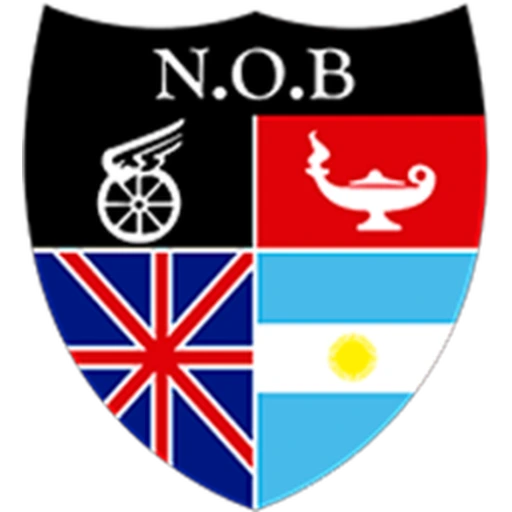
The first known crest, used from 1903 to 1905, was a complex quartered shield reflecting the club’s origins. The upper section contained the initials “N.O.B.”, while the quarters incorporated several symbols, including the Union Jack and Argentine colours. These elements represented the British-Argentine background of the club and its connection with Isaac Newell, the English-born educator whose school provided the foundations from which Newell’s Old Boys emerged.
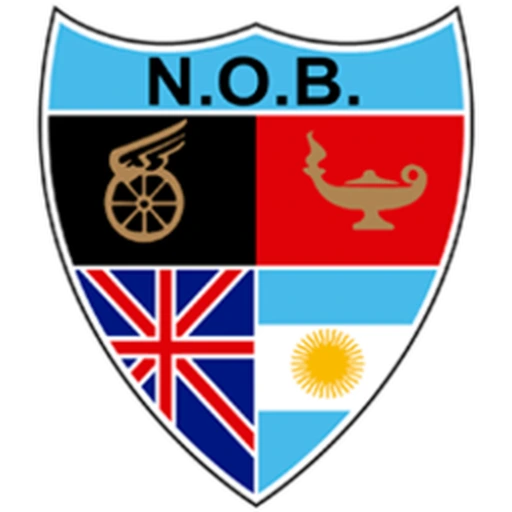
Between 1905 and 1926, this early design was refined. The basic quartered composition remained, but the colours and individual symbols became clearer and more structured. It was still very different from the simple red-and-black identity that would eventually define the club.
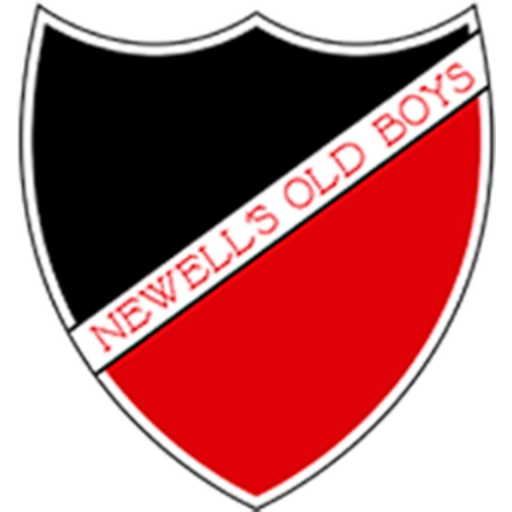
A major transformation occurred in 1926. The elaborate historical imagery disappeared and was replaced by a conventional football shield divided diagonally into black and red, crossed by a white sash carrying the words “Newell’s Old Boys.” This marked the beginning of a much simpler and more football-focused visual identity.
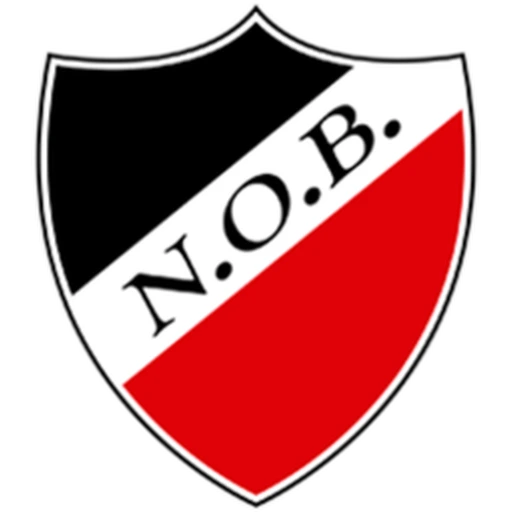
The 1934–1942 version retained the diagonal division but shortened the inscription to “N.O.B.” The three initials became an increasingly important part of the club’s visual language and would return repeatedly in later decades.
Between 1942 and 1945, Newell’s introduced the design that forms the basis of its modern identity. The shield was divided vertically into two equal halves: red on the left and black on the right. All lettering was removed, leaving an exceptionally simple emblem based entirely on the club colours.
The diagonal sash returned for 1945–1950, this time carrying the full name “Newell’s Old Boys.” From 1950 to 1952, the inscription was again abbreviated to N.O.B., but the general diagonal red-and-black arrangement remained.
In 1952, the club returned to the plain vertically divided shield. The 1952–1955 crest used red and black without any lettering, while the 1955–1959 version refined the outline and proportions. By this stage, the half-red, half-black shield had clearly become the fundamental symbol of Newell’s Old Boys.
An unusual variation appeared between 1959 and 1988. The vertically divided shield contained a large white number 6. This referred to the club’s championship achievements recognised at the time, introducing sporting success directly into the badge rather than relying solely on initials or colours.
In 1989–1990, the number disappeared and the letters N, O and B were placed individually across the red-and-black shield. This concept was refined in 1990–1997, with the letters arranged diagonally from the upper-left to the lower-right.
The 1997–1998 crest retained the vertically divided shield and the diagonal arrangement of the initials, while the 1998–1999 version briefly returned to a diagonal division of the red and black halves.
For 1999–2000, the club restored the vertical division and simplified the lettering. The white initials NOB became increasingly prominent, establishing the basic arrangement used in many of the club’s twenty-first-century designs.
During the early 2000s, stars became a recurring element around the shield. The 2000–2002 and 2002–2003 versions surrounded the traditional crest with stars representing the club’s major domestic championships. The precise arrangement changed several times as designers experimented with how Newell’s honours should be displayed.
The 2003–2005 crest took the opposite approach. The initials disappeared completely, leaving only the classic red-and-black shield beneath a row of stars. This placed the club colours themselves at the centre of the identity.
Between 2005 and 2011, the NOB initials returned. Stars were positioned around or beneath the shield in several arrangements, while the central red-and-black design remained largely unchanged.
A dramatic historical revival occurred in 2011. The 2011–2013 crest reintroduced elements of the club’s original emblem from the early twentieth century, including the quartered structure and historical symbols. It was a deliberate reference to Newell’s origins and stood apart from the minimalist badges used during most of the previous century.
The traditional shield quickly returned. In 2013–2014, the familiar red-and-black halves and NOB initials were restored, accompanied by stars representing the club’s championship history. Alternative versions from 2013 also experimented with different star arrangements.
From 2014 to 2017, the design became much cleaner. The shield remained vertically divided red and black, while the initials NOB were presented prominently in white across the centre. Decorative elements were substantially reduced.
The 2017–2021 crest maintained this composition but again incorporated championship stars beneath the shield. Despite these additions, the essential visual identity remained unchanged.
Since 2021, Newell’s Old Boys has used an especially minimalist version of its historic badge. The shield is divided vertically into red and black, with the bold white initials NOB positioned across the centre. Stars and other external decorations have been removed, returning the emblem to its most recognisable elements.
Newell's Old Boys Club History
Newell’s Old Boys was founded on 3 November 1903 in Rosario, Santa Fe Province, by former students of the Colegio Comercial Anglicano Argentino, a school established by the English-born educator Isaac Newell. The club was named in his honour, and its unusual English name remains a direct reminder of the British influence on the early development of football in Argentina.
From its earliest years, Newell’s became one of the leading clubs in Rosario. It competed in the regional competitions organised by the Liga Rosarina de Fútbol, winning its first major local championship in 1905. During the following decades, Newell’s established itself alongside Rosario Central as one of the dominant football institutions in the city.
That competition produced the defining rivalry in the club’s history. Matches between Newell’s Old Boys and Rosario Central became known as the Clásico Rosarino, one of Argentina’s oldest and most intense football derbies. The rivalry divides Rosario between the red and black of Newell’s and the blue and yellow of Central and has remained central to the identity of both clubs for more than a century.
Newell’s nickname, La Lepra (The Lepers), also has its roots in Rosario folklore. According to the traditional story, Newell’s agreed to participate in a charity match intended to raise money for a leprosy hospital, while Rosario Central declined. Newell’s supporters consequently became known as Leprosos, while the nickname became an enduring symbol of pride rather than an insult.
For several decades, Newell’s achievements were concentrated in regional football because the national professional structure was dominated by clubs from Buenos Aires and its surroundings. The transformation of Argentine football eventually provided Rosario's major clubs with greater access to national competition, and Newell’s entered the Argentine Primera División in 1939, together with Rosario Central.
Newell’s gradually established itself as a major national club. The breakthrough came in 1974, when the team won the Metropolitano championship, its first Argentine top-flight league title. The triumph became particularly memorable because the championship was secured against arch-rivals Rosario Central, giving the achievement enormous significance for the club's supporters.
Further success followed during the 1980s. Newell’s captured the 1987–88 Primera División championship with a team remembered for being composed entirely of players developed by the club. It reinforced Newell’s reputation as one of Argentina's outstanding producers of football talent.
That tradition became even more prominent under Marcelo Bielsa, who took charge of the first team in 1990. Bielsa had spent much of his coaching career within Newell’s youth structure and built an aggressive, tactically disciplined side around players developed by the club.
Under Bielsa, Newell’s won the 1990–91 championship and subsequently the 1992 Clausura. The team also became a major force in South American football, reaching the Copa Libertadores final in 1992, where it narrowly lost to São Paulo after a penalty shoot-out. Newell’s had previously reached the Libertadores final in 1988, meaning the club twice came extremely close to becoming South American champion.
The Bielsa period became one of the most influential chapters in the club’s history. His connection with Newell’s remained so strong that the club's stadium was officially renamed Estadio Marcelo Bielsa in 2009. The ground, situated in Rosario's Parque Independencia and widely known as El Coloso del Parque, is one of the most distinctive football venues in Argentina.
Another championship arrived with the 2004 Apertura, when a team coached by Américo Gallego returned Newell’s to the summit of Argentine football. Thousands of supporters travelled to Buenos Aires for the decisive stages of the campaign, demonstrating the enormous following the club commands in Rosario and throughout Santa Fe Province.
Newell’s returned to championship-winning form in 2013 under coach Gerardo Martino, himself a legendary former Newell’s player. Playing an attractive possession-oriented style, the club won the 2013 Final tournament and again reached the latter stages of the Copa Libertadores, advancing to the semi-finals.
The club's reputation extends well beyond its championships. Newell’s has developed one of the most celebrated youth systems in South American football. Among the players associated with its academy or first team are Gabriel Batistuta, Jorge Valdano, Maxi Rodríguez, Walter Samuel, Mauricio Pochettino and Lionel Messi. Messi spent part of his childhood in the Newell’s youth system before moving to Barcelona, creating one of the club's most famous connections with world football.
Despite its national achievements, Newell’s identity remains inseparable from Rosario. The Clásico Rosarino against Rosario Central is consequently much more than another league fixture. Families, neighbourhoods and generations of supporters are divided between the two clubs, and victory in the derby can carry an importance comparable to winning a major competition.