Nickname(s):El Tomba (The Tomba),El Expreso(The Express),Bodeguero(The Winemaker)
Founded:1921
Stadium:Estadio Feliciano Gambarte (La Bodega)
Capacity:15,000
1927-1933
1933-1941
1941-1945
1945-1950
1960-1987
1987-1994
1994-2001
2001-2007
2007-Present
2017-2018
Godoy Cruz Antonio Tomba Crest History
The crest history of Godoy Cruz Antonio Tomba reflects the evolution of the club from a small local institution in Mendoza into one of the most recognisable football clubs from Argentina's interior. Although the earliest emblems varied considerably, the blue-and-white vertical stripes and diagonal name band eventually became the defining elements of the club's identity.
The earliest crest shown, used from 1927 to 1933, was extremely simple. It consisted of a circular blue-and-white emblem containing the initials “C.S.G.C.”, referring to the club's identity before the merger that eventually created Club Deportivo Godoy Cruz Antonio Tomba. The restrained design was very different from the striped shields that would later become synonymous with the club.
Between 1933 and 1941, the club adopted a completely new badge. The 1933–1941 crest was a solid blue geometric shield carrying the words “G. Cruz Tomba” in white. This design directly referenced both Godoy Cruz and Antonio Tomba and represented an early attempt to establish a unified identity following the merger.
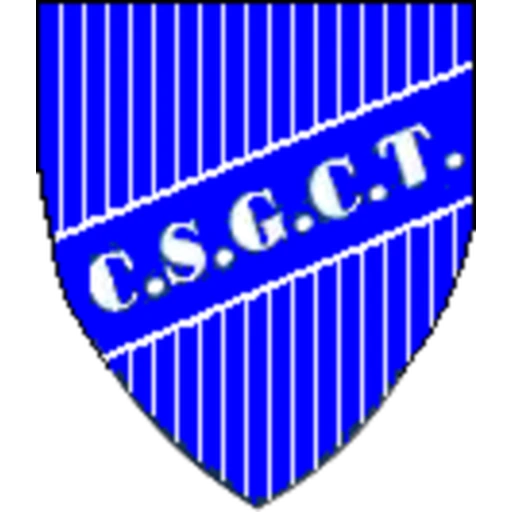
In 1941, the basic structure of the modern crest began to emerge. The 1941–1945 badge introduced a traditional shield filled with numerous narrow blue-and-white vertical stripes. A diagonal blue band crossed the centre and carried the initials “C.S.G.C.T.” This combination of stripes, shield and diagonal band would become the foundation for virtually every later Godoy Cruz crest.
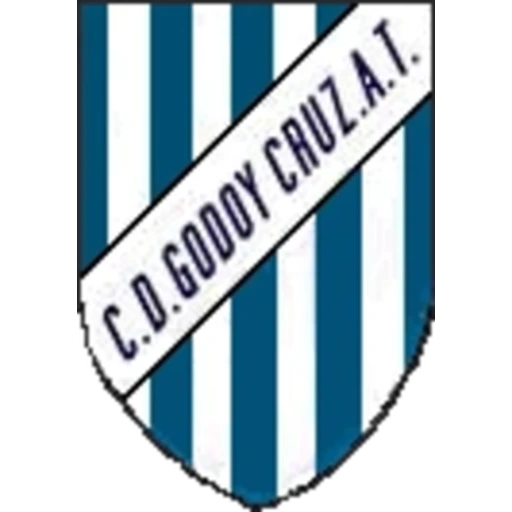
The 1945–1950 version retained the striped shield but changed its proportions and colouring. The vertical stripes became broader, while a white diagonal sash carried the name “C.D. Godoy Cruz A.T.” This was an important step toward the club's modern identity because the full reference to Godoy Cruz Antonio Tomba became incorporated directly into the emblem.
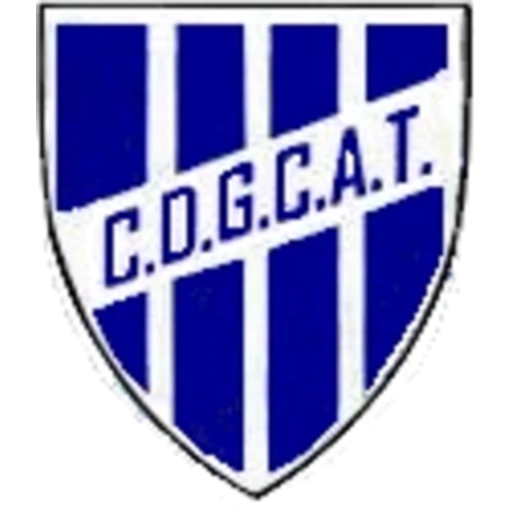
By 1960, the crest had evolved into a cleaner and more compact shield. The 1960–1987 design used dark-blue vertical stripes against a white background, crossed by a white diagonal band carrying the abbreviation “C.D.G.C.A.T.” The badge had a more traditional football-shield shape and established the visual formula that remains immediately recognisable today.
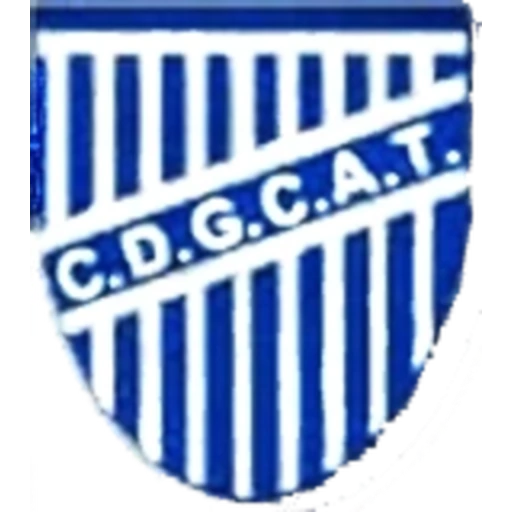
The 1987–1994 crest retained this same concept but used considerably narrower and more numerous blue-and-white stripes. The diagonal band became darker and more prominent, while the initials remained positioned across its centre.
Another refinement arrived in 1994. The 1994–2001 badge was taller and more streamlined, with a brighter blue colour and clearly defined white vertical stripes. The diagonal white band continued to carry C.D.G.C.A.T., maintaining the strong continuity with earlier versions.
Between 2001 and 2007, Godoy Cruz introduced one of the most substantial modern redesigns. The traditional striped shield was placed inside a large circular outer badge. The words “Godoy Cruz” appeared above the shield and “Mendoza” below it, explicitly emphasising the club's geographical identity.
This was particularly significant as Godoy Cruz increasingly represented Mendoza on the national stage. The circular design connected the traditional club crest with a broader regional identity.
In 2007, the circular composition was refined. The 2007–Present version shown retains the striped shield at its centre, surrounded by a grey-and-white circular border carrying “Godoy Cruz” and “Mendoza.” The blue tones became slightly more restrained and the overall composition cleaner and more balanced.
A temporary alternative appeared during 2017–2018. This crest removed the surrounding circle entirely and returned to the standalone shield. It featured a dark navy-blue outline, numerous narrow white vertical stripes and the familiar diagonal band carrying “C.D.G.C.A.T.”
The 2017–2018 badge was therefore not a complete reinvention but rather a modern interpretation of the classic striped shields used throughout much of the twentieth century. Its simplified construction made the historic identity particularly prominent.
Godoy Cruz Antonio TombaClub History
Godoy Cruz Antonio Tomba was founded in 1921 in the city of Godoy Cruz, Mendoza Province, and developed into one of the most important football institutions in western Argentina. The club's history is closely connected with the growth of football in Mendoza and, eventually, with the increasing presence of clubs from outside Buenos Aires in Argentina's national competitions.
The club originated as Sportivo Godoy Cruz, founded on 1 June 1921. During its early years it became an increasingly important sporting institution in the local community and competed in Mendoza's regional football structure. A decisive moment came in 1930, when Sportivo Godoy Cruz merged with Deportivo Bodega Antonio Tomba, a club associated with the famous Antonio Tomba winery. The merger created the institution that eventually became known as Club Deportivo Godoy Cruz Antonio Tomba.
The connection with the wine industry contributed to the nickname El Tomba, while Bodeguero – The Winemaker – also became associated with the club. Another famous nickname, El Expreso (The Express), developed from the team's reputation and the railway culture that formed an important part of the surrounding area.
For much of the twentieth century, Godoy Cruz competed primarily within the football structure of Mendoza, becoming one of the province's traditional powers. Its most important historic local rivalry developed with Andes Talleres, another club from Godoy Cruz. Meetings between the two became known as the Clásico Godoycruceño, representing the football rivalry within the city itself.
Godoy Cruz also developed important provincial rivalries with other major Mendoza clubs, particularly Independiente Rivadavia, Gimnasia y Esgrima de Mendoza and San Martín de Mendoza. These matches carried considerable importance during the era when the regional leagues played a much larger role in Argentine football.
The club's ambitions increasingly extended beyond Mendoza. Like many major provincial sides, Godoy Cruz sought a permanent place in Argentina's national league structure. Its breakthrough came during the 1990s, when the club progressed through the national divisions and won the Torneo del Interior in 1994, earning promotion to the Primera B Nacional.
That promotion transformed the scale of the club. Godoy Cruz was no longer primarily a regional Mendoza institution but a regular participant in national football. After more than a decade of competing in the second tier, El Tomba achieved its historic first promotion to the Argentine Primera División in 2006.
The initial stay in the top flight was brief. Godoy Cruz was relegated in 2007, but the setback proved temporary. The club won promotion again in 2008, beginning the period that established it as one of Argentina's most successful provincial clubs of the modern era.
Godoy Cruz subsequently achieved something particularly significant for a club from outside Argentina's traditional football centres: qualification for major CONMEBOL competitions. Strong league performances earned the club its first appearance in the Copa Libertadores in 2011, putting a team from Mendoza onto South America's biggest club stage.
Further continental campaigns followed, including appearances in both the Copa Libertadores and Copa Sudamericana. Godoy Cruz's development demonstrated how far the club had travelled from its regional beginnings, with matches against major South American opposition becoming part of its modern history.
One of the club's strongest domestic campaigns came in the 2017–18 Argentine Primera División, when Godoy Cruz finished second behind Boca Juniors. It represented the club's best top-flight league performance and confirmed its status as far more than simply a provincial outsider.
The rise of Godoy Cruz also changed the character of its Mendoza rivalries. With Independiente Rivadavia likewise possessing a large following and deep roots in the province, meetings between the clubs carry particular significance as a contest for football supremacy in Mendoza. The rivalry became especially prominent again when both clubs competed at the highest national level.