Estudiantes de La Plata Crest History
The crest history of Estudiantes de La Plata is unusually varied, moving between traditional striped shields, pennants, commemorative emblems and designs based on one of the club's oldest symbols: the oak leaf. Despite these changes, red and white have remained the defining colours throughout the club's history.
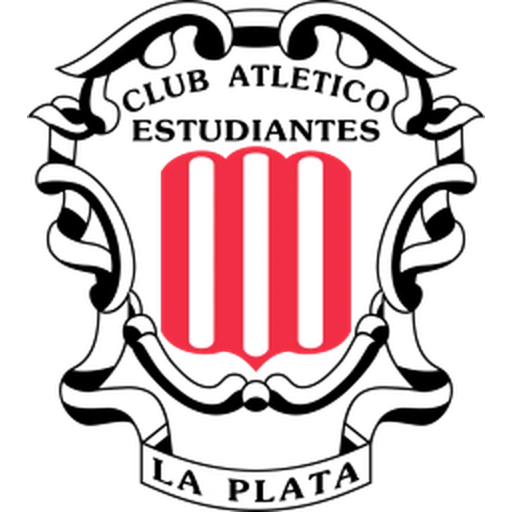
The earliest crest shown, used from 1905 to 1920, was an elaborate heraldic design. At its centre was a vertically striped red-and-white shield, surrounded by decorative scrollwork carrying the words “Club Atlético Estudiantes” and “La Plata.” Although considerably more ornate than later badges, it already established the striped identity that would repeatedly return throughout Estudiantes' history.
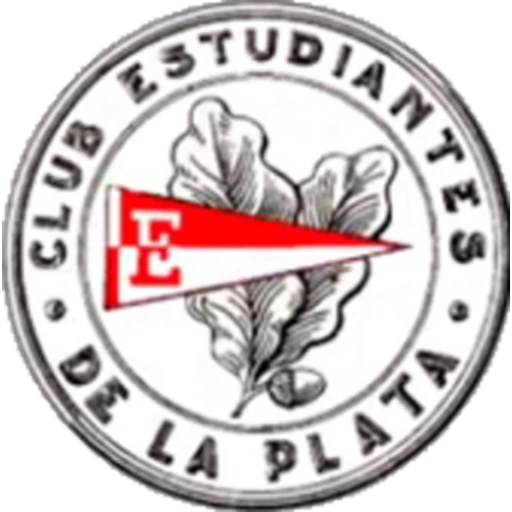
By 1934, the club had adopted a completely different emblem. The 1934–1950 crest was circular, with “Club Estudiantes de La Plata” written around the outer ring. In the centre appeared a red triangular pennant containing a stylised white “E”, placed over a group of leaves. This introduced two elements that would become particularly important in later decades: the pennant and foliage.
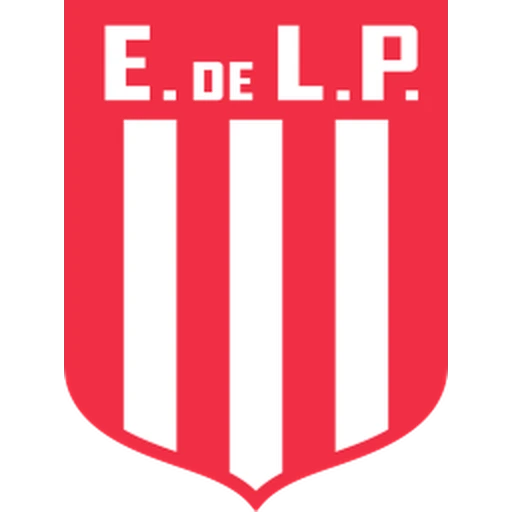
A major simplification appeared in 1968. The 1968–1982 badge consisted of a classic red shield containing three prominent white vertical stripes. Across the upper section appeared the abbreviation “E. de L.P.” for Estudiantes de La Plata. This clean design became closely associated with the club's extraordinary golden era, when Estudiantes won three consecutive Copa Libertadores titles between 1968 and 1970 and the 1968 Intercontinental Cup.
For a brief period between 1982 and 1983, the same basic shield was rendered almost entirely in black and white. The structure and abbreviation remained unchanged, making this primarily a colour variation rather than a completely new identity.
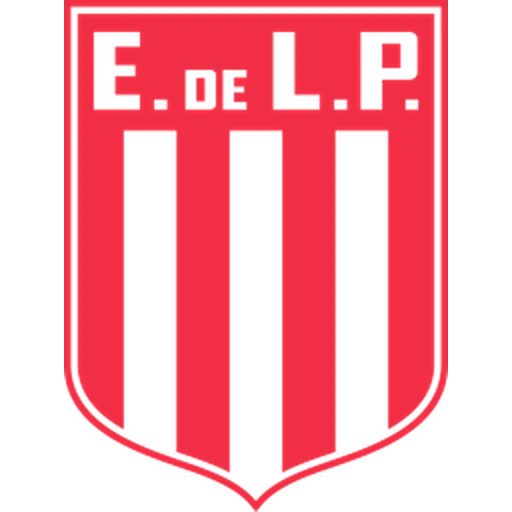
The 1983–1989 crest restored the traditional red and white, with a cleaner outline and slightly refined proportions. The striped shield and E. de L.P. inscription continued to provide a direct and highly recognisable representation of the club.
In 1989, Estudiantes introduced a special emblem celebrating its international heritage. The 1989–1994 design was circular and carried the full name “Club Estudiantes de La Plata” together with the words “Campeón Intercontinental.” Its central imagery referenced the club's historic 1968 Intercontinental Cup triumph, one of the greatest achievements in Estudiantes' history.
Between 1994 and 1996, the club adopted perhaps its simplest-ever crest: a standalone red triangular pennant containing the traditional white stylised “E.” The design removed virtually every secondary element and focused entirely on one of the club's oldest symbols.
The pennant was incorporated into a more elaborate badge in 1996. The 1996–1998 crest placed it over green oak leaves inside a white shield with a dark outline. The oak imagery revived a symbol already visible in earlier Estudiantes emblems and became an increasingly important part of the club's modern visual identity.
A dramatic redesign appeared between 1998 and 2000. This version featured a black lion inside a shield, with the Estudiantes pennant positioned beneath it. Decorative stars appeared above the badge. The lion represented another club symbol associated with the nickname El León, but this experimental crest survived for only a short period.
In 2000, Estudiantes returned to the combination of the red pennant and green oak leaves. The 2000–2004 version abandoned the surrounding shield, leaving the pennant and foliage as the principal elements. Gold stars were arranged around the lower portion to commemorate the club's historic achievements.
From 2004 to 2007, the same concept was refined. The pennant became more prominent, the oak leaves were simplified and the arrangement of gold stars around the emblem was altered.
Further modifications followed between 2007 and 2009, with changes to the number and positioning of the stars while the central pennant-and-leaves composition remained intact.
The 2009–2010 and 2010–2012 versions continued this visual language. Gold stars surrounded the historic pennant and foliage, emphasising Estudiantes' extensive collection of domestic and international honours. These badges became particularly associated with another successful era that included the club's 2009 Copa Libertadores triumph.
After years dominated by the pennant-and-oak design, Estudiantes eventually returned to the traditional striped shield.
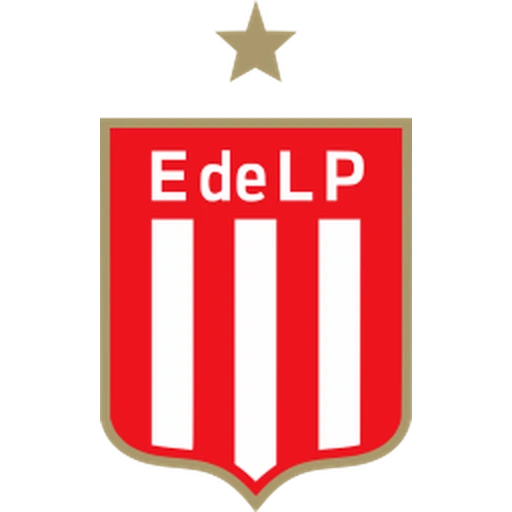
The 2019–2025 crest strongly revived the identity used during the club's golden era. It featured a red shield with three white vertical stripes, the abbreviation “E de LP” across the upper section and gold detailing around the border. A gold star positioned above the shield provided a link with the club's championship heritage.
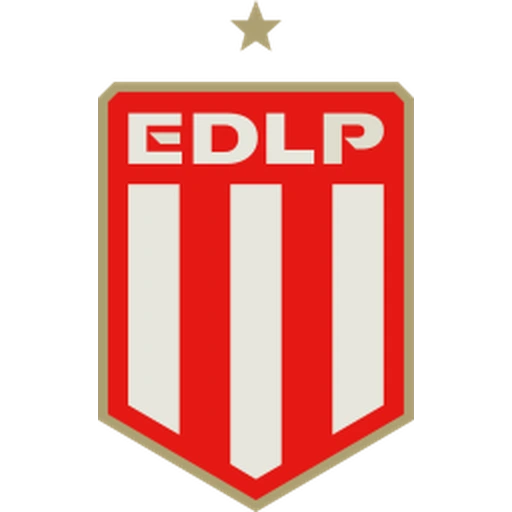
For 2026, Estudiantes introduced another modernisation of this historic concept. The 2026–Present crest retains the red shield and three white vertical stripes but uses a more geometric and angular shape. The abbreviation has been simplified to “EDLP”, displayed in a bold contemporary typeface across the top.
A gold-toned outline provides additional definition, while a single gold star remains above the badge. The result is a more compact and digitally adaptable interpretation of the traditional Estudiantes shield.
Estudiantes de La Plata Club History
Founded in 1905, Estudiantes de La Plata is one of Argentina’s most successful and historically important football clubs. Known as Los Pincharratas and El León, the club is particularly famous for its extraordinary international success during the late 1960s and for developing a football culture built around tactical discipline, organisation and competitive intensity.
Estudiantes was founded on 4 August 1905 in La Plata by a group of young footballers who wanted to create a club primarily dedicated to football. The name “Estudiantes” (Students) reflected the backgrounds of several of its founders, many of whom were students in the university city.
The club adopted red-and-white vertical stripes, colours that have remained central to its identity ever since. Estudiantes established its home at 1 y 57 in La Plata, where the historic Estadio Jorge Luis Hirschi eventually developed.
Estudiantes became an important force during the amateur era and won the 1913 Primera División championship. One of the club's most celebrated early generations emerged during the 1930s, centred around the famous attacking line known as Los Profesores. Players such as Miguel Ángel Lauri, Alejandro Scopelli, Alberto Zozaya, Manuel Ferreira and Enrique Guaita became renowned for their technical and attacking football.
The club experienced more difficult circumstances during the early 1950s, including relegation, but quickly recovered and returned to the Primera División. The defining transformation in Estudiantes' history, however, began during the 1960s.
Under coach Osvaldo Zubeldía, Estudiantes developed a highly organised and tactically sophisticated team. Detailed preparation, set pieces, pressing and intense competitive football became hallmarks of the side. At a time when Argentine football was dominated by the traditional major clubs, Estudiantes challenged the established hierarchy.
The breakthrough came in 1967, when Estudiantes won the Metropolitano championship. The title was historic because the club became the first team outside Argentina's traditional “Big Five” to win a professional-era league championship.
Domestic success immediately developed into an extraordinary period of international dominance.
In 1968, Estudiantes won the Copa Libertadores for the first time, defeating Palmeiras in the final series. The victory qualified Los Pincharratas for the Intercontinental Cup against European champions Manchester United.
Estudiantes won the first leg 1–0 in Buenos Aires before earning a 1–1 draw at Old Trafford, becoming 1968 Intercontinental Cup champions. The triumph remains one of the defining moments in club history and established Estudiantes as a major international force.
The club successfully defended the Copa Libertadores in 1969, defeating Nacional of Uruguay, and won the competition for an unprecedented third consecutive time in 1970, overcoming Peñarol.
Three consecutive Libertadores titles between 1968 and 1970 transformed Estudiantes into one of the dominant clubs in South American football. The team also won the 1969 Interamerican Cup, further strengthening its international reputation.
Estudiantes' highly competitive style generated both admiration and controversy. Zubeldía's team became celebrated for tactical innovation and preparation but was also criticised for its physical approach and gamesmanship. Regardless of interpretation, its influence on Argentine and South American football was substantial.
After the golden generation faded, Estudiantes remained an important club but endured a less successful period during much of the 1970s.
Another excellent generation emerged during the early 1980s. Under Carlos Bilardo, himself closely connected with the successful 1960s Estudiantes side, the club won the 1982 Metropolitano championship.
Bilardo subsequently became manager of Argentina and carried many of the tactical principles associated with Estudiantes into international football, eventually guiding the national team to victory at the 1986 FIFA World Cup.
Estudiantes continued its domestic success by winning the 1983 Nacional championship, confirming its return to the summit of Argentine football.
The following decade was more difficult, and in 1994 the club was relegated to the second division. The setback proved temporary. Estudiantes dominated the 1994–95 Primera B Nacional, earning an immediate return to the top flight.
An important new generation subsequently emerged from the club's youth system, most famously including Juan Sebastián Verón, who would become one of the greatest symbols in Estudiantes' modern history.
The club entered another golden period during the 2000s. Under coach Diego Simeone, Estudiantes won the 2006 Apertura, defeating Boca Juniors 2–1 in a championship play-off after the clubs finished level on points.
The title ended more than two decades without a top-flight championship and marked the beginning of another internationally successful era.
With Verón back at his boyhood club, Estudiantes reached the final of the 2008 Copa Sudamericana, narrowly losing to Internacional of Brazil.
One year later came the club's greatest modern international achievement.
Under coach Alejandro Sabella, Estudiantes won the 2009 Copa Libertadores. After drawing the first leg of the final against Cruzeiro, Los Pincharratas travelled to Brazil and won 2–1 in Belo Horizonte, securing their fourth Copa Libertadores title.
The victory came 39 years after their previous Libertadores triumph and restored Estudiantes to the summit of South American football.
As continental champions, Estudiantes competed in the 2009 FIFA Club World Cup and reached the final against Barcelona. Estudiantes led for much of the match before Barcelona equalised late and eventually won 2–1 after extra time. Despite the defeat, the performance reinforced Estudiantes' reputation as an exceptionally difficult opponent on the international stage.
Domestic success continued with the 2010 Apertura championship, adding another Argentine league title to the club's honours.
The club also spent many years away from its traditional stadium while the historic ground at 1 y 57 underwent complete reconstruction. Estudiantes finally returned to the modernised Estadio Jorge Luis Hirschi, commonly branded UNO, in 2019. The return was highly symbolic, reconnecting the club with the location that had been its home for generations.
Another successful period began during the 2020s. Estudiantes won the 2023 Copa Argentina, defeating Defensa y Justicia in the final and adding another major national trophy.
Success continued in 2024, when Estudiantes captured the Copa de la Liga Profesional, defeating Vélez Sarsfield on penalties in the final. These achievements confirmed the club's return as a regular contender for major Argentine honours.
The defining rivalry throughout Estudiantes' history is with Gimnasia y Esgrima La Plata. Their meetings form the Clásico Platense, one of Argentina's oldest and most intense city derbies.
Both clubs represent La Plata, and their stadiums are located only a short distance apart. The rivalry extends across generations of families and neighbourhoods, making the division between Estudiantes and Gimnasia fundamental to the football culture of the city.
For Estudiantes supporters, success against Gimnasia carries enormous importance regardless of league position. While Estudiantes' international achievements have given the club a considerably broader profile, the Clásico Platense remains the emotional centre of its domestic identity.