Nickname(s):Los Cuervos(The Crows), El Ciclón(The Cyclone)
Founded:1908
Stadium:Estadio Pedro Bidegain(El Nuevo Gasómetro)
Capacity:47,964
1908-1921
1921-1941
1941-1954
1954-1960
1960-1994
1994-1996
1996-2000
2000-2002
2002-2007
2007-2015
2015-2025
2025-Present
CA San Lorenzo de Almagro Crest History
The crest history of CA San Lorenzo de Almagro is characterised by exceptional continuity. Since the club's foundation in 1908, virtually every principal crest has featured the same three defining elements: a shield, vertical red-and-blue stripes and the circular CASLA monogram. Most changes have therefore involved proportions, typography, borders and shades of colour rather than fundamental alterations to the club's identity.
The original 1908–1921 crest already established the basic design that survives today. A pointed shield was divided into alternating red and dark-blue vertical stripes, while a white circular field in the centre contained the intertwined initials CASLA, representing Club Atlético San Lorenzo de Almagro. Remarkably, all the essential elements of the modern badge were therefore present from the beginning.
Between 1921 and 1941, the crest was subtly refined. The shape of the shield became slightly broader, while the central monogram was redrawn with more compact lettering. The red-and-blue striped background remained unchanged, reinforcing an identity that was already firmly established.
The 1941–1954 version introduced a noticeably different shield shape. The sides became straighter and the upper edge more pronounced, while the vertical stripes were made narrower and more numerous. The central white circle containing the CASLA monogram remained the focal point.
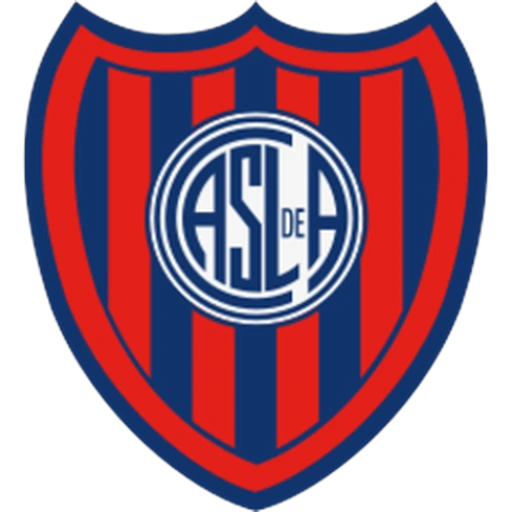
In 1954, San Lorenzo adopted a cleaner and brighter interpretation. A prominent white outer border surrounded the shield, while the red and blue became more vivid. The central monogram was rendered in red inside a white circle, creating stronger contrast with the striped background.
The 1960–1994 crest represented another significant refinement and became one of the club's longest-serving designs. The shield received a strong dark-blue outer border, while the central CASLA monogram was changed to blue. The red-and-blue stripes became more regular and symmetrical, giving the badge a more balanced appearance.
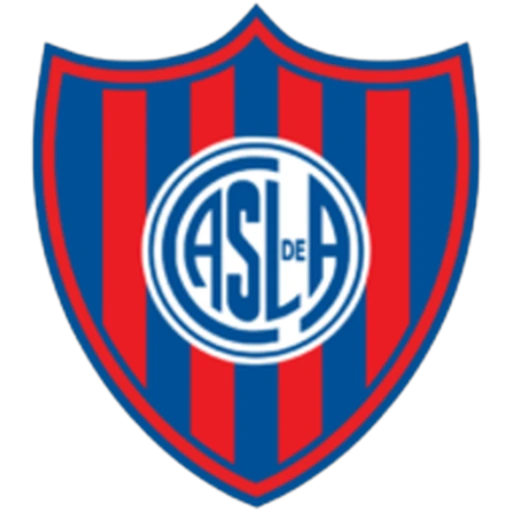
A lighter variation appeared between 1994 and 1996. The dark outer border was replaced by a prominent white surround, and the CASLA monogram returned to red. Although the fundamental design remained unchanged, the lighter treatment gave the crest a noticeably different appearance.
Between 1996 and 2000, the shield became broader and more rounded. The red-and-blue stripes were strengthened and the central monogram remained red inside its white circular field. A thin dark outline helped separate the shield from surrounding backgrounds.
The 2000–2002 version made another subtle adjustment to the colour balance. The central CASLA initials were rendered in blue, while the proportions of the shield and stripes were slightly modified.
A more substantial modernisation arrived in 2002. The 2002–2007 crest featured cleaner geometry, a heavier dark-blue border and brighter red stripes. The central circular monogram was carefully redrawn, producing a sharper emblem better suited to modern reproduction and digital applications.
In 2007, the badge was refined again. The shield became slightly narrower and more pointed at the bottom, while the outer blue border was reduced. The central CASLA monogram remained prominent, maintaining the direct connection with the original 1908 design.
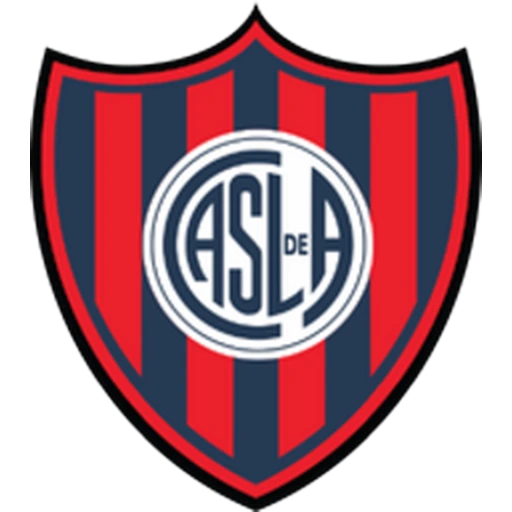
The 2015–2025 version introduced a particularly strong visual treatment. A bold black outer outline surrounded the traditional red-and-dark-blue shield, giving the badge greater contrast. The central monogram remained blue within a white circle, while the stripes were simplified and strengthened.
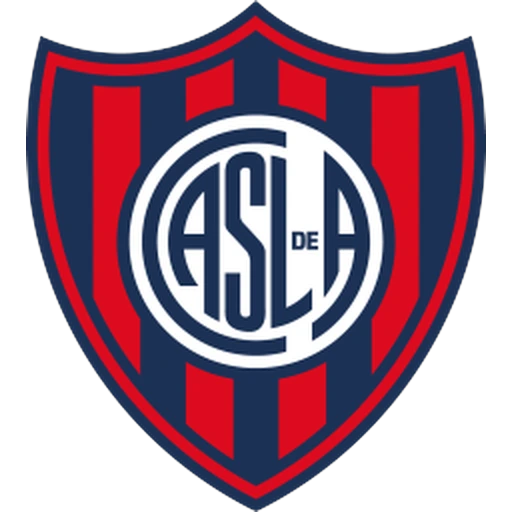
In 2025, San Lorenzo introduced another updated version of its historic crest. The 2025–Present emblem removes the heavy black outline and restores a dark navy-blue border, creating a closer visual relationship with several earlier versions of the badge. The red stripes are brighter and more clearly defined, while the central white circle contains a cleaner and more precisely drawn CASLA monogram.
The current crest therefore represents an evolution rather than a reinvention. Its cleaner lines and stronger proportions make it suitable for contemporary digital and commercial use while preserving the same fundamental identity established more than a century ago.
The red-and-blue colours themselves are deeply embedded in San Lorenzo's history. Known in Argentina as azulgrana, the combination has become inseparable from the club and has produced another widely used name for its supporters and teams: Los Azulgranas.
Few major Argentine clubs have maintained such a consistent visual identity. From 1908 to the present day, San Lorenzo has never abandoned the combination of the striped shield and circular CASLA monogram.
The modern 2025–Present badge is therefore immediately recognisable as a descendant of the original 1908 emblem.
CA San Lorenzo de Almagro Club History
Founded in 1908, Club Atlético San Lorenzo de Almagro is one of Argentina's most historic and successful football clubs. Traditionally associated with the Boedo neighbourhood of Buenos Aires, San Lorenzo is one of Argentina's famous “Big Five” and is known by several nicknames, most notably “El Ciclón” (The Cyclone) and “Los Cuervos” (The Crows).
San Lorenzo was officially founded on 1 April 1908 by a group of boys who played football in the streets of the Almagro district. A key figure in the club's creation was the Salesian priest Lorenzo Massa, who allowed the youngsters to use the grounds of his church after becoming concerned about the dangers of playing football in the streets.
The name San Lorenzo de Almagro reflected both Father Lorenzo Massa and the club's geographical origins. The young institution adopted red and blue vertical stripes, colours that have remained inseparable from San Lorenzo ever since and produced the description Azulgrana.
San Lorenzo progressed rapidly through organised Argentine football and reached the top level during the 1910s. The club soon became one of the country's strongest teams, winning championships during the amateur era and developing a substantial following in Buenos Aires.
The 1920s brought major success. San Lorenzo won league championships in 1923, 1924 and 1927, establishing itself among the elite of Argentine football before the introduction of professionalism.
After professional football began in 1931, San Lorenzo continued to prosper. The club won the 1933 championship, while its exciting attacking football and ability to overwhelm opponents helped establish the famous nickname “El Ciclón.”
Another celebrated championship arrived in 1946. That team became particularly admired for its technically sophisticated and attacking style. Following the season, San Lorenzo undertook a famous tour of Spain and Portugal, producing impressive performances that enhanced the club's international reputation.
An important part of San Lorenzo's identity was its original stadium in Boedo, the Estadio Gasómetro, which opened in 1916 on Avenida La Plata. Its enormous wooden terraces and intense atmosphere made it one of the legendary grounds of Argentine football. For generations of supporters, the Gasómetro became inseparable from the club itself.
San Lorenzo enjoyed another outstanding period during the 1960s and early 1970s. The legendary 1968 team, known as “Los Matadores” (The Killers), won the Metropolitano championship without losing a match, becoming the first team to complete an Argentine professional championship undefeated.
Further titles followed in 1972, when San Lorenzo achieved the remarkable feat of winning both the Metropolitano and Nacional championships in the same year. Another Nacional championship followed in 1974.
The late 1970s and early 1980s brought one of the most difficult periods in the club's history. San Lorenzo lost ownership of its historic Avenida La Plata ground, and the Gasómetro closed in 1979 before eventually being demolished. The loss of the stadium remains one of the most emotional episodes in San Lorenzo's history.
Sporting difficulties followed. In 1981, San Lorenzo became the first of Argentina's traditional Big Five to be relegated from the Primera División.
The response from supporters was extraordinary. Despite playing in the second division, San Lorenzo attracted enormous crowds throughout 1982, frequently using larger neutral stadiums because of the number of supporters attending its matches. The club immediately won promotion back to the Primera División, and this period became an important symbol of the loyalty of the San Lorenzo fan base.
For more than a decade, the club played without a permanent home. That situation finally ended in 1993 with the inauguration of the Estadio Pedro Bidegain, better known as the Nuevo Gasómetro, in the Bajo Flores area of Buenos Aires.
Two years later, San Lorenzo won the 1995 Clausura championship, ending a 21-year wait for a top-flight league title. The success produced enormous celebrations and marked the club's return to the summit of Argentine football.
Another outstanding team emerged in 2001 under coach Manuel Pellegrini. San Lorenzo won the Clausura championship with a highly impressive campaign and later captured the Copa Mercosur, giving the club its first major international trophy.
International success continued with victory in the 2002 Copa Sudamericana, strengthening San Lorenzo's position in South American football.
The club won another Argentine championship in the 2007 Clausura, before capturing the 2013 Inicial championship under coach Juan Antonio Pizzi.
The greatest international achievement in San Lorenzo's history followed in 2014. Despite its long domestic tradition, the Copa Libertadores had remained the major trophy missing from the club's honours.
Under coach Edgardo Bauza, San Lorenzo reached the Libertadores final against Paraguayan club Nacional. After a 1–1 draw in Asunción, San Lorenzo won the return match 1–0 at the Nuevo Gasómetro, with Néstor Ortigoza scoring the decisive penalty.
San Lorenzo were finally champions of South America.
Winning the Libertadores was particularly significant because San Lorenzo had been the only member of Argentina's traditional Big Five that had never won the competition. The triumph allowed the club to participate in the 2014 FIFA Club World Cup, where it reached the final before losing to Real Madrid.
The defining rivalry in San Lorenzo's history is with CA Huracán. Their meetings form one of Argentina's oldest traditional derbies and are commonly known as the Clásico Porteño or Clásico de Barrio.
The rivalry developed from the geographical proximity of San Lorenzo's traditional home in Boedo and Huracán's base in Parque Patricios. Although both clubs later experienced changes in their stadium locations, the neighbourhood character of the rivalry survived. For San Lorenzo supporters, matches against Huracán remain among the most important fixtures of the season.
San Lorenzo also maintains major rivalries with the other members of Argentina's Big Five — Boca Juniors, River Plate, Independiente and Racing Club — but Huracán remains its traditional neighbourhood rival.
One of the most important movements in the club's modern history has taken place away from the pitch. Supporters campaigned for years for San Lorenzo to recover its historic connection with Avenida La Plata in Boedo. The campaign, widely known as the Vuelta a Boedo (Return to Boedo), became a major cultural movement involving generations of supporters.
The club eventually recovered the historic property, creating the possibility of building a new stadium on the site of the old Gasómetro. The return to Boedo represents far more than a stadium project for supporters: it symbolises the restoration of a central part of San Lorenzo's historical identity.
The nickname “Los Cuervos” (The Crows) is another distinctive part of that identity. It originated from the black clothing traditionally worn by Catholic priests and consequently became associated with Father Lorenzo Massa and the club that grew around his support.