Nickname(s):Los Millonarios(The Millionaires), La Banda(The Band)
Founded:1901
Stadium:Estadio Mâs Monumental (El Monumental)
Capacity:85,018
1914-1918
1918-1928
1928-1930
1930-1931
1931-1932
1932-1933
1933-1935
1935-1936
1936-1938
1938
1939-1941
1941-1949
1950-1970
1970-1985
1985-1986
1986-1993
1993-1998
1998-2006
2001-2002
2006-2014
2014-2022
2022-Present
CA River Plate Crest History
The crest history of CA River Plate shows how one of the most famous identities in world football gradually developed around three enduring elements: the club's white shield, red diagonal sash and intertwined CARP monogram. River experimented considerably with its emblem during the first half of the twentieth century, but from the 1940s onward these elements became increasingly consistent.
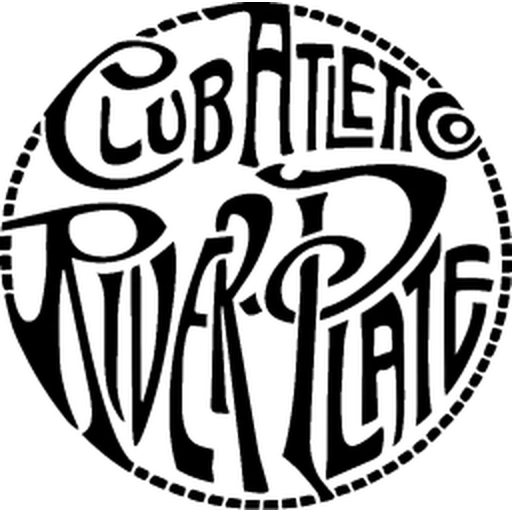
The earliest crest shown, used from 1914 to 1918, was dramatically different from the modern badge. It consisted of an ornate circular composition in which the words “Club Atlético River Plate” were transformed into decorative lettering. There was no shield or red sash, making it one of the most distinctive designs in the club's history.
Between 1918 and 1928, River adopted another circular emblem, this time centred around an elaborate intertwined monogram formed from the club's initials. This was an important development because the CARP monogram would eventually become one of the fundamental components of River's identity.
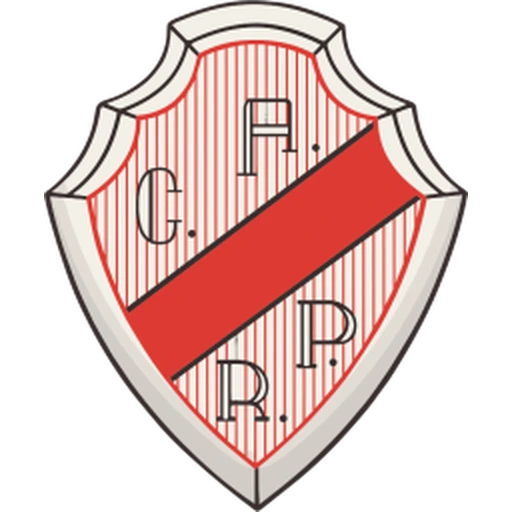
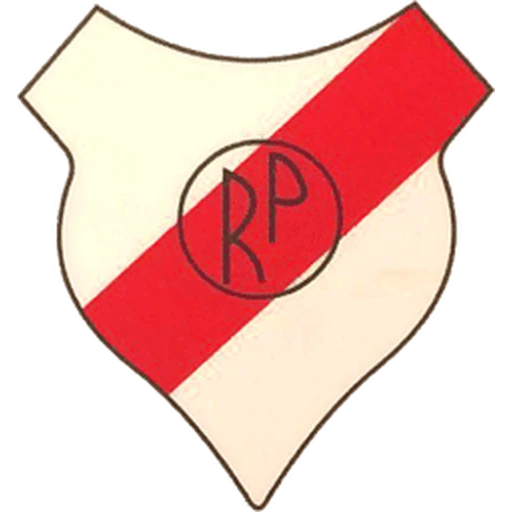
The 1928–1930 crest introduced the feature that would ultimately define River Plate. A traditional shield appeared with a red diagonal sash running across a white background. Fine vertical red lines filled the shield, while the club initials were incorporated into the design. The famous Banda Roja had now become part of River's official visual identity.
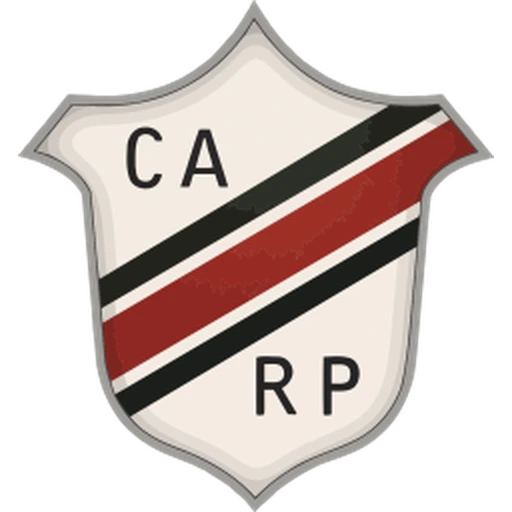
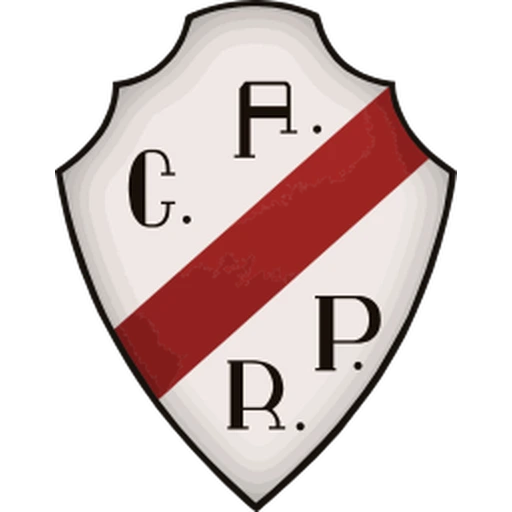
For 1930–1931, the shield was simplified. The red sash was accompanied by a dark parallel stripe, while the letters C, A, R and P were positioned individually around the badge. The 1931–1932 version removed the additional dark stripe and returned the design closer to the familiar white shield crossed by a single red band.
River briefly abandoned the shield in 1932–1933. A circular cream-coloured badge appeared with a horizontal red band carrying “C.A.R.P.” This represented one of several experiments during the 1930s with alternatives to the traditional shield.
Between 1933 and 1935, the club introduced a standalone red CARP monogram. No shield or sash surrounded it, placing complete emphasis on the club's initials.
The 1935–1936 crest returned to the white shield and red diagonal band. A small circular monogram was positioned at the centre where the sash crossed the badge, combining River's two emerging visual traditions.
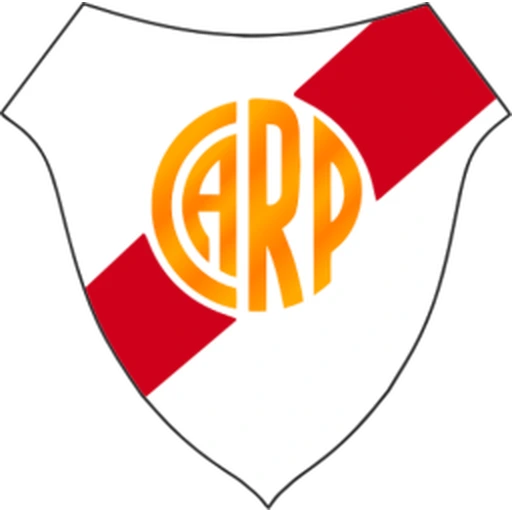
For 1936–1938, River again used a circular emblem dominated by a large red CARP monogram. A related experiment appeared in 1938, when an orange monogram was placed inside a white shield crossed by sections of the red sash.
Between 1939 and 1941, another circular badge appeared. The elongated letters CARP filled a silver-grey disc, producing one of the most minimalist designs in River's history.
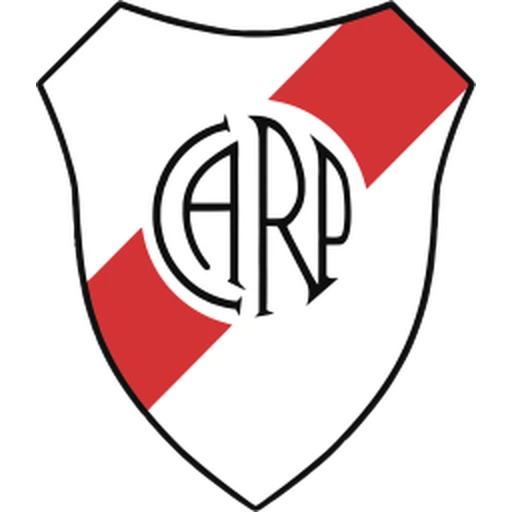
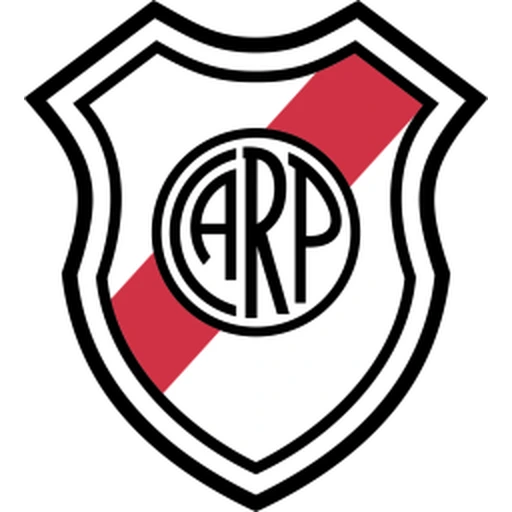
A decisive change came in 1941. The 1941–1949 crest combined the white shield, red diagonal sash and black CARP monogram into a single composition. This established the fundamental design that has defined River Plate ever since.
The 1950–1970 version refined this formula. The shield became more symmetrical, the black outline more prominent and the red sash broader. The large circular CARP monogram occupied the centre of the badge, overlapping the sash.
Only minor changes followed between 1970 and 1985. The overall structure remained identical, although the proportions of the shield, sash and monogram were adjusted. By this point, River's visual identity had become firmly established.
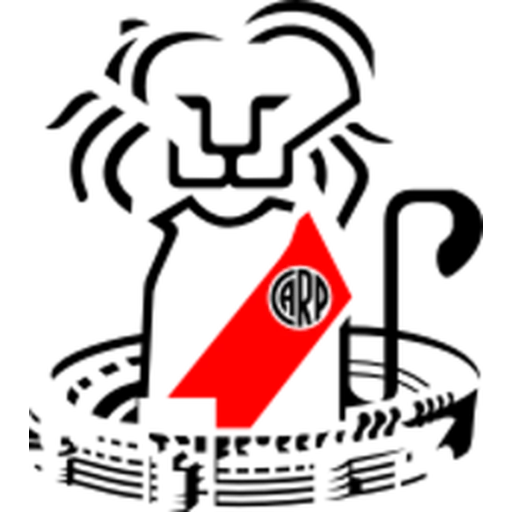
A radical redesign arrived in 1985. The traditional shield was replaced by an elaborate illustration featuring a lion emerging above the Monumental stadium, with a River shield incorporated into the composition. The lion symbolised strength and was connected with the successful River side of the period.
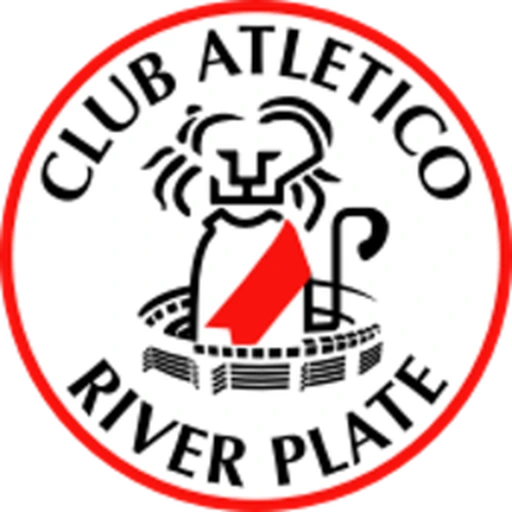
The concept was refined between 1986 and 1993 into a circular emblem. The words “Club Atlético River Plate” surrounded the lion-and-stadium motif, while the traditional white shield and red sash remained visible at its centre. Although highly distinctive, this experiment represented a major departure from River's historically simple identity.
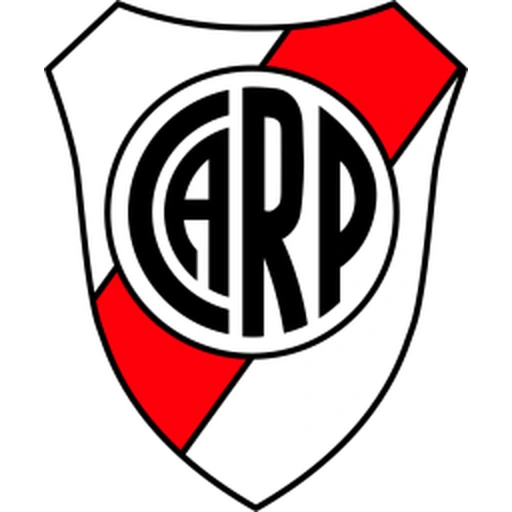
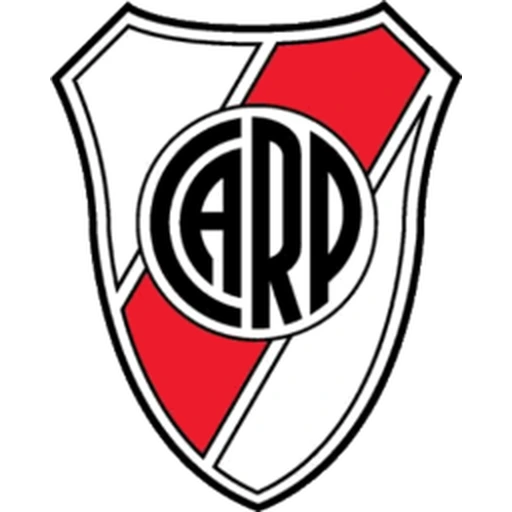
In 1993, River returned decisively to its traditional crest. The 1993–1998 badge once again featured the white shield crossed by the red diagonal sash with the black CARP monogram in the centre. Multiple black outlines gave this version a heavier appearance.
The 1998–2006 crest refined the same design with thinner outlines and a brighter red sash, creating a cleaner and more modern interpretation without changing the underlying identity.
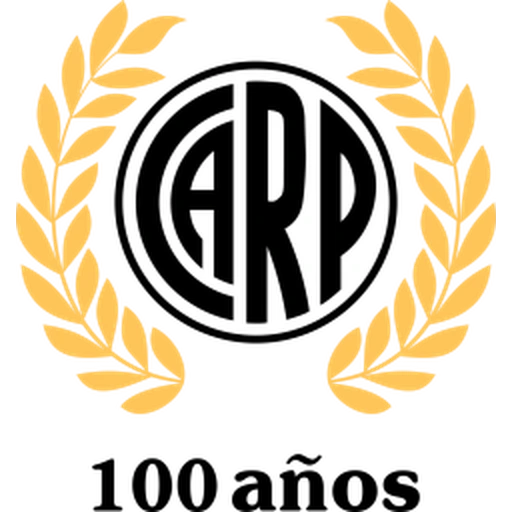
River celebrated its centenary in 2001 with a special commemorative emblem. The CARP monogram was surrounded by golden laurel branches, accompanied by the inscription “100 años.” Rather than replacing the traditional identity permanently, it served as a tribute to the club's first century.
Between 2006 and 2014, the standard shield was modernised again. The red sash, black monogram and layered outline remained, but the proportions became cleaner and more balanced. The 2014–2022 version made further subtle adjustments while preserving virtually the same overall composition.
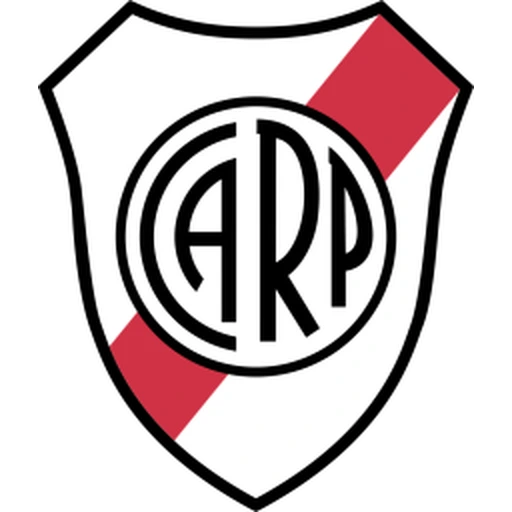
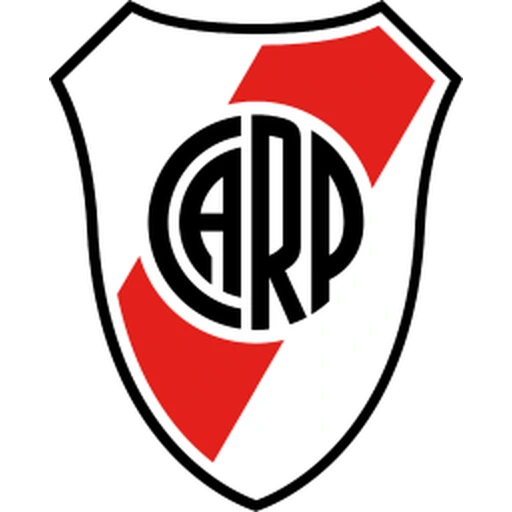
A significant simplification arrived in 2022. River removed much of the additional internal outlining that had accumulated around the crest over previous decades. The shield became cleaner and flatter, while the red diagonal sash and black CARP monogram were given greater prominence.
The 2022–Present crest therefore represents a return to the essential elements of River Plate's historic identity rather than a completely new design. The simplified construction makes the badge more closely resemble some of the classic twentieth-century versions while adapting it for modern digital and commercial use.
CA River Plate Club History
Club Atlético River Plate was founded on 25 May 1901 in the La Boca district of Buenos Aires, traditionally said to have emerged from the merger of two local clubs, Santa Rosa and La Rosales. Although River would eventually become closely associated with the affluent northern neighbourhood of Núñez, its origins were in the same working-class port district as its greatest rival, Boca Juniors.
River's famous white shirt with a red diagonal sash appeared during the club's early years and became one of the most recognisable football shirts in the world. After competing in the lower divisions, River reached Argentina's top level in 1908 and won its first major league championship in 1920, during the amateur era.
The introduction of professional football in Argentina in 1931 transformed River's history. The club spent heavily on leading players, most famously acquiring Carlos Peucelle and later Bernabé Ferreyra for enormous fees by contemporary standards. These expensive transfers helped create the nickname Los Millonarios – The Millionaires, which has remained with River ever since.
River moved north through Buenos Aires before eventually establishing itself in Núñez. In 1938, the club opened the monumental stadium that became its permanent home. Today officially known as the Estadio Mâs Monumental, it developed into Argentina's largest football stadium and has also served as the principal home of the Argentine national team.
The 1940s produced one of the most celebrated teams in South American football history. River's legendary attacking unit known as La Máquina included players such as José Manuel Moreno, Adolfo Pedernera, Ángel Labruna, Félix Loustau and Juan Carlos Muñoz. Rather than depending on fixed attacking positions, the players constantly exchanged roles, creating a fluid style of football that was remarkably advanced for its era.
River won multiple championships during this period and became one of Argentina's dominant institutions. Ángel Labruna, in particular, became one of the greatest symbols in club history as both player and later coach. His goals, personality and deep identification with River made him an enduring figure for generations of supporters.
Central to River's identity is its rivalry with Boca Juniors. Because both clubs originated in La Boca, their rivalry developed early before River moved to the north of the city. Their meetings became known as the Superclásico, eventually growing into Argentina's most famous football fixture and one of the best-known club rivalries anywhere in the world. River's Millonarios identity and Boca's association with the port neighbourhood provided an additional social mythology around a rivalry already driven by sporting competition.
After the successes of the 1940s and 1950s, River entered a long championship drought. Despite producing outstanding teams and players, the club went 18 years without a league title between 1957 and 1975. The drought finally ended under Ángel Labruna, who returned as coach and guided River to championships in 1975. The breakthrough began another successful period in which the club won numerous domestic titles.
River's youth system also became one of the foundations of its success. Over the decades, the club developed or launched the careers of players such as Omar Sívori, Daniel Passarella, Norberto Alonso, Ramón Díaz, Ariel Ortega, Hernán Crespo, Javier Saviola, Pablo Aimar and Javier Mascherano, reinforcing River's reputation for technically gifted attacking football.
The club's long pursuit of continental success finally ended in 1986. Under coach Héctor Veira, River won its first Copa Libertadores, defeating América de Cali in the final. River then defeated Steaua București in Tokyo to win the Intercontinental Cup, becoming world club champion for the first time.
A second Copa Libertadores arrived in 1996, again against América de Cali. A young Hernán Crespo scored both goals in the decisive second leg at the Monumental, giving River another major continental triumph during a successful era under coach Ramón Díaz.
The early twenty-first century brought further domestic championships but eventually one of the greatest crises in River's history. Poor sporting results combined with institutional and financial difficulties, and in 2011 the unthinkable happened: River Plate were relegated from the Primera División after losing a promotion/relegation playoff against Belgrano.
Relegation was one of the most traumatic events in Argentine football history. River spent the 2011–12 season in the Primera B Nacional, but returned to the top division at the first attempt. Rather than defining the club permanently, the experience became the starting point for one of the most successful periods in River's history.
The central figure in that revival was Marcelo Gallardo, who became coach in 2014. River rapidly returned to international prominence, winning the Copa Sudamericana in 2014 and the Copa Libertadores in 2015, alongside several other continental trophies.
The defining moment of the Gallardo era came in the 2018 Copa Libertadores. For the first time, River and Boca Juniors met in the final of South America's most prestigious club competition. After a 2–2 first leg at Boca's La Bombonera, the return match was postponed following serious incidents outside the Monumental and eventually relocated to the Santiago Bernabéu in Madrid.
On 9 December 2018, River defeated Boca 3–1 after extra time, winning the final 5–3 on aggregate. Because it combined the Copa Libertadores, the Superclásico and the extraordinary circumstances surrounding the match, the victory became one of the most celebrated moments in River Plate's history and added an entirely new chapter to the rivalry between the clubs.
River's rivalry with Boca overwhelmingly dominates its football culture, but the club also shares historic rivalries with the other members of Argentina's traditional Cinco Grandes: Independiente, Racing Club and San Lorenzo. Matches against these clubs have played an important role in Argentina's championship history, although none approaches the cultural importance of the Superclásico.