Stadium:Estadio Ciudad de Lanús – Néstor Díaz Pérez (La Fortaleza)
Capacity:47,027
1915-1931
1931-1932
1932-1935
1935-1937
1937-1940
1940-1950
1950-1955
1955-1960
1960-1974
1974-1977
1977-1980
1980-1992
1992-1996
1996-1998
1998-2004
2004-2007
2007-2009
2009-2012
2012-2013
2013-2014
2014-2017
2015
2017-2024
2021
2025-Present
CA Lanús Crest History
The crest history of CA Lanús is characterised by remarkable continuity. Since the club's foundation in 1915, almost every principal emblem has revolved around an intertwined CAL monogram and the distinctive garnet colour (granate) that gave the club its famous nickname “El Granate.” Rather than repeatedly replacing its identity, Lanús has continuously refined the same basic concept.
The original 1915–1931 crest introduced the fundamental symbol immediately. It consisted of a circular garnet badge containing large intertwined white letters representing Club Atlético Lanús. This early CAL monogram established the visual foundation that has survived for more than a century.
Between 1931 and 1932, the badge became considerably more decorative. The circular monogram was surrounded by a distinctive scalloped outer edge, while the intertwined lettering was redrawn into a more geometric composition.
The 1932–1935 version retained the scalloped border but introduced an even more intricate monogram. Multiple circular lines surrounded the letters, creating a dense emblem that anticipated many later Lanús designs.
In 1935, the crest was simplified. A smooth circular outline replaced the scalloped edge and the central monogram was radically redrawn with thinner, more abstract lines. This 1935–1937 badge was one of the most minimalist interpretations of the club's initials.
Between 1937 and 1940, Lanús returned to the decorative outer border. The CAL monogram became heavier and more structured, combining the circular form of the original emblem with the scalloped appearance introduced earlier in the decade.
The 1940–1950 version continued this development, with thicker white lettering and a darker garnet central field. By this period, the intertwined monogram had become firmly established as the central element of the club's visual identity.
A major departure occurred in 1950, when Lanús adopted a triangular pennant rather than a conventional circular crest. The garnet flag contained a small version of the traditional monogram near its centre. A similar pennant remained in use between 1955 and 1960, although the central emblem was modified.
In 1960, Lanús returned permanently to the circular format. The 1960–1974 badge featured a large garnet field with a scalloped white outer border and the familiar geometric monogram prominently displayed in white.
Between 1974 and 1977, the colour arrangement was reversed. The badge became predominantly white, with the CAL monogram and circular outlines rendered in garnet. This created one of the lightest-looking crests in the club's history.
The 1977–1980 design returned to a garnet centre and strengthened the intertwined lettering. The scalloped outer border remained, reinforcing the traditional appearance.
Between 1980 and 1992, the monogram was redrawn once again. Small decorative dots were incorporated into the composition and the lettering became more angular and experimental. Despite these details, the fundamental circular garnet identity remained unchanged.
The 1992–1996 crest simplified the design substantially. Decorative elements disappeared, leaving a clean garnet circle surrounded by white outlines and containing a clearly defined white CAL monogram.
Only minor adjustments followed between 1996 and 1998, particularly to the thickness and positioning of the intertwined letters.
The 1998–2004 version continued the same visual approach, with subtle refinements to the monogram and circular borders. By this period, Lanús had effectively standardised the emblem around the historic CAL symbol.
Between 2004 and 2007, the club revived the traditional scalloped outer edge, giving the badge a stronger resemblance to several designs from the 1930s and 1960s.
Beginning in 2007, stars started appearing above versions of the crest to commemorate major sporting achievements. The underlying monogram remained unchanged, demonstrating that Lanús preferred to represent its growing honours around the badge rather than fundamentally redesigning it.
The 2009–2012 and 2012–2013 versions continued this approach, combining the traditional garnet monogram with commemorative stars above the emblem.
By 2013–2014, three gold stars appeared above the crest, reflecting the increasing number of major honours recognised by the club.
In 2014, Lanús introduced another cleaner interpretation of its historic badge. The 2014–2017 crest featured a rich garnet scalloped border, a matching central field and a crisp white CAL monogram. The championship stars were removed from the regular design itself.
A special emblem was created in 2015 to commemorate the club's centenary. The badge incorporated 1915–2015, the number 100 and decorative garnet ribbons surrounding the traditional monogram, celebrating one hundred years of Club Atlético Lanús.
The 2017–2024 crest again featured the historic monogram but was accompanied by a series of gold stars above the badge, representing the club's major achievements. The design combined Lanús's century-old visual identity with recognition of its increasingly successful modern era.
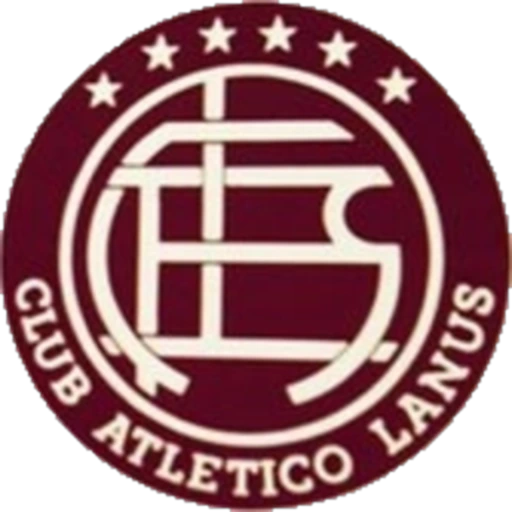
An alternative 2021 emblem placed the monogram inside a conventional circular ring carrying the full inscription “Club Atlético Lanús.” Stars appeared across the upper portion of the outer ring. This was an unusual variation because most Lanús badges rely almost entirely on the monogram without spelling out the club's name.
In 2025, Lanús returned to a particularly traditional and minimalist interpretation. The current 2025–Present crest consists of the familiar garnet scalloped circle, white inner rings and the historic intertwined CAL monogram, without external stars or additional wording.
The modern badge therefore deliberately reconnects Lanús with the designs used throughout much of the twentieth century. Its simplicity demonstrates how little is actually required to identify the club: garnet colour, circular form and the CAL monogram.
CA Lanús Club History
Founded in 1915, Club Atlético Lanús is one of the most important football clubs from the southern part of Greater Buenos Aires. Based in the city of Lanús, the club is instantly recognisable by its distinctive garnet colours, which have given it the nickname “El Granate” (The Garnet).
Lanús was founded on 3 January 1915, following the merger and reorganisation of several local sporting groups. From its earliest years, the club developed a strong connection with the rapidly growing industrial and working-class community south of Buenos Aires.
The club adopted its characteristic garnet (granate) colour early in its history. The unusual colour helped distinguish Lanús from the numerous Argentine clubs using red, blue or black and eventually became so closely associated with the institution that El Granate became its principal nickname.
Lanús entered the leading Argentine competitions during the amateur era and gradually established itself as an important club from outside the city of Buenos Aires. Following the introduction of professionalism in 1931, the club experienced alternating periods in the first and second divisions.
One of the most celebrated early Lanús teams emerged during the 1950s. The talented 1956 side became known as “Los Globetrotters” because of its attractive, technically accomplished attacking football. Lanús challenged strongly for the league championship and ultimately finished runner-up behind River Plate. Despite missing the title, the team remains one of the most admired generations in club history.
The following decades were considerably more difficult. Lanús suffered relegations and financial problems, and by the late 1970s the institution faced one of the most serious crises in its history. The club dropped as far as Argentina's third level and accumulated substantial debts.
Rather than disappearing, Lanús underwent a remarkable institutional recovery during the 1980s. Supporters and club officials worked to rebuild its finances, infrastructure and football operation. Promotion back through the divisions followed, and Lanús eventually returned to the Primera División in 1990.
Although relegated again shortly afterwards, another promotion in 1992 marked the beginning of a much more successful era. From this period onward, Lanús gradually transformed itself from a club regularly fighting for survival into one of Argentina's best organised and most competitive football institutions.
The first major international breakthrough arrived in 1996, when Lanús won the Copa CONMEBOL. Coached by Héctor Cúper, El Granate defeated Colombian club Santa Fe in the final to claim the first major international trophy in its history.
Lanús continued strengthening its youth development, infrastructure and sporting organisation during the following decade. This long-term approach eventually produced the club's first top-flight Argentine league championship.
In 2007, under coach Ramón Cabrero, Lanús won the Apertura championship. The title represented one of the defining moments in the club's history. Having come close to financial collapse and lower-division football only a few decades earlier, El Granate was now champion of Argentina.
Another major international success followed in 2013, when Lanús won the Copa Sudamericana. Under coach Guillermo Barros Schelotto, the club defeated Brazilian side Ponte Preta in the final, adding one of South America's most prestigious trophies to its honours.
The club enjoyed another exceptional period in 2016. Managed by Jorge Almirón, Lanús won the Argentine Primera División championship, defeating San Lorenzo emphatically in the championship final. The club subsequently added the Copa Bicentenario and Supercopa Argentina, making this one of the most successful periods in Lanús history.
Lanús reached an even greater international stage in 2017, advancing to its first Copa Libertadores final. Its campaign included a dramatic semi-final comeback against River Plate. After losing the first leg and falling two goals behind on aggregate in the return match, Lanús produced a remarkable turnaround to reach the final.
El Granate ultimately lost the Libertadores final to Brazilian club Grêmio, but reaching the continental final represented another major milestone and confirmed Lanús's transformation into an internationally competitive club.
Lanús again reached a major continental final in the 2020 Copa Sudamericana, eventually finishing runner-up to fellow Argentine side Defensa y Justicia.
A fundamental reason for the club's modern success has been its emphasis on youth development. Lanús has developed numerous players through its academy and has built a reputation for combining player development with careful financial and institutional management. This model has allowed the club to compete successfully despite having fewer resources than Argentina's largest institutions.
The club's home is the Estadio Ciudad de Lanús – Néstor Díaz Pérez, widely known as “La Fortaleza” (The Fortress). Located in Lanús, the stadium and surrounding sporting complex form the heart of an institution that extends far beyond football and maintains deep links with its local community.
Lanús's defining rivalry is with nearby CA Banfield. Their meetings form the Clásico del Sur (Southern Derby), one of the most important local rivalries in Argentine football.
The rivalry is intensely geographical. Lanús and Banfield represent neighbouring communities in southern Greater Buenos Aires, and supporters of both clubs frequently live and work alongside one another. This proximity gives the derby a particularly strong neighbourhood character, making victory in the Clásico del Sur one of the most important results of the season for both clubs.
Lanús also has historical competitive relationships with other clubs from southern Greater Buenos Aires, but Banfield is unquestionably its principal traditional rival.