Nickname(s):El Sabalero(The Sabalero), Rojinegro(The Red and Black)
Founded:1905
Stadium:Estadio Brigadier General Estanislao López (El Cementerio de los Elefantes)
Capacity:40,000
1905-1918
1918-1934
1934-1960
1960-1995
1995-1998
1998-2008
2008-2021
2021-Present
CA Colón de Santa Fe Crest History
The crest history of CA Colón de Santa Fe is dominated by remarkable continuity in the club’s most important visual element: the famous red-and-black vertically divided shield. Although Colón experimented with several alternative designs during the twentieth century, the club repeatedly returned to this simple identity, which remains at the heart of the modern crest.
The earliest crest shown, used from 1905 to 1918, was extremely simple. It consisted solely of a traditional shield divided vertically into black on the left and red on the right. There was no lettering, monogram or additional decoration. This established the two colours that have represented Colón since its foundation.
In 1918, the arrangement of the colours was reversed. The 1918–1934 crest displayed red on the left and black on the right, while the initials “CAC”, representing Club Atlético Colón, were placed prominently across the upper centre. This was the first version in the sequence to explicitly identify the club through lettering.
A much more experimental design appeared in 1934. The 1934–1960 badge retained the red-and-black division but introduced a football in the centre and the word “Colón” arranged around it in large stylised white letters. Compared with the restrained earlier badges, it was one of the most decorative crests in the club’s history.
In 1960, Colón returned to a much simpler identity. The 1960–1995 crest restored the vertically divided red-and-black shield and introduced a white panel across the top carrying the name “COLON” in black lettering. The red-left, black-right colour arrangement established here became the basis of the club’s modern badge.
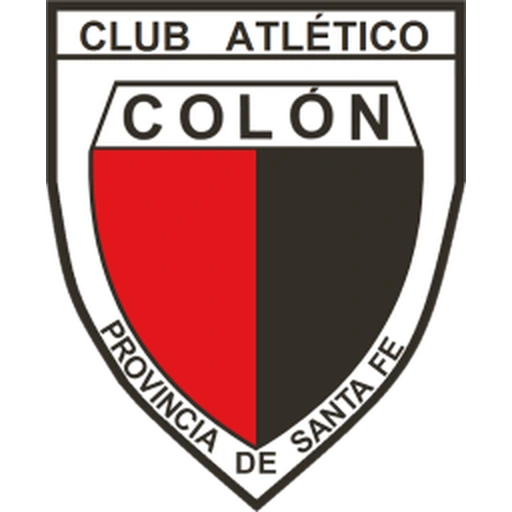
A significant redesign arrived in 1995. The traditional shield was placed inside a larger white-bordered emblem carrying the words “CLUB ATLÉTICO COLÓN” and “PROVINCIA DE SANTA FE.” This version placed greater emphasis on the club's complete name and geographical identity while preserving the traditional red-and-black shield at its centre.
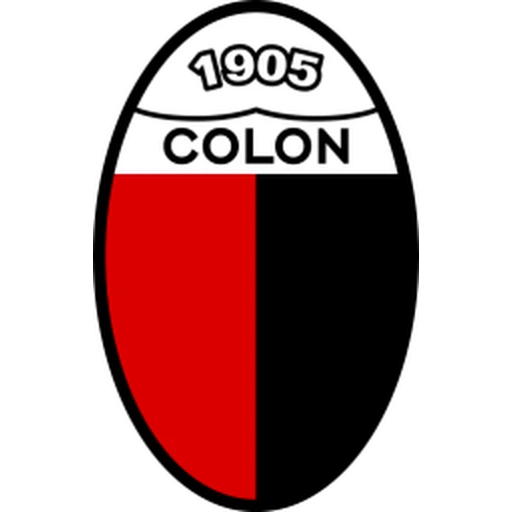
In 1998, Colón moved away from the conventional shield altogether. The 1998–2008 crest adopted an unusual vertical oval shape. The lower section remained divided into red and black halves, while white bands at the top displayed “1905” and “COLON.” Although distinctive, this format lasted only a decade.
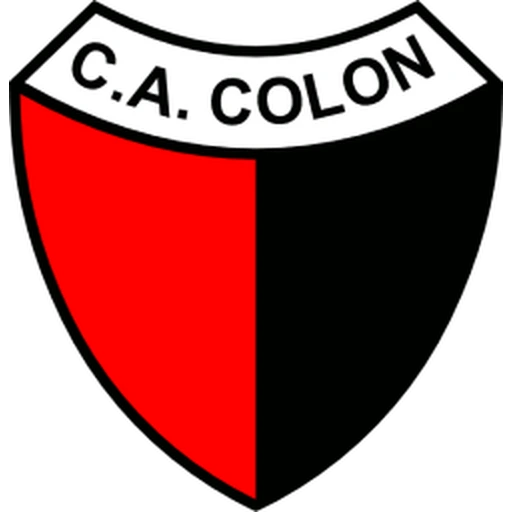
The club returned decisively to its traditional shield in 2008. The 2008–2021 crest featured a broad white upper panel containing “C.A. COLON”, above the familiar vertically divided field of red on the left and black on the right. A bold black outline gave the badge a clean and immediately recognisable appearance.
The most important sporting achievement in Colón's history brought the final major addition to the crest.
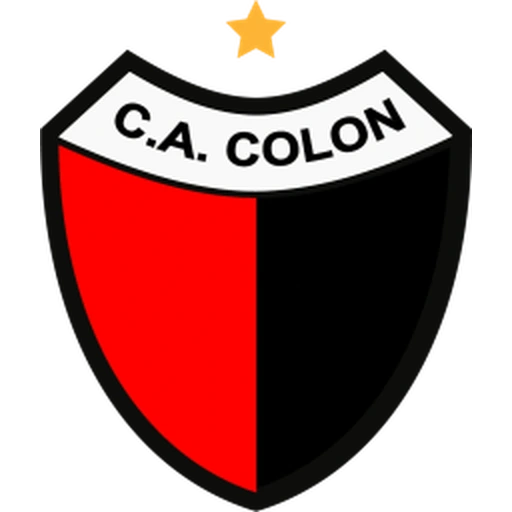
In 2021, Colón won the Copa de la Liga Profesional, defeating Racing Club 3–0 in the final and securing the club's first major top-level national title. The historic victory was subsequently represented by the addition of a gold star above the crest.
The 2021–Present badge therefore leaves the traditional design itself virtually untouched. It retains the white upper section with “C.A. COLON”, the red-and-black vertically divided shield and the black outline, while the single gold star commemorates the breakthrough 2021 championship.
Across more than a century, Colón has experimented with initials, football imagery, elaborate frames and even an oval badge, but repeatedly returned to the simplicity of its original identity. The red-and-black divided shield introduced in 1905 remains the defining symbol of El Sabalero, while the gold star now records the greatest domestic triumph in the history of CA Colón de Santa Fe.
CA Colón de Santa Fe Club History
Founded in 1905, Club Atlético Colón de Santa Fe is one of the most important football institutions in Argentina's Santa Fe Province. Known as “El Sabalero”, the club is famous for its red-and-black colours, passionate support and intense rivalry with neighbouring Unión de Santa Fe.
Colón was founded on 5 May 1905 by a group of young football enthusiasts in the city of Santa Fe. The club was named after Christopher Columbus (Cristóbal Colón), reportedly because the founders were studying the explorer's history around the time the club was created.
The club adopted red and black as its colours, which quickly became fundamental to its identity. Colón initially competed in local and regional football, gradually establishing itself as one of the strongest clubs in Santa Fe.
For much of its early history, Argentine football was heavily concentrated around Buenos Aires and Rosario. Provincial clubs such as Colón therefore had limited opportunities to participate regularly in the country's principal national competitions.
A major step forward came when Colón entered the Primera B, then Argentina's second level, during the late 1940s. The club spent many years attempting to reach the Primera División before finally achieving its breakthrough in 1965, when Colón won promotion to the top flight for the first time.
The period surrounding that promotion also helped create one of the most famous nicknames associated with Colón's stadium. During the 1960s, several powerful teams suffered unexpected defeats when visiting Santa Fe, contributing to the ground becoming known as the “Cementerio de los Elefantes” – the Cemetery of the Elephants. The nickname reflected Colón's reputation for defeating major clubs at home.
Colón remained an established Primera División club for many years following promotion. Although it did not win a national championship during this period, El Sabalero developed into a respected provincial opponent capable of challenging Argentina's traditional powers.
The club suffered relegation in 1981, beginning a long and difficult period outside the Primera División. For more than a decade, Colón attempted to return to the country's highest level while maintaining one of the strongest supporter bases in Argentina's second division.
The breakthrough finally arrived in 1995, when Colón secured promotion back to the Primera División. This began one of the most successful and stable periods in the club's history.
Only two years after returning, Colón produced an outstanding campaign in the 1997 Clausura, finishing runner-up behind River Plate. It was one of the club's best-ever performances in a top-flight league competition and demonstrated how rapidly El Sabalero had developed after promotion.
Colón's improving domestic performances also opened the door to international football. The club participated in competitions including the Copa CONMEBOL, Copa Libertadores and Copa Sudamericana, gradually building a continental profile.
One particularly memorable international campaign came in the 1998 Copa Libertadores, when Colón reached the quarter-finals. The run represented one of the club's most significant achievements of the twentieth century.
The following decades brought periods of strong performances mixed with more difficult seasons. Colón remained in the Primera División until 2014, when relegation ended almost two decades of uninterrupted top-flight football.
The setback was short-lived. Colón immediately fought its way back and returned to the Primera División for 2015, beginning another important chapter in the club's history.
Internationally, the greatest breakthrough came during the 2019 Copa Sudamericana. Colón produced a remarkable campaign to reach its first major continental final.
The final against Independiente del Valle was played in Asunción, Paraguay, and tens of thousands of Colón supporters travelled from Argentina. The enormous movement of Sabalero fans became almost as famous as the match itself and demonstrated the extraordinary scale and loyalty of the club's support.
Colón ultimately lost the final 3–1, but reaching the Copa Sudamericana final represented one of the greatest achievements in the club's history.
Two years later came the moment generations of supporters had been waiting for.
In 2021, Colón enjoyed an exceptional campaign in the Copa de la Liga Profesional. After progressing through the competition, El Sabalero reached the final against Racing Club.
On 4 June 2021, Colón defeated Racing 3–0, securing the first major top-level national championship in the club's history. After 116 years, El Sabalero finally celebrated a major Argentine title.
The achievement became a defining moment in the history of both the club and the city. A gold star was subsequently incorporated above the crest to commemorate the historic championship.
Colón's fortunes changed dramatically after the triumph. Difficult league campaigns eventually left the club fighting against relegation, and in 2023 Colón faced Gimnasia y Esgrima La Plata in a relegation play-off. A 1–0 defeat sent El Sabalero down to the Primera Nacional, ending its latest spell in Argentina's top division.
Throughout these sporting highs and lows, one fixture has remained central to Colón's identity: the Clásico Santafesino against Unión de Santa Fe.
The rivalry divides the city of Santa Fe and is regarded as one of the most important provincial derbies in Argentine football. Colón and Unión represent two enormous supporter communities located within the same city, meaning that encounters carry significance far beyond league position.
The rivalry has developed over more than a century through local competitions, national championships and periods when both clubs fought for supremacy in Santa Fe. For supporters of El Sabalero, defeating Unión remains one of the most important results of any season.