Nickname(s):El Pirata(The Pirate), Los Celestes(The Sky Blues)
Founded:1905
Stadium:Estadio Julio César Villagra (El Gigante de Alberdi)
Capacity:38,500
1905
1915-1927
1927-1938
1938-1962
1962-1980
1980-1985
1985-1991
1991-1993
1993-1997
1997-2003
2003-2005
2005-2006
2006-2010
2010-2012
2012-Present
2022
CA Belgrano de Córdoba Crest History
The crest history of CA Belgrano de Córdoba is dominated by one remarkably consistent symbol: the intertwined initials “CAB”, representing Club Atlético Belgrano. Although the colours, typography and surrounding elements have changed considerably since 1905, the circular monogram and the club's characteristic sky blue have provided strong continuity throughout its history.
The original 1905 crest already introduced the basic concept that would define Belgrano's identity for more than a century. A circular badge contained the stylised initials CAB, rendered in black over a sky-blue background. Despite its simplicity, the fundamental arrangement is immediately recognisable as the ancestor of the modern emblem.
Between 1915 and 1927, the badge was redrawn in black and white. The initials became narrower and more decorative, with elongated lettering filling almost the entire circular field. This created a more intricate interpretation of the original monogram.
In 1927, Belgrano adopted a much heavier and more abstract design. The letters CAB were compressed together within an incomplete black circular form. The resulting emblem was bold and highly stylised, moving away from the more delicate appearance of its predecessor.
Another redesign followed in 1938. The intertwined initials were reorganised into a stronger geometric composition contained within a complete black circle. This version established many of the proportions that would influence later Belgrano badges and remained in use until 1962.
In 1962, the club returned prominently to its traditional sky-blue colour. The familiar CAB monogram was rendered in white and sky blue within a circular border. The basic structure of the earlier black-and-white badge remained, but the use of club colours gave it a much more distinctive Belgrano identity.
The 1980 redesign simplified the emblem further. The outer border became thinner and the sky-blue monogram was given a cleaner, more open appearance. The letters remained tightly integrated, preserving the historic visual concept.
Between 1985 and 1991, darker shades of blue were introduced. The badge featured a bright blue interior surrounded by dark-blue outlines, giving the traditional CAB monogram a stronger and more contemporary appearance.
In 1991, the colours became even more contrasting. A bright sky-blue field was combined with a heavy black monogram and circular border. Despite these changes, the design continued to rely entirely on the historic CAB symbol.
A major development occurred in 1993, when the simple monogram was placed inside a much larger white circular badge. The outer ring carried the full inscription “CLUB ATLETICO BELGRANO – CORDOBA”, while the traditional sky-blue CAB emblem remained at the centre. This was the first major step towards the club's present crest.
The 1997 version retained this composition but softened the central colour to a lighter shade of sky blue. The black outer lettering and white background remained unchanged, creating a clean and easily identifiable badge.
In 2003, stronger sky-blue colouring returned. Both the central monogram and parts of the outer border were emphasised in the club's traditional colour, producing a brighter interpretation of the circular crest.
Belgrano briefly returned to the simpler historic monogram in 2005. The surrounding club-name ring disappeared, leaving a blue circular CAB emblem similar to versions used during the 1980s and early 1990s.
The full circular crest returned in 2006. The traditional CAB monogram again occupied the centre, surrounded by a white ring carrying “CLUB ATLETICO BELGRANO – CORDOBA.” The heavier black border and lettering gave the badge a particularly strong appearance.
Minor refinements followed in 2010, including adjustments to the proportions, lettering, border and shade of sky blue. These changes modernised the emblem without altering its fundamental structure.
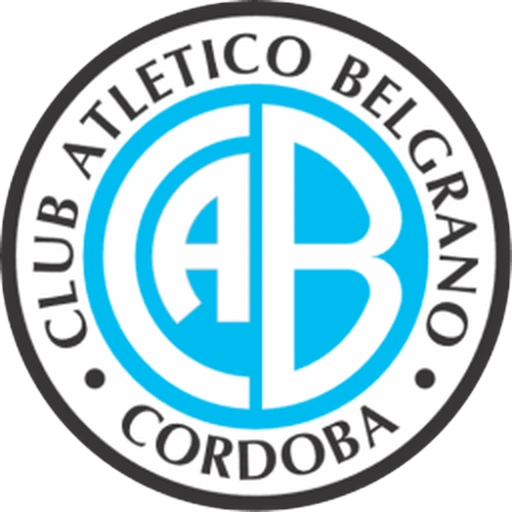
The 2012–Present crest further refined this design. It consists of the historic sky-blue CAB monogram inside a white circular field, surrounded by the full club name and Córdoba in black lettering. The clean black outer border creates a simple and highly recognisable modern identity while maintaining a direct visual connection with the club's first emblem from 1905.
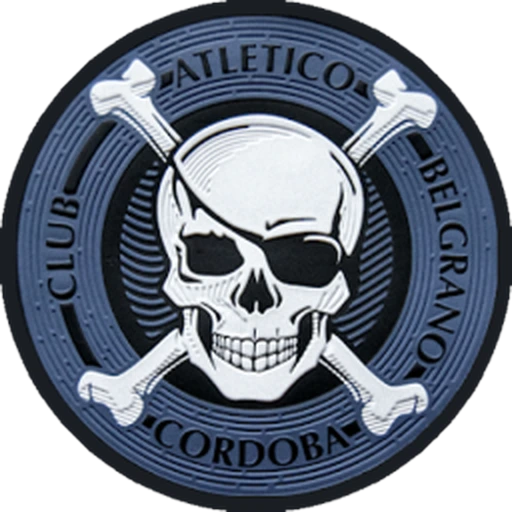
A special alternative emblem appeared in 2022. Reflecting Belgrano's famous nickname “El Pirata” (The Pirate), the commemorative design featured a dramatic skull and crossed bones inside a dark circular badge. The club name and Córdoba appeared around the outside. Unlike the regular crest, this pirate-themed emblem celebrated the supporter culture and nickname associated with Belgrano rather than replacing the official identity.
CA Belgrano de Córdoba Club History
Founded in 1905, Club Atlético Belgrano is one of the most historic and strongly supported football clubs in Córdoba, Argentina. Based in the traditional Alberdi neighbourhood, the club is known as “El Pirata” (The Pirate) and “Los Celestes” (The Sky Blues), the latter referring to its famous light-blue colours.
Belgrano was founded on 19 March 1905 by a group of young football enthusiasts led by Arturo Orgaz. The club was named after Manuel Belgrano, one of the most important figures in Argentine independence and the creator of the Argentine flag. This connection also inspired the adoption of sky blue as the club's traditional colour.
During its early decades, Belgrano became one of the leading teams in Córdoba football. Before Argentine football developed into the national competition structure familiar today, clubs outside Buenos Aires largely competed in powerful regional leagues. Belgrano established itself as a major force in the Liga Cordobesa de Fútbol, winning numerous championships and building a large supporter base.
The club's identity became closely connected with Alberdi, a working-class neighbourhood west of central Córdoba. In 1929, Belgrano inaugurated its stadium there. Today officially known as the Estadio Julio César Villagra, it is popularly called “El Gigante de Alberdi” (The Giant of Alberdi) and remains one of the great symbols of the club.
Belgrano's famous nickname “Los Piratas” also became deeply embedded in its supporter culture. Several explanations exist for its origin, but the pirate identity eventually became so closely associated with the club that skulls, pirate imagery and the phrase Pirata Cordobés frequently appear in supporter culture and commemorative designs.
As Argentine football became increasingly nationalised, Belgrano began competing more regularly against clubs from outside Córdoba. The creation of the Torneo Nacional during the late 1960s provided provincial clubs with greater access to national competition, and Belgrano became an increasingly important representative of Córdoba football.
The restructuring of Argentine football during the 1980s created a clearer route into the national professional divisions. Belgrano subsequently became a regular competitor between the country's first and second levels, experiencing numerous promotions and relegations while establishing itself as one of the most prominent clubs from Argentina's interior.
One of the defining characteristics of Belgrano has been its exceptionally passionate support. Despite periods outside the Primera División, the club has consistently attracted large crowds and maintained a powerful connection with Córdoba and particularly the Alberdi neighbourhood.
The most famous moment in Belgrano's modern history came in 2011. After an excellent campaign in the second division, the club qualified for a promotion playoff against Argentine giants River Plate.
Belgrano won the first leg 2–0 in Córdoba. The return match at River's Estadio Monumental finished 1–1, giving Belgrano a 3–1 aggregate victory and promotion to the Primera División. The result simultaneously caused the first relegation in River Plate's history, making the tie one of the most memorable events in modern Argentine football.
Following promotion, Belgrano enjoyed one of its strongest periods at national level. Under coach Ricardo Zielinski, the club established itself in the Primera División and produced several highly competitive campaigns, including strong finishes during the 2011–12 season.
Belgrano also qualified for South American competition, representing Córdoba in the Copa Sudamericana and strengthening its profile beyond Argentina.
After several seasons in the top flight, the club was relegated in 2019. Belgrano subsequently began rebuilding with the objective of returning to the Primera División.
That goal was achieved emphatically in 2022, when Belgrano won the Primera Nacional championship and secured promotion back to Argentina's highest level. The successful campaign produced enormous celebrations in Córdoba and demonstrated once again the scale of the club's supporter base.
The defining rivalry in Belgrano's history is with Talleres de Córdoba. Their matches form the Clásico Cordobés, one of the largest and most passionate football rivalries outside Greater Buenos Aires. The rivalry extends far beyond individual matches, dividing families, neighbourhoods and communities throughout Córdoba. For supporters of both clubs, victory in the clásico carries exceptional importance.
Belgrano also has significant historical rivalries with other Córdoba clubs, particularly Instituto, while matches against Racing de Córdoba have additional local importance. Nevertheless, Talleres is unquestionably Belgrano's principal rival, and the Clásico Cordobés remains central to the identity of both institutions.