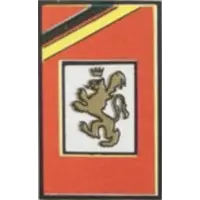
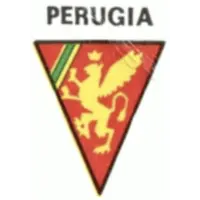
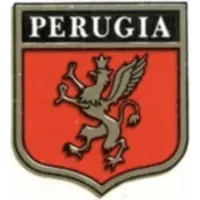
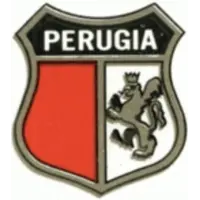
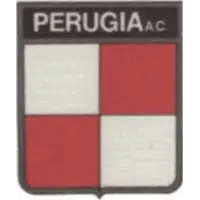
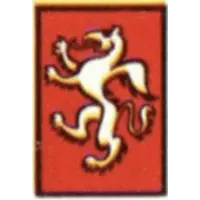
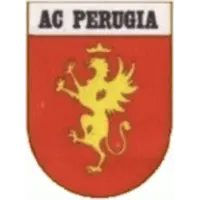
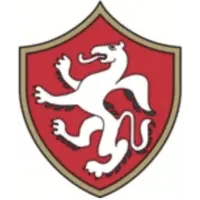
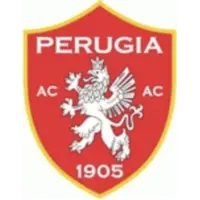
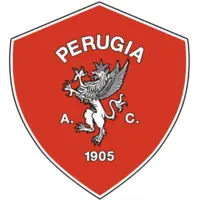
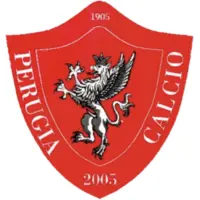
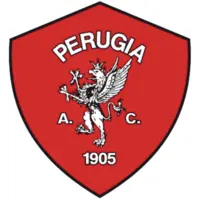
Perugia's badge became inseparably linked to one of the most enduring symbols of the city itself: the griffin. Over more than a century, the club's crest has evolved through various designs, but the mythical creature has remained the defining feature of Perugia's identity.
In the club's earliest decades, Perugia used relatively simple emblems that reflected the graphic style of early Italian football. As the club developed within Italian football, the need for a stronger and more recognisable visual identity led to the adoption of symbols drawn directly from Perugia's civic heritage.
The most important of these symbols was the griffin, a mythical creature combining the body of a lion and the head and wings of an eagle. The griffin has been associated with the city of Perugia for centuries and appears prominently in its municipal heraldry. By incorporating the griffin into its crest, the club established a powerful connection between the football team and the history of the Umbrian capital.
Throughout the mid-twentieth century, Perugia experimented with a variety of badge designs. Some versions featured shields containing the club's initials, while others gave greater prominence to the griffin itself. As football branding became increasingly important, the club gradually moved towards simpler and more recognisable emblems centred on the city's historic symbol.
During the 1970s, a golden era in the club's history, the griffin became even more strongly associated with Perugia's football identity. Under the presidency of Franco D'Attoma and the management of Ilario Castagner, Perugia emerged as one of Italy's most admired teams. The crest seen during this period often featured a stylised griffin rendered in a modern graphic style, helping create an identity that was both traditional and contemporary.
One of the most recognisable badge designs appeared in the late twentieth century, featuring a red shield containing a white griffin. The design successfully combined the club's famous red colours with the city's historic emblem, creating a badge that became instantly recognisable throughout Italian football. Unlike many clubs that frequently altered their visual identity, Perugia increasingly focused on refining this core concept rather than replacing it.
Following financial difficulties and several corporate restructurings during the early twenty-first century, the club introduced updated versions of the crest while preserving its traditional symbolism. Changes generally focused on typography, shield shape and graphic clarity rather than on altering the underlying identity. The griffin remained central to every redesign, ensuring continuity despite organisational upheaval.
Modern versions of the crest continue to feature the white griffin prominently displayed against a red background. The club name and foundation details have been adjusted over time to reflect changes in ownership and legal structure, but the overall concept remains faithful to the traditions established decades earlier. The result is a badge that feels unmistakably Perugian while remaining suitable for modern branding and digital media.
AC Perugia Club History
AC Perugia is one of the most historic football clubs in central Italy and has long served as the principal football representative of the Umbrian capital.
The club was originally founded in 1905 as Associazione Calcistica Perugia, becoming one of the earliest organised football institutions in the region.
The club's players became known as the Biancorossi ("The Red and Whites") due to their traditional colours of red shirts and socks paired with white shorts. Another enduring nickname is Grifoni ("The Griffins"), derived from the griffin that serves as the historic heraldic symbol of the city of Perugia and has long been featured in the club's visual identity.
The club's fortunes changed dramatically during the 1970s, when Perugia entered the most successful period in its history. Under the presidency of Franco D'Attoma and the management of Ilario Castagner, the club developed into one of the most admired teams in Italy.
The pinnacle of this era arrived during the 1978–79 Serie A season. Perugia completed the entire league campaign unbeaten, becoming the first club in Italian football history to finish a Serie A season without suffering a defeat. Although the team ultimately finished second behind AC Milan due to a large number of draws, the achievement remains one of the most remarkable accomplishments in Italian football history.
Throughout the 1980s and 1990s, Perugia experienced both promotions and relegations but remained a familiar name within Italian professional football. The club became particularly well known under the ownership of Luciano Gaucci, whose unconventional approach often brought national attention. During this period, Perugia developed a reputation for recruiting international talent from less traditional football markets and provided opportunities to several future stars.
Among the most famous players to represent the club was Hidetoshi Nakata, whose performances helped raise Perugia's international profile in the late 1990s. The club also provided an important early platform for players such as Marco Materazzi and Fabio Grosso before they achieved greater success elsewhere.
Financial instability eventually brought an end to this era. In 2005, the original Associazione Calcistica Perugia folded due to economic difficulties. The club was immediately re-founded as Perugia Calcio, preserving football in the city and allowing supporters to maintain continuity with their historic institution.
However, financial challenges persisted. In 2010, the re-founded club dissolved once again and underwent another restructuring, emerging under its current identity as AC Perugia Calcio. Despite the setbacks, the club retained its traditions, colours, supporters and historical legacy, ensuring that Perugia's football heritage survived.
In the years following its rebirth, Perugia worked its way back through the Italian football pyramid. The club re-established itself within the professional leagues and spent much of the following decade competing in Serie B while pursuing a return to Serie A. Although promotion proved elusive, Perugia remained one of the most prominent clubs outside Italy's top division.
The club plays its home matches at the Stadio Renato Curi, named after the beloved Perugia midfielder Renato Curi, who tragically died during a Serie A match in 1977. The stadium remains a central symbol of the club's identity and one of the most recognisable football venues in central Italy.
Perugia's most significant rivalry is with Ternana Calcio. Matches between the two sides are known as the Derby dell'Umbria and represent the most important football fixture in the region. The rivalry reflects the historic competition between the cities of Perugia and Terni and is among the fiercest regional rivalries in Italian football.