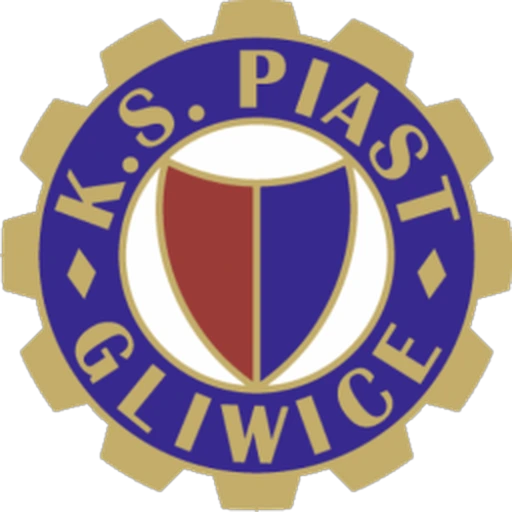
From 1945 to 1964, GKS Piast Gliwice used its first official crest, which reflected the club's industrial origins. The badge consisted of a gold cogwheel, symbolising the heavy industry and engineering traditions of Gliwice and Upper Silesia. Inside the cogwheel was a blue circular ring carrying the inscription K.S. Piast Gliwice, while the centre featured a red-and-blue shield, representing the club's traditional colours. The emblem reflected Piast's identity as a workers' sports club during the post-war years and its close ties to the city's industrial community.
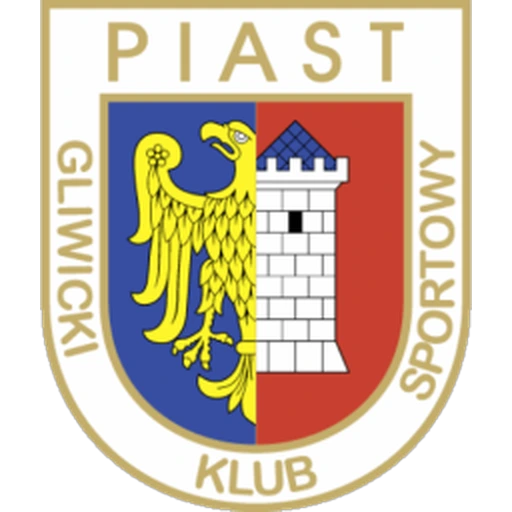
Between 1964 and 1997, the club adopted a completely new shield-shaped crest inspired by the coat of arms of Gliwice. The badge displayed a golden Piast eagle on a blue background alongside a white defensive tower on a red background. The eagle symbolised the medieval Piast dynasty, from which the club takes its name, while the tower represented the historic fortifications and architecture of Gliwice. The words Piast, Gliwice, Klub, and Sportowy surrounded the shield, creating an elegant design that firmly linked the club with both the city and the history of Silesia.
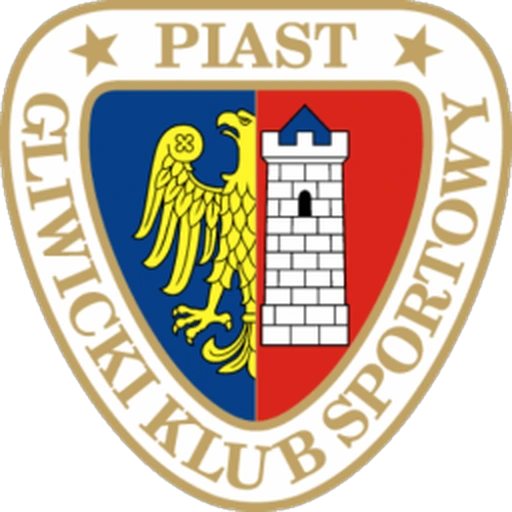
Since 1997, GKS Piast Gliwice has used a refined version of the same shield. The club retained the golden Piast eagle, the white tower, and the blue-and-red shield, but introduced a rounded white outer border with the full name Gliwicki Klub Sportowy surrounding the central emblem. Two gold stars were added beside the word Piast as decorative elements, while the artwork and typography were modernised. The redesign preserved the club's historic symbols while creating the badge that became associated with the most successful period in Piast's history, including its 2018–19 Ekstraklasa championship.
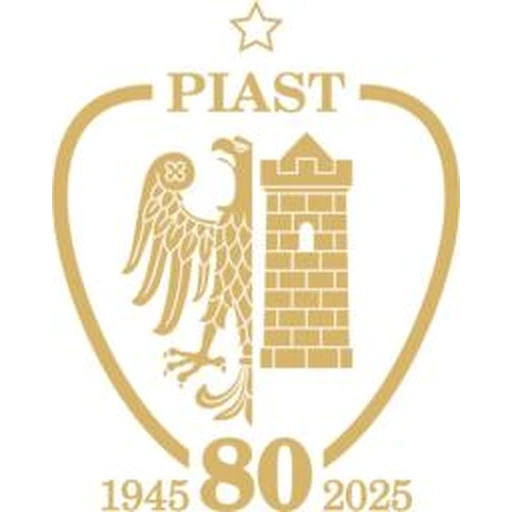
In 2025, to celebrate the club's 80th anniversary, Piast unveiled a special commemorative crest. The anniversary emblem featured a gold outline of the modern shield containing the familiar Piast eagle and Gliwice tower, together with the years 1945 and 2025. A large gold 80 dominated the lower part of the badge, while a single gold star appeared above the crest.
GKS Piast Gliwice Club History
GKS Piast Gliwice was founded on 18 June 1945 in Gliwice, Upper Silesia, shortly after the end of the Second World War. The club was established as a multi-sports organisation and named after the Piast dynasty, the first royal dynasty of Poland, symbolising the region's historical and cultural heritage. From its earliest years, Piast developed strong links with the industrial community of Gliwice and gradually became one of Upper Silesia's most respected football clubs.
During its early decades, Piast competed mainly in Poland's regional and lower national divisions. Although the club regularly challenged for promotion, it spent much of the post-war period outside the country's top flight. Despite this, Piast earned a reputation for developing talented players and maintaining a strong local identity within one of Poland's most football-passionate regions.
A historic breakthrough came in 2008, when Piast Gliwice earned promotion to the Ekstraklasa, Poland's highest division, for the first time in the club's history. Although the club was relegated after one season, it quickly rebuilt and returned to the top flight in 2012, where it established itself as a competitive and well-organised side.
The greatest achievement in the club's history came during the 2018–19 season. Under coach Waldemar Fornalik, Piast produced one of the biggest surprises in Polish football by winning its first-ever Ekstraklasa championship. After narrowly avoiding relegation the previous season, the club mounted a remarkable title challenge and finished ahead of traditional giants such as Legia Warsaw, Lechia Gdańsk, and Lech Poznań. The championship secured Piast's first qualification for the UEFA Champions League.
Piast has also enjoyed success in domestic cup competitions. The club reached the Polish Cup Final in 1978, finishing as runners-up, and returned to the final in 1983, again narrowly missing out on the trophy. More recently, Piast has consistently reached the latter stages of the Polish Cup, underlining its status as one of Poland's strongest clubs.
In European competition, Piast has represented Poland in the UEFA Champions League, Europa League, and Europa Conference League qualifying rounds. The club recorded memorable victories against opponents such as BATE Borisov and Riga FC, gaining valuable experience on the continental stage and enhancing its international profile.
Throughout the 2020s, Piast has remained a regular member of the Ekstraklasa, consistently finishing in the upper half of the table while maintaining a reputation for disciplined football, excellent coaching, and sensible financial management. The club has become one of Poland's model provincial teams, regularly competing with clubs from much larger cities.
Piast's fiercest rivalry is with Górnik Zabrze in the Upper Silesian Derby, one of Poland's oldest and most passionate regional rivalries. Matches against Ruch Chorzów, GKS Katowice, and Zagłębie Sosnowiec also carry great significance due to the clubs' shared Silesian heritage.