Historical Crests US Sassuolo Calcio
Name: US Sassuolo Calcio
Nickname(s): I Neroverdi (The Black and Greens)
Founded: 1920
Stadium: Mapei Stadium (Sassuolo)
Capacity: 21,584
US Sassuolo Calcio Crest History
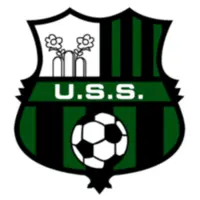
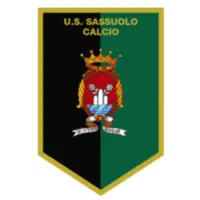
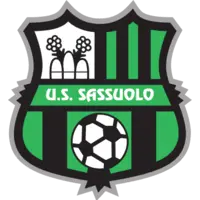
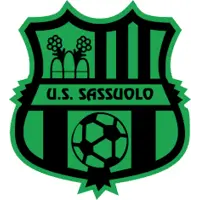
Throughout its history, Sassuolo's crest has reflected the club's close connection to the town of Sassuolo and its civic identity. While many Italian clubs built their badges around animals or monograms, Sassuolo's modern emblems have largely been inspired by the municipal coat of arms, incorporating local symbols alongside the club's famous black-and-green colours.
During the 2000s, Sassuolo adopted the crest that would become internationally recognised as the club rose through the divisions. The badge featured a shield divided into multiple sections, combining the club's black-and-green stripes with civic elements from the city coat of arms. A football was placed at the centre, while the club name appeared prominently across the design.
In 2010, the club refined and modernised its crest. The familiar shield was retained, but the design became cleaner and more balanced. The emblem featured four distinct sections containing the black-and-green stripes, a football, the civic symbols of Sassuolo and the club name. Three stylised hills, also taken from the city's heraldry, were incorporated into the composition. This version became the badge most closely associated with Sassuolo's years in Serie A and its qualification for European competition.
A further redesign was unveiled in 2025 as part of a broader rebranding project. The club simplified the badge by removing unnecessary details and creating a more modern and digital-friendly appearance. The shield became a cleaner pentagonal shape while retaining the key elements that had defined Sassuolo's identity: the black-and-green stripes, the football and the civic symbolism of the town. The redesign reflected modern branding trends while respecting the club's heritage.
US Sassuolo Calcio Club History
Founded in 1920 as Unione Sportiva Sassuolo, the club represents the town of Sassuolo in Emilia-Romagna. For much of its history, Sassuolo was a small local team competing in regional and amateur football, with little indication that it would one day become one of the most remarkable success stories in Italian football.
A turning point arrived during the 1970s, when several local football organisations merged under the Sassuolo name, helping create a stronger and more ambitious club. The team's traditional black-and-green colours became firmly established during this period, earning the nickname Neroverdi.
The transformation accelerated in the early 2000s following the involvement of Giorgio Squinzi and the Mapei Group, one of Italy's largest industrial companies. Under Squinzi's ownership, Sassuolo adopted a long-term development strategy focused on financial stability, infrastructure and sustainable sporting growth.
A historic breakthrough came in 2006, when Sassuolo achieved promotion to Serie C1, reaching the third tier of Italian football for the first time. The club's progress continued rapidly, and in 2008 Sassuolo secured promotion to Serie B, completing a remarkable rise through the divisions.
The club quickly established itself in the second tier and became a serious promotion contender. Under coach Eusebio Di Francesco, Sassuolo developed an attractive and attacking style of play that attracted attention throughout Italy.
The greatest achievement in the club's history arrived in 2013, when Sassuolo won the Serie B title and earned promotion to Serie A for the first time. The achievement was extraordinary for a club representing a town of fewer than 50,000 inhabitants and was widely regarded as one of the most impressive stories in modern Italian football.
The club's most successful campaign came in 2015–16, when Sassuolo finished sixth in Serie A, securing qualification for European competition for the first time in its history. The achievement represented the culmination of years of steady growth and placed the club among Italy's leading teams.
During the 2016–17 season, Sassuolo competed in the UEFA Europa League, reaching the group stage after defeating Red Star Belgrade in the qualifying rounds. Although the European adventure was relatively brief, it marked a historic milestone for the club.
Throughout the following years, Sassuolo gained a reputation as one of Italy's best-run clubs. The team became known for identifying and developing talented players, including Domenico Berardi, Manuel Locatelli, Giacomo Raspadori, Davide Frattesi, Gianluca Scamacca and many others.
One player became particularly synonymous with the club: Domenico Berardi. A product of Sassuolo's rise, Berardi remained loyal to the club throughout much of his career and became its all-time leading scorer and greatest modern icon.
The club also became renowned for its progressive coaching philosophy. Managers such as Eusebio Di Francesco, Roberto De Zerbi and Alessio Dionisi helped establish Sassuolo as one of the most entertaining teams in Italian football.
Sassuolo plays its home matches at the Mapei Stadium – Città del Tricolore in nearby Reggio Emilia. Although not located within Sassuolo itself, the stadium has become closely associated with the club's modern success and its years in Serie A and European competition.
Unlike many historic Italian clubs, Sassuolo has relatively few traditional rivalries. However, competitive relationships have developed with nearby clubs such as Modena, Reggiana, Parma and Bologna, reflecting the club's growing presence within Emilia-Romagna football.
US Sassuolo Pins
Your Dynamic Snippet will be displayed here... This message is displayed because you did not provide enough options to retrieve its content.