Skip to Content

Historical Crests US Lecce

Name: US Lecce
Nickname(s): ​I Salentini (The Salentians)
Founded: 1908
Stadium: ​​Stadio Via del Mare (Lecce)
Capacity: ​​31,533

1977-1981
1981-1998
1998-2001
2001-Present

US Lecce Crest History
Throughout its history, Lecce's crest has been defined by two enduring symbols: the wolf and the holm oak tree. Both elements are taken directly from the coat of arms of the city of Lecce and have become inseparable from the club's identity. Combined with the club's famous yellow-and-red colours, these symbols have created one of the most distinctive visual identities in southern Italian football.
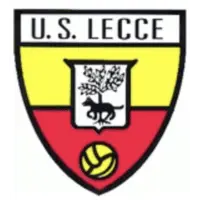
During the 1970s and 1980s, when Lecce began establishing itself in professional football and eventually reached Serie A, several crest variations appeared. Most incorporated the wolf and tree within shield-shaped designs while prominently displaying the club's yellow-and-red colours. These badges accompanied the club during its first historic promotions to the top flight.
One of the most recognisable historical crests was introduced during the 1980s. The badge featured a stylised shield with the wolf and oak tree positioned above the club name. This design became closely associated with Lecce's emergence as one of the leading clubs in southern Italy.
Throughout the 1990s , the club modernised its crest while preserving the traditional symbols. The wolf became more stylised, the tree more defined and the overall design cleaner and easier to reproduce across merchandise and media. Despite these updates, the club remained faithful to its historic identity.
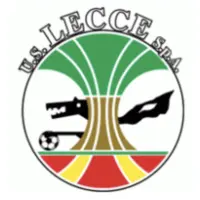
A significant redesign arrived in 1998, when Lecce adopted an oval-shaped badge featuring a more detailed representation of the wolf and holm oak. The club name was incorporated into the border, while the yellow-and-red colours continued to dominate the design. This version became one of the most widely recognised crests in the club's history.
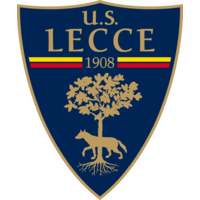
In 2001, Lecce introduced the modern crest that remains the basis of the club's identity today. The badge adopted a more elegant shield shape with a dark blue background bordered in gold. At its centre appeared the club's traditional symbol: the she-wolf beneath the holm oak tree, taken directly from the coat of arms of the city of Lecce. The club name "U.S. Lecce 1908" was placed prominently across the top of the crest, while the yellow-and-red colours were incorporated into the design through the stylised tree and background elements.
The redesign represented a significant modernization compared to the previous badge used between 1981 and 2001. While preserving the historic civic symbols of the wolf and tree, the new crest adopted cleaner lines and a more professional appearance suitable for the modern era of football branding.
Since its introduction in the 2001–02 season, only minor graphical refinements have been made. The wolf, the holm oak tree and the shield shape have remained central to the club's identity, making the 2001 redesign one of the longest-lasting and most successful badges in Lecce's history.

US Lecce Club History
Founded on 15 March 1908 as Sporting Club Lecce, the club initially included football, athletics and cycling. The first president was Francesco Marangi, and the team's original colours were black and white. Lecce is one of the oldest football clubs in southern Italy and has become the sporting symbol of the Salento region.
During its early years, Lecce competed mainly in regional competitions. After a temporary suspension of activities in the 1920s, the club was re-established in 1927 as Unione Sportiva Lecce following the merger of local teams Juventus and Gladiator
Lecce gradually climbed the Italian football pyramid and achieved promotion to Serie B for the first time in 1929, becoming one of the leading clubs in Apulia. Throughout the following decades, the club alternated between the second and third divisions while developing a loyal and passionate fan base throughout the Salento peninsula.
The greatest breakthrough in the club's history arrived in 1985, when Lecce secured promotion to Serie A for the first time. For the first time ever, the club from Salento was competing among Italy's elite. Although relegation followed after one season, the achievement transformed the club and permanently raised its profile within Italian football.
The late 1980s and early 1990s became one of the most successful periods in the club's history. Under coaches such as Carlo Mazzone, Lecce established itself as a competitive Serie A side and achieved some memorable league campaigns. During these years, the club became renowned for discovering and developing talented players while consistently punching above its weight against much wealthier opponents.
One of Lecce's greatest contributions to football has been its youth development system. The club helped launch the careers of several future stars, most notably Antonio Conte, who began his professional career with Lecce before captaining Juventus and later becoming one of Europe's most successful coaches. Other notable players associated with the club include Francesco Moriero, Mirko Vučinić, Valeri Bojinov, Cristian Ledesma, Javier Chevantón and Ernesto Chevantón.
The 2004–05 season under coach Zdeněk Zeman remains one of the most entertaining in club history. Lecce played highly attacking football and secured a comfortable Serie A finish while becoming one of the league's most exciting teams to watch.
After relegation in 2012, the club entered a difficult period that included several seasons in Serie C. Despite the setback, Lecce remained one of the largest clubs outside the top two divisions and continued to attract significant support.
A revival began under coach Fabio Liverani, who guided the club to consecutive promotions. Lecce returned from Serie C to Serie A between 2018 and 2019, restoring top-flight football to Salento and marking one of the most impressive recoveries in modern Italian football.
The club continued to alternate between Serie A and Serie B before establishing itself more firmly in the top flight during the early 2020s. Promotion as Serie B champions in 2022 marked another milestone and helped launch one of the most stable periods in the club's modern history.
Lecce plays its home matches at the Stadio Via del Mare, one of the largest stadiums in southern Italy. Opened in 1966, the stadium has witnessed the club's rise from regional football to Serie A and remains a symbol of the passion of the Salento supporters.
Historically, Lecce's fiercest rivalry is with Bari in the Derby di Puglia, one of the most intense rivalries in southern Italy. Strong rivalries also exist with Taranto, Foggia and other clubs from the region.