Skip to Content

Historical Crests SSD Città di Teramo

Name: ​SSD Città di Teramo
Nickname(s): Il Diavoli (The Devil)
Founded: 1929 (Refoubded 2008 and 2022)
Stadium: Gaetano Bonolis
Capacity: ​​7,498

2008-2009
2009-2019
2019-Present

SSD Città di Teramo Crest History
Throughout its history, Teramo's crests have been closely linked to three defining elements: the club's traditional red-and-white colours, the devil that inspired the nickname Il Diavolo, and the civic symbols of the city of Teramo. While the club has experienced multiple bankruptcies and refoundations, its visual identity has consistently sought to preserve a connection to the city's history and footballing heritage.
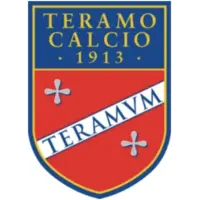
As the club developed, Teramo increasingly embraced civic symbolism. The historic crest was inspired by the coat of arms of the city of Teramo, featuring a distinctive shield divided into blue and red sections. The lower portion included the word "Teramum", the ancient Latin name of the city, displayed diagonally across a white banner. This design became one of the most recognisable symbols in the club's history and strengthened the connection between the football club and the city it represented.
The club's visual identity also became closely associated with the devil, a symbol derived from the team's red colours. Over time, the stylised devil became an important secondary emblem and helped establish the nickname Il Diavolo, which remains widely used by supporters today.
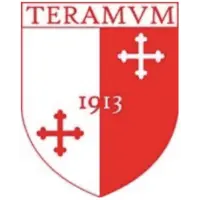
Following the club's first bankruptcy in 2008, football in Teramo was reborn under the name Real Teramo. A completely new crest was introduced for the 2008–09 and 2009–10 seasons, reflecting the new organisation while maintaining the traditional red-and-white colours. Although short-lived, this badge represented the beginning of a new chapter in the club's history.
After the return to the historic Teramo identity, the club reinstated the traditional crest, which remained in use between 2009 and 2019. This version became associated with one of the most successful periods in the club's history, including promotion campaigns and the club's historic, though ultimately revoked, promotion to Serie B in 2015.
A major redesign arrived in 2019. The club adopted a more modern badge that simplified several traditional elements while preserving the red-and-white colour scheme. The redesign sought to create a cleaner and more contemporary identity while retaining links to the club's heritage. 
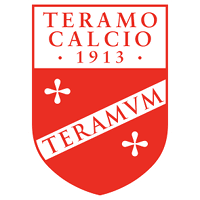
The next significant development came when the club moved back toward its historic identity, eventually recovering the traditional Teramo Calcio 1913 name and logo. The restoration of the classic badge was widely welcomed by supporters, who viewed it as a reconnection with the club's long history and traditions.

SSD Città di Teramo / Teramo Calcio 1913 Club History
The origins of football in Teramo date back to 1913, a year that remains central to the club's identity and heritage. Although the modern organisation was formally established in 1929 as Associazione Sportiva Teramo, the year 1913 is widely recognised as the birth of organised football in the city and continues to be celebrated in the club's name and traditions.
In its early years, the club initially wore red and yellow, but after becoming associated with the local Società Ginnastica Gran Sasso, it adopted the famous red-and-white colours that remain its trademark today. These colours earned the club the nickname Biancorossi, while the prominence of red also inspired the enduring nickname Il Diavolo ("The Devil").
During the 1970s and 1980s, Teramo began enjoying greater success, achieving promotions and becoming a regular presence in the national leagues. The club developed a reputation for competitiveness and passionate local support, helping it establish itself among the strongest provincial clubs in central Italy.
One of the most notable achievements in the club's history came in 1984, when Teramo reached the final of the Anglo-Italian Cup. Although the trophy ultimately escaped them, the achievement remains one of the most significant international moments ever experienced by the club.
A major setback occurred in 2008, when financial difficulties led to bankruptcy. The collapse forced the club to restart from the amateur divisions, threatening the future of organised football in the city. However, local supporters and investors quickly ensured that the tradition would survive.
The greatest sporting achievement in Teramo's history appeared to arrive in 2015, when the club won its Lega Pro group and secured promotion to Serie B for the first time. Celebrations erupted throughout the city as supporters believed they had finally reached the second tier of Italian football after more than a century of history.
However, the dream was short-lived. Following the Dirty Soccer match-fixing investigation, Teramo's promotion was revoked and the club was denied entry into Serie B. The decision remains one of the most painful and controversial episodes in the club's history, as the city was deprived of what would have been its greatest footballing achievement.
Despite this disappointment, Teramo remained a competitive force in Serie C for several years, regularly holding its own against more established professional clubs and maintaining its position as one of Abruzzo's leading teams.
A second major crisis emerged in 2022, when financial problems once again prevented the club from continuing in professional football. The organisation was excluded from Serie C and ceased operations, forcing another restart.
To preserve football in the city, SSD Città di Teramo was established in 2022 and admitted to the regional divisions. Beginning from Promozione Abruzzo, the new club immediately demonstrated its ambition by winning consecutive championships. Promotion from Promozione was followed by victory in Eccellenza Abruzzo, allowing the club to return to Serie D within just two seasons.
As stability returned, the club gradually reconnected with its historical roots and eventually recovered the famous Teramo Calcio 1913 identity. The restoration of the traditional name represented an important symbolic victory for supporters, reaffirming the continuity of more than a century of football in the city despite multiple bankruptcies and rebirths.
Teramo plays its home matches at the Stadio Gaetano Bonolis, one of the most modern stadiums in Abruzzo. Since its opening in 2008, the stadium has become a symbol of the club's modern era and has hosted many of its most memorable matches.
Historically, the club's fiercest rivalries are with fellow Abruzzese sides such as L'Aquila, Giulianova, Chieti, Pescara and Avezzano. These matches are among the most passionate fixtures in regional football and reflect decades of competition throughout Abruzzo.