Skip to Content

Historical Crests Spezia Calcio

Name: ​​Spezia Calcio
Nickname(s): Aquilotti (Little Eagles)
Founded: 1906 (Refounded 2008)
Stadium: Stadio Alberto Picco (La Spezia)
Capacity: ​​11,466

1990s
2005-2008
2008
2023-2025
2025-Present

Spezia Calcio Crest History
Throughout its history, Spezia's crests have been closely linked to three defining symbols: the club's traditional black-and-white colours, the eagle that inspired the nickname Le Aquile, and the intertwined club initials that have appeared in various forms for decades. 
The earliest emblems used during the first half of the twentieth century were relatively simple and often centred on the club's initials. Like many Italian clubs of the period, Spezia relied more on monograms and civic references than on elaborate heraldic designs. The black-and-white colours gradually became established as the defining feature of the club's identity.
A more recognisable visual identity emerged during the 1970s and early 1980s with the introduction of a crest featuring the monogram S.F.C. (Spezia Football Club). This badge represented one of the first modern attempts to create a distinctive and consistent club identity and remained associated with the club throughout much of the decade.
In 1986, Spezia adopted a new emblem featuring two stylised eagles in flight. The eagle had long been associated with the club and the city, and its inclusion helped strengthen the connection to the nickname Le Aquile. The design gave Spezia a more dynamic and modern appearance while preserving the club's traditional black-and-white colours.
The early 1990s brought another significant redesign. The club adopted an eagle taken directly from the civic heraldry of La Spezia while also introducing the monogram S.A.C., reflecting the club's contemporary corporate identity. The badge reinforced the link between the football club and the city it represented.
A further redesign arrived in 1996, when the eagle motif was reinterpreted through a distinctive crest featuring the head of a bird of prey. This version became one of the most recognisable badges in Spezia's history and remained closely associated with the club throughout the late 1990s and early 2000s. The eagle was now firmly established as the dominant symbol of Spezia Calcio.
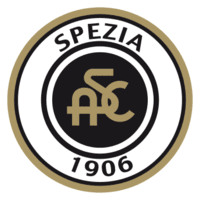
One of the most important changes occurred in 2005, during the club's centenary celebrations. Spezia introduced a circular black-and-white crest featuring the intertwined initials A.S.C. at its centre and the foundation year 1906. The badge abandoned the eagle imagery and instead embraced a cleaner, more traditional design built around the club's initials. The circular crest quickly became one of the most iconic symbols in the club's history.
The centenary badge proved so popular that it remained in use for almost two decades. It accompanied Spezia through promotion battles, bankruptcy in 2008, the club's rebirth, and ultimately its historic rise to Serie A in 2020. For many supporters, it became the definitive visual identity of modern Spezia.
In 2023, the club unveiled a dramatically different crest. The new design adopted a highly minimalist shield featuring a geometric eagle above intertwined S and C initials. Inspired by maritime themes, the monogram was designed to resemble both an anchor and the prow of a ship, reflecting La Spezia's deep connection to the sea. The redesign sought to combine the club's history, the city's naval heritage and modern branding principles into a single symbol.
Despite its ambitious concept, the 2023 crest generated considerable debate among supporters. Many fans felt that the minimalist design departed too far from the traditional circular badge that had accompanied the club's greatest modern achievements.
A new chapter began in 2025 when Spezia unveiled another crest following a fan consultation process. The redesign returned to a more traditional identity, drawing direct inspiration from the historic 1944 wartime championship badge. The new shield featured intertwined S and C initials enclosed within a circle and set inside a classic shield shape. By combining modern graphic standards with historic symbolism, the crest sought to reconnect the club with its roots while looking toward the future.

Spezia Calcio Club History
Founded on 10 October 1906 as the football section of Sport Club Spezia, Spezia Calcio is one of the oldest football clubs in Liguria. The club was established by Swiss merchant Hermann Hurni, who helped introduce organised football to the city after bringing experience from the game’s early development in England and Switzerland. Initially, the team wore light blue and white colours before eventually adopting the famous black-and-white shirts that would become synonymous with the club.
The official creation of Spezia Football Club followed in 1911, allowing the organisation to participate fully in the growing Italian football structure. 
One of the most extraordinary chapters in Italian football history occurred during World War II. In 1944, Spezia competed under the name of the local Fire Brigade Corps and won the wartime national championship after defeating the powerful Torino side. Although the tournament was not initially considered equivalent to the standard Serie A championship, the Italian Football Federation later formally recognised Spezia's achievement in 2002, granting the club a unique honorary tricolour badge. This remains one of the most distinctive honours in Italian football history.
Following the war, Spezia spent several seasons in Serie B, but from the 1950s onward the club entered a long period in the lower divisions. For decades, Spezia alternated between Serie C and Serie D, building a reputation as a respected provincial club with a loyal and passionate supporter base.
The club plays its home matches at the Stadio Alberto Picco, named after one of Spezia's earliest captains who died during the First World War. Opened in 1919, it remains one of the oldest stadiums in Italian football and is considered a symbol of the club's deep connection to the city.
A major breakthrough arrived in 2006, when Spezia won promotion back to Serie B after more than fifty years away from the second tier. The achievement represented one of the club's greatest modern successes and generated enormous enthusiasm throughout the city.
However, the celebration proved short-lived. Following relegation and severe financial difficulties, Spezia was declared bankrupt in 2008. The collapse forced the club to restart from Serie D, threatening the future of one of Liguria's oldest football institutions.
Football in La Spezia survived through the creation of a successor organisation that inherited the club's colours, traditions and identity. Under the ownership of businessman Gabriele Volpi, Spezia began an ambitious rebuilding project. The club quickly returned to professional football and steadily climbed through the divisions.
A historic season followed in 2011–12, when Spezia achieved a remarkable treble by winning the Lega Pro Prima Divisione, the Coppa Italia Lega Pro and the Supercoppa di Lega, securing promotion to Serie B and confirming its return among Italy's leading provincial clubs.
The greatest achievement in the club's history arrived during the 2019–20 season. Under coach Vincenzo Italiano, Spezia finished third in Serie B and won the promotion play-offs, securing promotion to Serie A for the first time ever. More than a century after its foundation, the club had finally reached the highest level of Italian football.
Following relegation in 2023, the club returned to Serie B but retained its ambition to compete for a return to the top division. The foundations established during the Serie A years allowed Spezia to remain one of the strongest and most stable clubs in the second tier.
Historically, Spezia's fiercest rivalry is with Carrarese in the Derby Lunense, one of the oldest rivalries in central Italian football. Important rivalries also exist with Pisa, Livorno, Genoa and Sampdoria, reflecting both regional competition and historical encounters.
 

Spezia Calcio

Your Dynamic Snippet will be displayed here... This message is displayed because you did not provide enough options to retrieve its content.