Nickname(s):Gli Estensi (The House of Este), I Biancazzurri (The White and Blues)
Founded:1907 (Refounded 2005 and 2012)
Stadium:Stadio Paolo Mazza (Ferrara)
Capacity:16,134
1995-2005
2005-2008
2006-2007
2008-2012
2013-Present
S.P.A.L. Ferrara Crest History
The earliest badges used by S.P.A.L. following its foundation in 1907 were relatively simple and focused primarily on the club's initials. As the club's full name, Società Polisportiva Ars et Labor, became established, the acronym S.P.A.L. increasingly became the central element of its visual identity.
One of the most distinctive periods in S.P.A.L.'s crest history arrived during the 1980s and early 1990s, when the club adopted a badge featuring a fawn. The animal became an unusual but memorable symbol associated with the club and remains fondly remembered by many supporters. Unlike most Italian clubs, which traditionally relied on civic heraldry or initials, S.P.A.L.'s use of the fawn gave the club a unique and recognisable identity during this era.
The fawn remained part of the club's official badge until the mid-1990s, when S.P.A.L. gradually returned to a more traditional visual identity centred on the club's initials and the heraldic symbols of Ferrara.
The 1995 redesign marked the end of the fawn era and introduced a more traditional approach. The club adopted an elegant oval-shaped crest, a format that would define S.P.A.L.'s visual identity for decades. The badge incorporated the club's light-blue and white colours together with the black-and-white heraldic emblem of Ferrara, creating a stronger connection between the club and the city it represented.
In 2005, the crest underwent a refinement rather than a complete redesign. The oval structure remained intact, while the club acronym became more prominent and the Ferrara emblem was integrated more cleanly into the overall composition. The result was a cleaner and more balanced badge that maintained continuity with the 1995 version.
A further update arrived in 2006 following another corporate reorganisation. The crest retained the familiar oval format but adopted a more streamlined appearance. The white upper band became more pronounced, the typography was modernised, and the overall design was simplified while preserving the key symbols that supporters associated with the club.
The 2008 crest continued this process of refinement. The light-blue background became brighter and more vibrant, while graphic details were cleaned up to create a more contemporary appearance. Despite these updates, the badge remained firmly rooted in the design introduced during the mid-1990s, ensuring visual continuity throughout a difficult period in the club's history.
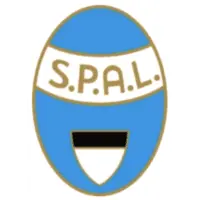
A significant redesign arrived in 2013, producing the badge that remains the basis of S.P.A.L.'s identity today. The crest features a light-blue oval shield bordered in gold. Across the upper section runs a white horizontal band containing the acronym S.P.A.L. in gold lettering. Beneath it sits the historic black-and-white emblem of Ferrara, prominently displayed at the centre of the badge.
S.P.A.L. Ferrara Club History
Founded in March 1907 as Circolo Ars et Labor ("Art and Work Club"), S.P.A.L. is one of the oldest football institutions in Italian football. The organisation was established by the Salesian priest Pietro Acerbis as a cultural and religious association dedicated to education, sport and social development. In 1913, the organisation evolved into a multi-sport club and adopted the name Società Polisportiva Ars et Labor, from which the famous acronym S.P.A.L. originates.
The club's traditional light-blue and white colours derive directly from the Salesian emblem. Since 1962, S.P.A.L.'s iconic home kit has consisted of a light-blue-and-white vertically striped shirt combined with white shorts and white socks. The only significant departure from these colours occurred between 1939 and 1943, when the club was temporarily known as A.C. Ferrara and adopted black-and-white colours in honour of the city's civic heraldry.
The club's golden era arrived during the 1950s and 1960s. Under the presidency of Paolo Mazza, one of the most influential figures in Italian football, S.P.A.L. became a respected Serie A club. The team spent 16 seasons in Serie A between 1951 and 1968, the longest uninterrupted top-flight period in the club's history.
During these years, S.P.A.L. gained a reputation for excellent scouting and player development. The club helped launch the careers of several future Italian stars, most notably Fabio Capello, who began his professional career in Ferrara before becoming one of Italy's greatest players and coaches.
The club's home ground, the Stadio Paolo Mazza, became one of the most respected venues in Italian football. Named after the president who transformed S.P.A.L. into a top-flight club, the stadium remains a symbol of the club's most successful era.
Following relegation from Serie A in 1968, S.P.A.L. spent much of the following decades moving between Serie B and Serie C. Although occasional promotion challenges emerged, the club struggled to regain the stability and success it had enjoyed during the Mazza years.
Financial problems increasingly affected the organisation during the late twentieth century and early twenty-first century. The first major collapse arrived in 2005, when the club was declared bankrupt. Football in Ferrara survived through the creation of SPAL 1907 S.r.l., which inherited the sporting tradition and colours of the historic club.
A second crisis followed in 2012, resulting in another bankruptcy. Once again, the club was forced to restart and was refounded as S.S.D. Real SPAL. Despite the setback, supporters and local investors remained determined to preserve one of Ferrara's most important sporting institutions.
The rebirth proved remarkably successful. Under the ownership of the Colombarini family, S.P.A.L. began one of the most impressive climbs in modern Italian football. Starting from the lower divisions, the club achieved consecutive promotions and rapidly returned to the professional ranks.
The breakthrough came in 2016, when S.P.A.L. won promotion to Serie B after more than two decades away from the second tier. One year later, the club achieved an even greater feat by winning Serie B and securing promotion to Serie A for the first time since 1968.
The return to the top flight ended a 49-year absence and represented one of the most celebrated achievements in the club's history. S.P.A.L. subsequently spent three consecutive seasons in Serie A, successfully competing against many of Italy's biggest clubs and re-establishing itself on the national stage.
Historically, S.P.A.L.'s most important rivalries are with fellow Emilia-Romagna clubs. Matches against Bologna are particularly significant due to geographical proximity and the long history between the two cities. Rivalries also exist with Modena, Reggiana, Cesena and Ravenna, while fixtures against Vicenza and Padova have developed importance through frequent meetings in the lower divisions.