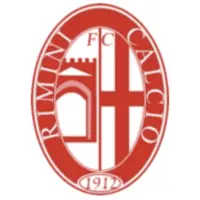
For much of the twentieth century, Rimini used relatively simple emblems based on the club's red-and-white colours.
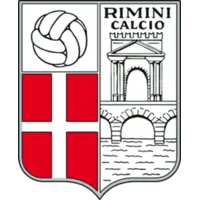
During the 1970s and early 1980s, the club increasingly incorporated the coat of arms of the city of Rimini into its visual identity. These designs featured two of the city's most famous landmarks: the Ponte di Tiberio (Tiberius Bridge) and the Arco d'Augusto (Arch of Augustus). Both monuments remain among the most recognisable symbols of Rimini and helped strengthen the connection between the football club and the city's Roman heritage.
Throughout the 1980s, Rimini experimented with several different badge designs. One notable version featured a dolphin alongside part of the Arch of Augustus, introducing a maritime element that reflected the club's location on the Adriatic coast. Other badges retained the city's heraldic symbols while modernising the overall appearance.
During the 1990s, the club adopted a variety of designs that continued to emphasise local identity. Some versions featured a rising sun over the sea, while others returned to the dolphin motif or reworked earlier shield designs. Despite the changes, the red-and-white colours remained the defining feature of every badge.
A major redesign arrived in the early 2000s. Rimini introduced an ancile-shaped shield divided into two sections. One half displayed the Arch of Augustus, while the other incorporated a red cross on a white background, a reference to the city's heraldry. This badge became one of the most recognisable in the club's history and accompanied Rimini during one of its most successful modern periods, including its years in Serie B.
The crest remained largely unchanged until the club's centenary celebrations in 2012, when special commemorative versions were introduced. Following the anniversary, Rimini returned to a design strongly inspired by the city's historic coat of arms and its traditional red-and-white identity.
After financial difficulties and the club's reorganisation in 2015 and 2016, the newly formed Rimini Football Club retained the traditional visual identity, preserving the historic colours and civic symbolism that supporters had come to associate with the club. The crest introduced during this period featured the familiar red-and-white chequered pattern and references to Rimini's historic monuments.
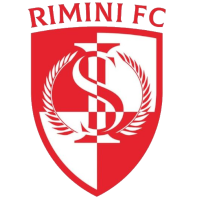
A dramatic and controversial redesign arrived in 2024. The club abandoned the traditional imagery of the Arch of Augustus and the Tiberius Bridge in favour of a modern crest centred around the intertwined letters "SI". The symbol referenced Sigismondo Pandolfo Malatesta, the fifteenth-century ruler of Rimini, and Isotta degli Atti, whose relationship became one of the city's most famous historical stories. The new badge also retained the club's iconic red-and-white chequered background but moved away from the Roman symbolism that had characterised previous designs for decades.
Rimini FC Club History
Founded in 1912 as Libertas Rimini, Rimini FC is one of the oldest football clubs in Emilia-Romagna and has represented the Adriatic city of Rimini for more than a century. The club is traditionally associated with its red-and-white colours, earning the nickname Biancorossi, and has spent most of its history competing in the lower professional divisions of Italian football.
The club's home is the Stadio Romeo Neri, named after a local athlete and war hero. Opened in 1934, it remains one of the most recognisable football venues in Romagna and has hosted generations of Rimini supporters.
The most successful period in the club's history arrived during the 2000s. Under ambitious ownership and strong management, Rimini climbed through the divisions and achieved promotion to Serie B in 2005 after winning the Serie C1 play-offs. For the first time in decades, the Biancorossi were competing in the second tier of Italian football.
One of the most memorable moments in the club's history occurred during the 2006–07 Serie B season, when Rimini drew both league matches against Juventus during the Turin club's only season outside Serie A.
The club spent four consecutive seasons in Serie B between 2005 and 2009, narrowly missing promotion to Serie A on several occasions. This period is widely regarded as the golden era of modern Rimini football.
Following relegation in 2009, financial difficulties began to affect the club. Despite attempts to return to Serie B, economic instability increasingly undermined progress both on and off the pitch.
The crisis culminated in 2010, when Rimini Calcio was declared bankrupt. Football in the city survived through a successor organisation that inherited the club's colours and traditions, allowing the Biancorossi to continue competing despite the collapse of the historic company.
A significant revival occurred in 2022, when Rimini won Serie D Group D and secured promotion back to Serie C. The achievement marked another important step in the club's long recovery and restored professional football to the city.
One of the most historic moments in recent years arrived in 2023, when Rimini won the Coppa Italia Serie C, the first major national trophy in the club's history.
Historically, Rimini's fiercest rivalry is with Cesena. Matches between the two clubs form the Derby di Romagna, one of the most passionate rivalries in Emilia-Romagna. Strong rivalries also exist with Ravenna, Forlì, Sambenedettese and Vis Pesaro, reflecting decades of competition throughout central Italy.