For much of its early history, Reading did not wear a dedicated crest on its playing shirts. Early club publications and official materials often featured the Reading town coat of arms, but the club generally played without a regular badge on its kit.
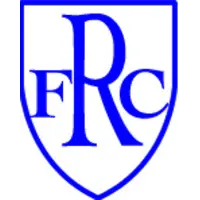
The first crest to appear on a Reading shirt was introduced in 1953 and consisted simply of the letter “R” displayed on a shield. The minimalist design was only used briefly and disappeared after a single season, after which Reading once again played for many years without a regular shirt crest.
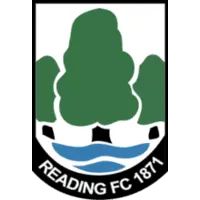
A new club badge finally appeared in 1981. This design featured three elm trees together with the rivers Thames and Kennet, reflecting Reading’s natural surroundings and its long association with Elm Park, the club’s historic home. Although distinctive, the crest remained in use for only two seasons.
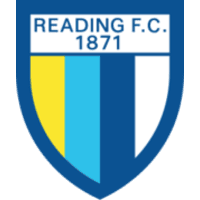
In 1987, Reading introduced another redesign that reflected the club’s updated kit colours. The badge incorporated yellow, sky blue, royal blue and white, creating a more colourful and modern appearance. This crest remained in use until 1996 and became closely associated with an important period in the club’s development.
During the late 1990s, as Reading prepared for a new era and an eventual move to the Madejski Stadium, the club sought a stronger and more enduring visual identity. The result was a completely new crest that first appeared on the club’s kits for the 1998–99 season.
The current badge is based on Reading’s traditional blue-and-white colours and remains in use today. The crest incorporates two important local symbols: a crown representing Berkshire’s status as the Royal County of Berkshire, and the famous Maiwand Lion, one of Reading’s best-known landmarks. The lion commemorates the Royal Berkshire Regiment and has become an enduring symbol of both the town and the football club.
Unlike many clubs that have repeatedly modernised their badges in recent decades, Reading has retained the 1998 design for more than twenty-five years. Its combination of the crown, the Maiwand Lion and the club’s traditional colours has created a strong and recognisable identity closely linked to the local area.
Reading FC Club History
Reading Football Club was established in 1871 and is one of the oldest football clubs in England. Based in Berkshire, the club is known today as “The Royals,” a nickname derived from the county’s status as the Royal County of Berkshire. Before adopting this identity, Reading were widely known as “The Biscuitmen,” reflecting the town’s famous association with the Huntley & Palmers biscuit company, once one of the largest biscuit manufacturers in the world.
Although founded in the nineteenth century, Reading did not join the Football League until 1920. For much of their history, the club competed outside the top tier of English football, building a loyal support base while establishing itself as a respected Football League club.
One of the defining features of Reading’s history is Elm Park, the club’s home for 102 years between 1896 and 1998. The stadium became synonymous with Reading FC and hosted generations of supporters before the club moved to a new era at the Madejski Stadium in 1998. Named after former chairman Sir John Madejski, the modern stadium provided improved facilities and helped support the club’s ambitions for future growth.
The most successful period in Reading’s history arrived during the 2000s. Under manager Steve Coppell, Reading won the Championship title in 2005–06 with a then-record points total of 106, securing promotion to the top flight for the first time in the club’s history. The following season, 2006–07, saw Reading make its debut in the highest division of English football, where the club exceeded expectations by finishing eighth in the Premier League.
Throughout its history, Reading has also been known for producing colourful and memorable personalities. Perhaps none is more famous than Robin Friday, the gifted but unconventional striker who played for the club during the 1970s. Despite spending only a short period at Reading, Friday became a cult hero and was voted the club’s “Player of the Millennium” in 1999, achieving legendary status among supporters.
Historically, Aldershot were considered Reading’s principal rivals, but following Aldershot’s collapse in 1992 that rivalry faded. Today, Reading’s strongest rivalries are with Oxford United and Swindon Town, fixtures that generate significant interest among supporters and are among the most anticipated matches of the season.