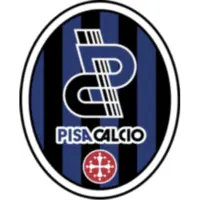
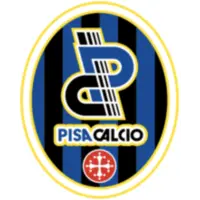
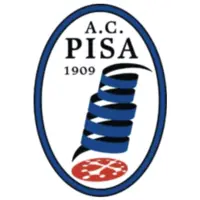
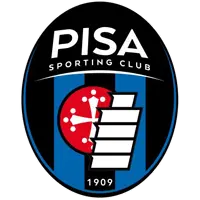
For much of its history, Pisa's badges focused primarily on the club's initials, colours and civic symbols. While references to the city of Pisa were always present, the famous Leaning Tower was not yet the dominant element of the club's visual identity.
A major turning point arrived in 1983, when Pisa introduced a crest featuring the Leaning Tower of Pisa as its central symbol for the first time. The tower immediately provided the club with a unique and globally recognisable identity. Few football clubs could draw upon a landmark as famous as the Torre Pendente, and the emblem established a direct visual connection between the team and the city it represented.
During the club's successful Serie A years in the 1980s under president Romeo Anconetani, the tower became firmly established as the defining symbol of Pisa Sporting Club. Subsequent redesigns varied in shape and graphic style, but the tower remained the central element of the club's identity.
During the 1990s, the crest underwent several refinements. The tower remained central, while typography and shield shapes were modernised to reflect contemporary design trends. Despite these updates, the club consistently preserved the symbols most closely associated with its identity.
Following financial difficulties and organisational changes during the late 1990s and early 2000s, Pisa adopted a number of different badges as new corporate entities succeeded one another. Although the exact designs varied, almost every version retained either the Leaning Tower, the Cross of Pisa, or both, ensuring continuity with the club's traditions.
After the bankruptcy of Pisa Calcio in 2009, football in the city continued through successor organisations. New crests introduced during this period maintained the traditional black-and-blue colours and preserved references to the tower, reflecting the determination to protect the club's historic identity despite its financial troubles.
A particularly notable redesign arrived in 2017, following the club's latest reorganisation. The new crest adopted a modern circular format centred around a highly stylised representation of the Leaning Tower of Pisa. The design simplified many of the traditional details and focused on a clean graphic interpretation of the city's most famous monument. The black-and-blue colours remained dominant, while the tower was integrated directly into the overall structure of the badge rather than appearing as a separate illustration. This version reflected contemporary football branding trends while maintaining a strong connection to Pisa's history and identity.
The 2017 crest also marked the beginning of a new era for the club following years of financial instability and ownership changes. By placing the tower at the centre of the design, Pisa reinforced the idea that the club's identity was inseparable from the city itself.
Pisa SC Club History
Founded in 1909 as Pisa Sporting Club, the club represents the historic Tuscan city of Pisa and is traditionally associated with its famous black-and-blue colours, earning the nickname Nerazzurri.
The club's home has long been the Arena Garibaldi, one of Italy's oldest football stadiums. Opened in 1919, the ground sits beneath the famous Leaning Tower and remains one of the most distinctive football venues in the country. Today it is officially known as the Arena Garibaldi – Stadio Romeo Anconetani, honouring the president most closely associated with the club's greatest successes.
The most successful era in Pisa's history arrived during the 1980s under the leadership of president Romeo Anconetani. An ambitious and charismatic figure, Anconetani transformed Pisa into a competitive Serie A club. The team achieved multiple promotions to the top flight and became known for its entertaining style and ability to challenge more established opponents.
During this period, Pisa featured several notable players who would later achieve international recognition. Among them was a young Diego Simeone, who began his European career with the club before becoming one of the most respected players and coaches in world football.
The club spent six seasons in Serie A between 1982 and 1991, the most sustained period of top-flight football in its history. Although Pisa was often involved in relegation battles, the team became a respected and difficult opponent capable of producing memorable victories against Italy's biggest clubs.
Following relegation in 1991, Pisa entered a period of decline. Financial difficulties increasingly affected the club, and by 1994Pisa was declared bankrupt. The collapse brought an abrupt end to the Anconetani era and forced the club to restart under a new corporate structure.
Football in the city survived through successor organisations that inherited Pisa's colours and traditions. Over the following decades, the club experienced several promotions, relegations and ownership changes while attempting to regain its former status.
Another major setback arrived in 2009, when Pisa encountered further financial problems and was again forced to restart. Despite the difficulties, support for the club remained strong, and the Nerazzurri gradually rebuilt their position within the Italian football pyramid.
A significant revival began during the 2010s. Pisa returned to professional football and secured promotion to Serie B in 2016 after defeating Foggia in the promotion play-offs. Although relegation followed, the club continued its upward trajectory and eventually re-established itself in the second division.
Historically, Pisa's fiercest rivalry is with Livorno. Matches between the two sides form the Derby del Tirreno, one of the most intense rivalries in central Italian football. Strong rivalries also exist with Lucchese, Siena, Empoli and Fiorentina, reflecting both geographical proximity and historical competition within Tuscany.