The earliest badges used by Modena during the first half of the twentieth century were relatively simple and reflected the style of the period. Most designs featured shield-shaped emblems incorporating the club's colours and initials. The yellow-and-blue colour scheme quickly became the defining visual element of the club and remains one of the oldest continuously used identities in Italian football.
During the post-war period, Modena increasingly adopted heraldic designs that emphasised the city's traditions and civic identity. Various shield formats were used, often featuring the club name alongside the traditional yellow-and-blue colours. These badges established the visual foundations that would remain associated with the club for decades.
By the second half of the twentieth century, the canary had become firmly established as Modena's defining symbol. Although not always prominently displayed on the crest itself, the bird was deeply embedded within the club's culture and supporter identity. The nickname I Canarini became recognised throughout Italian football and distinguished Modena from other clubs using similar colours.
Several redesigns followed during the 1970s, 1980s and 1990s. Most retained the traditional shield format while modernising typography and graphic details. The yellow-and-blue palette remained central throughout these changes, ensuring continuity with the club's heritage.
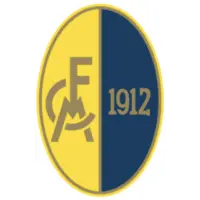
A significant redesign arrived during the early twenty-first century. The club adopted a crest based on a traditional shield divided into yellow and blue sections, often incorporating the club initials MFC and references to the year of foundation. This version became closely associated with Modena's years in Serie B and its return to Serie A in the early 2000s.
Following the financial difficulties and bankruptcy that affected the club in 2017, Modena was forced to restart under a new corporate structure. Despite the organisational changes, the club maintained its historic colours and visual identity, preserving the symbols most closely associated with its history.
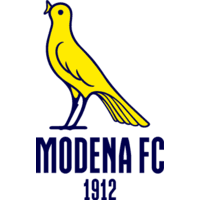
A major modernisation arrived in 2022, when Modena unveiled a completely new crest. For the first time, a stylised canary became the central feature of the badge, replacing the traditional heraldic shield that had characterised earlier designs. The redesign was intended to create a stronger and more recognisable identity capable of being understood and recognised throughout the world.
The canary had always been the club's most iconic symbol, but the new crest elevated it to the centre of Modena's visual identity. The yellow bird directly references the nickname I Canarini, which has accompanied the club for generations and remains one of the most recognisable nicknames in Italian football.
The typography used within the new visual identity also carried historical significance. The font was inspired by Modena Flash, a local newspaper published during the 1960s, creating a subtle connection between the club's modern branding and the city's cultural heritage.
Modena FC Club History
Founded in 1912, Modena FC is one of the oldest and most historic football clubs in Italy. Representing the city of Modena in Emilia-Romagna, the club is best known for its traditional yellow-and-blue colours, which have earned the team its famous nickname, I Canarini ("The Canaries").
The club was established as Modena Football Club and quickly became one of the leading teams in Emilia-Romagna during the early years of Italian football.
Throughout the interwar period, Modena established itself as a regular presence in the highest levels of Italian football. The club spent many seasons in Serie A, competing against the country's strongest teams and building a reputation as a difficult opponent despite operating with fewer resources than the traditional giants.
One of Modena's most successful eras arrived during the 1930s and 1940s, when the club became a stable Serie A side and achieved some of the best league finishes in its history. During this period, the Canaries earned respect throughout Italy for their organisation, consistency and strong local support.
The club's home has long been the Stadio Alberto Braglia, one of the oldest football stadiums in Italy. Named after Olympic gymnast Alberto Braglia, the stadium has hosted generations of Modena players and remains one of the most iconic sporting venues in Emilia-Romagna.
A new period of success emerged during the early 2000s under coach Gianni De Biasi. Modena won the Serie C1 title in 2001 and followed it with promotion from Serie B in 2002, achieving consecutive promotions and returning to Serie A after nearly four decades away from the top flight.
The club spent two seasons in Serie A between 2002 and 2004, competing against some of the biggest teams in Italy.
A major crisis arrived in 2017, when severe financial difficulties led to the club's exclusion from professional football. Modena FC ceased operations and was declared bankrupt, bringing an end to more than a century of continuous football history.
Football in the city survived through the creation of a successor club, Modena Football Club 2018, which inherited the colours, traditions and sporting heritage of the original organisation. Starting again from Serie D, the club immediately began rebuilding.
The recovery was remarkably swift. Modena won promotion back to professional football and gradually re-established itself within the Italian league system. A major milestone arrived in 2022, when the club won Serie C Group B and secured promotion to Serie B, marking a return to the division where it had spent much of its modern history.
Historically, Modena's most significant rivalry is with Bologna, a fixture often known as the Derby dell'Emilia. Other important rivalries exist with Reggiana, Parma, Carpi and Sassuolo, reflecting decades of competition between clubs from Emilia-Romagna.