Skip to Content

Historical Crests Hellas Verona FC

Name: Hellas Verona FC
Nickname(s): Il Gialloblu (The Yellow and Blues)
Founded: 1903
Stadium: Stadio Marcantonio Bentegodi (Verona)
Capacity: ​39,211

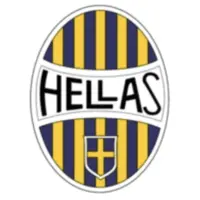
1903-1945
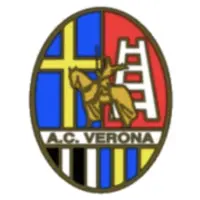
1945-1965
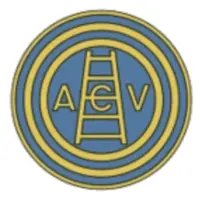
1965-1975
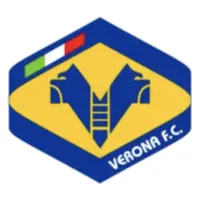
1975-1984
1984-1991
1991-1995
1995-1999
1999-2020
2020-Present

Hellas Verona FC Crest History
The earliest known crest, used during the first decades of the twentieth century, featured a traditional oval shield divided into the club's yellow-and-blue colours. The design incorporated the name Hellas, a reference to the club's Greek-inspired name chosen by one of its founders, and established the colour scheme that remains synonymous with Verona today.
During the interwar years, several variations appeared, often incorporating civic elements from the city of Verona alongside the club's colours. The Scala ladder, symbol of the Della Scala family, began to feature more prominently and gradually became one of the defining elements of the club's identity.
Following the Second World War, Hellas Verona introduced more elaborate crests that combined several important symbols of Verona. Designs from this period frequently featured the city's heraldic cross, the Scaliger ladder and references to Cangrande della Scala, the most famous ruler of medieval Verona. 
A significant simplification arrived during the 1960s. The club adopted cleaner, more modern designs that focused primarily on the Scala ladder, often presented within circular or shield-shaped badges. This period established the ladder as the club's principal symbol and reinforced its association with the Scaliger dynasty.
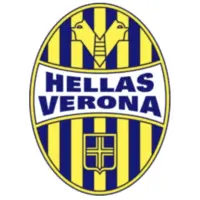
The most important turning point in Hellas Verona's crest history arrived in 1984. The club introduced what would become its most iconic badge: a yellow-and-blue shield featuring two stylised mastiff heads facing opposite directions, separated by the Scaliger ladder. The mastiffs were inspired by the heraldic symbols of the Della Scala family and immediately became the defining image of the club. This crest accompanied Hellas Verona during the greatest achievement in its history, the unforgettable 1984–85 Serie A title, and remains deeply cherished by supporters.
Following the Scudetto triumph, the mastiff emblem became inseparable from the club's identity. Various refinements and commemorative versions appeared throughout the late 1980s and early 1990s, but the fundamental design remained intact
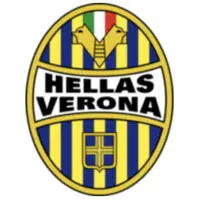
A major redesign arrived in 1995. The club returned to a more traditional shield format featuring yellow-and-blue vertical stripes. The mastiff-and-ladder symbol was retained at the top of the crest, while elements of Verona's civic heraldry were incorporated into the lower section. This design successfully combined the club's modern identity with its historical roots and remained in use for many years.
A refined version followed in 1999, modernising the typography and proportions while preserving the overall structure. 
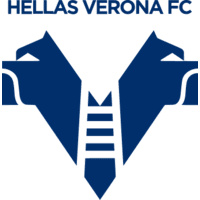
In 2020, Hellas Verona unveiled its current crest. Rather than introducing an entirely new identity, the club simplified the famous mastiff emblem. The shield and additional heraldic elements were removed, leaving a clean and modern design centred on the two mastiffs and the Scaliger ladder. The minimalist approach strengthened the visual impact of the club's most iconic symbol while maintaining a direct connection to Verona's medieval heritage.

Hellas Verona FC Club History
Founded in 1903, Hellas Verona Football Club is one of the oldest football clubs in Italy. The name "Hellas" was suggested by a classics teacher at the school where the club's founders studied, using the ancient Greek name for Greece. 
Hellas Verona traditionally plays in yellow and blue, the colours of the city of Verona. The club is commonly known as I Gialloblù ("The Yellow and Blues"), although throughout Italian football that nickname has also often been associated with local rivals Chievo Verona. Other popular nicknames include I Mastini ("The Mastiffs") and Gli Scaligeri, both references to the medieval Della Scala family that ruled Verona.
The club first reached Serie A in 1957 and spent the following decades alternating between the top two divisions while building a passionate supporter base.
The most famous chapter in the club's history arrived during the 1980s under coach Osvaldo Bagnoli. After several years of steady progress, Hellas Verona achieved one of the greatest underdog stories in European football by winning the 1984–85 Serie A title. Led by players such as Preben Elkjær, Antonio Di Gennaro, Hans-Peter Briegel and Roberto Tricella, Verona finished ahead of Italy's traditional giants to claim what remains its only Scudetto.
Following the Scudetto years, Verona continued to compete in Serie A and participated in European competitions, including the European Cup. However, maintaining that level of success proved difficult, and the club experienced several relegations and promotions during the following decades.
The 1990s and early 2000s were characterised by instability, with Verona frequently moving between Serie A and Serie B. 
Hellas plays its home matches at the Stadio Marcantonio Bentegodi, one of Italy's largest football stadiums. Opened in 1963 and extensively renovated for the 1990 FIFA World Cup, the stadium has been home to many of the club's greatest moments. For many years it was shared with city rivals Chievo Verona, creating one of the most unique football situations in Italy.
The club's most important rivalry is with Chievo Verona, with whom it contested the Derby della Scala, named after the Della Scala family. 
Other significant rivalries exist with Vicenza, Brescia and Venezia, reflecting both geographical proximity and decades of competitive encounters.
A new period of stability began during the late 2010s and early 2020s. After returning to Serie A in 2019, Verona established itself as a competitive top-flight club, earning praise for its organisation, recruitment and ability to compete with larger-budget teams. 

Hellas Verona Pins

Your Dynamic Snippet will be displayed here... This message is displayed because you did not provide enough options to retrieve its content.