Historical Crests Go Ahead Eagles
Name: Go Ahead Eagles
Nickname(s): The Pride of the IJssel
Founded: 1902
Stadium: De Adelaarshorst (Deventer)
Capacity: 10,000

1905-1965

1965-1966

1973-1988

1989-1990

1990-2000

2000-2007
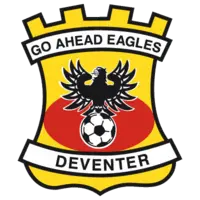
2007-Present
Go Ahead Eagles Crest History
Throughout its history, Go Ahead Eagles' crest has reflected the club's proud heritage in Deventer and its unique place within Dutch football. Unlike many clubs that frequently changed their visual identities, Go Ahead Eagles has remained remarkably faithful to its traditional symbols, colours and name, creating one of the most recognisable badges in the Netherlands.
The club was founded in 1902 as Be Quick before adopting the name Go Ahead in 1905. Early badges were relatively simple and often consisted of monograms, lettering or basic shield designs featuring the club's traditional red and yellow colours. These colours quickly became central to the club's identity and remain so today.
Throughout the first half of the twentieth century, Go Ahead established itself as one of the strongest clubs in Dutch football. During this period, various badge designs appeared featuring the club initials and name, generally using traditional shield formats and simple typography.
A major transformation occurred in 1971, when the club officially adopted the name Go Ahead Eagles. Inspired by the popularity of American sports nicknames and the club's desire for a stronger international image, the word "Eagles" was added to the club's name. This change would have a lasting influence on the club's visual identity.
Following the name change, the club introduced crests featuring the eagle, which quickly became the defining symbol of Go Ahead Eagles. The bird represented strength, ambition and fighting spirit, characteristics that supporters strongly associated with the club.
Throughout the 1970s and 1980s, several versions of the eagle crest were used. These badges generally combined the eagle with the club's red-and-yellow colours and shield-based designs. While the artistic style varied, the eagle remained the dominant visual element.
During the 1990s and early 2000s, the club modernised its badge while retaining its traditional symbolism. The eagle became more stylised, and the crest adopted cleaner lines and sharper typography. The redesigns were intended to improve visibility and branding while respecting the club's history.
A significant redesign arrived in the 2000s, introducing a more refined shield featuring a prominent eagle above the club name. The badge balanced modern presentation with historical continuity and became closely associated with the club's return to prominence in Dutch football.
The current crest continues to feature the iconic eagle alongside the traditional red-and-yellow colours. The bird is displayed in a strong and confident pose, symbolising the club's resilience and ambition. The design successfully combines modern football branding with more than a century of tradition.
What makes Go Ahead Eagles' crest history particularly distinctive is the successful integration of the eagle symbol into the club's identity. While the club existed for decades before adopting the Eagles name, the bird has become inseparable from Go Ahead's image and is now one of the most recognisable symbols in Dutch football. From the early Go Ahead badges to the modern crest, the club's visual history reflects both its rich heritage and its enduring connection to the city of Deventer.
Go Ahead Eagles Club History
Founded on 2 December 1902 as Be Quick, Go Ahead Eagles is one of the oldest professional football clubs in the Netherlands. Based in the historic city of Deventer, the club adopted the name Go Ahead in 1905, inspired by a popular encouragement used by supporters and players.
During the early twentieth century, Go Ahead emerged as one of the dominant forces in Dutch football. The club enjoyed its greatest success before the introduction of professional football, winning the Dutch national championship four times in 1917, 1922, 1930 and 1933. These titles established Go Ahead as one of the leading clubs of the amateur era and helped build a strong football culture in Deventer.
Throughout the 1920s and 1930s, the club regularly competed among the strongest teams in the Netherlands. The success of this period ensured that Go Ahead became one of the most recognised football institutions in the country.
Following the Second World War, Dutch football gradually evolved and professional football was introduced in 1954. Like many clubs that had dominated the amateur era, Go Ahead found it increasingly difficult to compete with larger and wealthier rivals. Nevertheless, the club remained a respected participant in the top divisions of Dutch football.
A major turning point arrived in 1971, when the club officially adopted the name Go Ahead Eagles. The addition of "Eagles" gave the club a more distinctive identity and quickly became one of the most recognisable names in Dutch football. The eagle symbol would eventually become inseparable from the club's image.
A significant achievement came in 2013, when Go Ahead Eagles secured promotion to the Eredivisie after a seventeen-year absence. The return to the top flight was celebrated passionately by supporters and marked the beginning of a new chapter in the club's history.
One of the greatest modern achievements arrived in 2025, when Go Ahead Eagles won the KNVB Cup for the first time in club history. The triumph ended a wait of more than a century for a major national trophy and secured qualification for European competition, creating one of the most memorable moments ever experienced by the club's supporters.
Go Ahead Eagles play their home matches at De Adelaarshorst ("The Eagle's Nest"), a stadium that has been the club's home since 1920. The ground is one of the most historic and atmospheric stadiums in the Netherlands and remains a symbol of the club's traditions and close connection to the city of Deventer.
The club's fiercest rivalry is with PEC Zwolle in the IJssel Derby, one of the oldest and most passionate rivalries in Dutch football.
Go Ahead Eagels
Your Dynamic Snippet will be displayed here... This message is displayed because you did not provide enough options to retrieve its content.